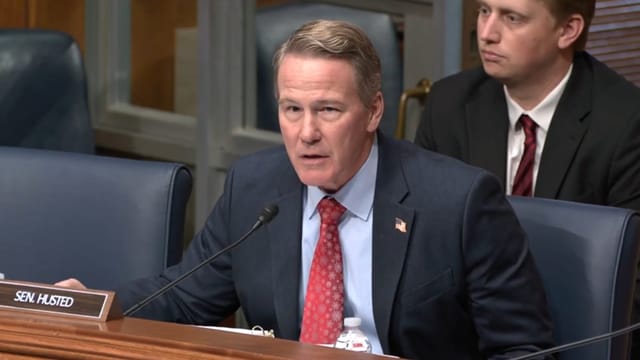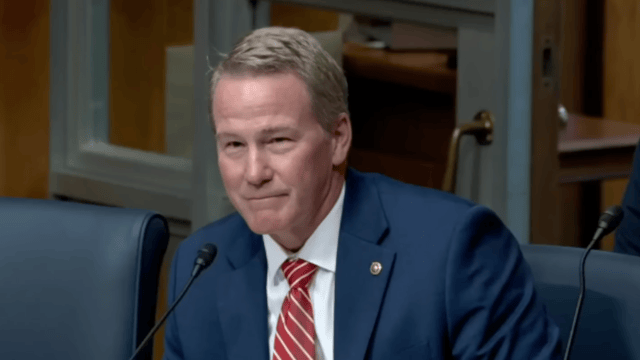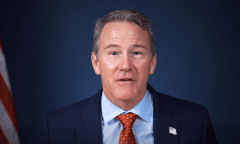

U.S. Sen. Jon Husted is living in a Washington, D.C., property owned by a corporate lobbyist who represents Meta, one of the technology giants at the center of Ohio’s controversial data-center expansion. Neither the Republican senator nor his landlord would provide Politico with the amount Husted pays in rent.
The arrangement was exposed Friday in a Politico investigation identifying Husted’s landlord as David Lugar, a veteran Washington lobbyist whose clients include Meta, Boeing and Wells Fargo.
Husted rents a separate apartment inside a multifamily house owned by Lugar, who co-chairs the lobbying firm 535 Group and chairs The Lugar Group. Republican Sen. Todd Young of Indiana also rents an apartment in the building. Lugar told Politico that he does not live or work at the property.
Both Husted’s office and Lugar insist the senator pays fair-market rent. But when Politico asked how much Husted actually pays, neither provided an amount. Husted’s spokesperson described the arrangement as “strictly a landlord and tenant relationship,” while Lugar maintained that he has never lobbied Husted or his staff.
Those assurances leave a central fact undisclosed: the amount of money a sitting U.S. senator pays to a corporate lobbyist whose clients include one of the companies benefiting from Ohio’s enormous data-center expansion.
Federal records confirm Husted’s landlord lobbies for Meta
Lugar’s relationship with Meta is documented in federal lobbying disclosures.
An April 20, 2026, filing, bearing Lugar’s digital signature, identifies Meta as a client of 535 Group. The firm reported receiving $30,000 in lobbying income from the company during the first three months of 2026.
The filing names Lugar as a lobbyist on matters involving online advertising, competition legislation, privacy and encryption. It identifies the U.S. Senate among the institutions covered by those lobbying activities, although it does not identify Husted’s office as a lobbying target.
Politico reported that Lugar acknowledged lobbying the office of his other Senate tenant, Todd Young, during Young’s tenancy. Lugar said he had never lobbied Husted or members of Husted’s staff.
The financial relationship nevertheless places Husted in a privately owned Washington residence controlled by a lobbyist whose corporate clients have significant business and policy interests before Congress.
Husted spent years championing Ohio’s data-center boom
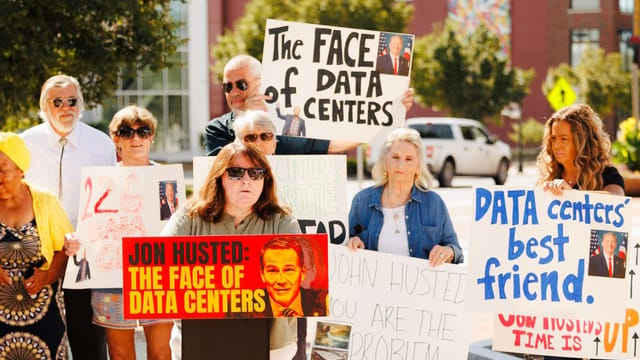
The disclosure comes just days before Ohio voters decide whether Husted will retain his Senate seat in a closely watched contest against Democrat Sherrod Brown, who has made Husted’s record of supporting data centers and corporate tax incentives a central campaign issue.
Before entering the Senate in 2025, Husted spent six years as Ohio’s lieutenant governor under Republican Gov. Mike DeWine. During that period, he repeatedly promoted data-center development, defended tax incentives for technology companies and helped announce major projects across the state.
One of those projects was in northwest Ohio.
In September 2023, DeWine and Husted announced approval of a 75%, 15-year data-center tax exemption for Aligned Data Centers in Perkins Township, Erie County. The development was projected to create just 18 full-time jobs.
The tax exemption was formally approved by the Ohio Tax Credit Authority, but the DeWine-Husted administration publicly championed the project as part of its economic development agenda.
Ohio’s broader data-center tax incentives have since proven vastly more expensive than state officials anticipated. According to the nonpartisan Ohio Legislative Service Commission, data-center sales-tax exemptions cost Ohio approximately $1.57 billion in forgone revenue during 2025 alone.
The cost was more than 11 times the state’s earlier forecast of approximately $136 million. In May 2026, DeWine suspended consideration of new data-center tax exemptions while lawmakers examined the industry’s rapidly growing footprint and financial consequences.
Existing agreements, however, remained in place.
Meta’s expansion reaches northwest Ohio
Meta, the company represented by Husted’s landlord, is developing its massive Prometheus artificial intelligence computing complex in New Albany, Ohio, while arranging enormous quantities of electricity to support its growing infrastructure.
Its energy interests extend directly into northwest Ohio.
In January, Meta announced major nuclear energy agreements, including long-term electricity purchases involving the Davis-Besse nuclear power plant near Oak Harbor in Ottawa County and the Perry nuclear plant in northeast Ohio.
Those agreements connect Meta’s expanding artificial intelligence operations to Ohio’s existing energy infrastructure and the broader regional electricity grid. Meta says it pays the full costs of the energy consumed by its data centers and supports investments to expand electricity generation.
Meanwhile, Husted has attempted to reposition himself on data centers as growing public opposition to corporate tax breaks, electricity costs and the industry’s expansion has become a major political issue.
In July, Husted introduced the Ratepayer Protection Act, legislation intended to address whether technology companies should pay for the additional electricity infrastructure required by their facilities. The measure would require states to consider standards for allocating those costs, rather than directly mandate them nationwide. It failed to advance in the Senate in September.
That effort followed years in which Husted had publicly defended incentives intended to bring the same industry into Ohio.
Husted’s rent remains undisclosed
The Ohio Democratic Party denounced the rental arrangement Saturday, accusing Husted of benefiting from a sweetheart deal with a lobbyist for Meta.
Husted rents housing from Lugar, Lugar lobbies for Meta, and neither supplied Politico with the amount of rent being paid.
The disclosure comes as Ohioans confront the financial consequences of the data-center industry Husted spent years promoting, including billions of dollars in tax incentives and disputes over who should pay for the electricity infrastructure needed to support massive technology facilities.
Husted has spent months arguing that powerful technology companies should pay their own way. When asked what he pays to live in a property owned by a lobbyist representing one of those companies, however, his office provided assurances that the price was fair without revealing what that price actually is.
Husted faces Democratic challenger Sherrod Brown in the Tuesday, Nov. 3 general election.