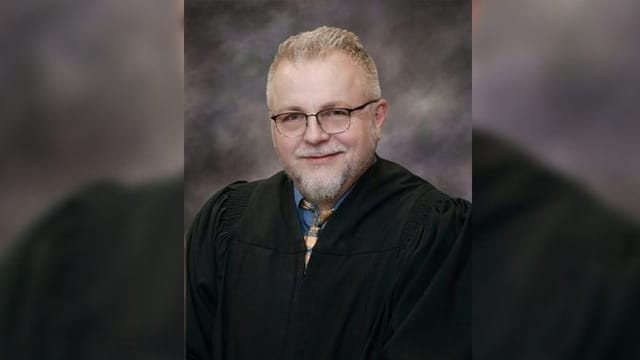


The lone Ohio Supreme Court justice with a “D” next to her name on the November general election ballot has sued to get rid of that party label, as part of her efforts to preserve what she says is a delicate balance between democracy and the rule of law.
Justice Jennifer Brunner has been on the state supreme court since 2021**,** after serving as the state’s secretary of state, working in private practice, and doing international work with the now-defunct U.S. Agency for International Development (USAID). Throughout her career, and especially now, she has seen changes happen to the democratic system that she said need to be the focus of voters when they head to the ballot box on Nov. 3.
“Democracy and the rule of law have to be working together, and the democracy piece is clearly being pummeled right now, and there are many courts who are shoring that up,” Brunner said.

On the national level, the judicial branch is “holding the line” in requiring the other two branches to work with each other, and in order for the country to continue to trust the justice system, that has to continue, even if the Trump administration slow-walks actions on court decisions, according to Brunner.
“It’s like the teenage kid that you say ‘you have to clean up your room,’ and they shove a bunch of things under their bed, and it just depends on how tough the judge is going to be,” she said.
“The public is watching what that judge does, because if the judge doesn’t hold the line, the public’s going to lose the confidence in the judiciary.”
In 2023, Brunner filed a federal suit trying to get rid of the 2021 state law passed to require supreme court races to include partisan labels on the ballot. The lawsuit, which is still active in the U.S. District Court for the Northern District of Ohio, cites the Ohio Code of Judicial Conduct, which bars judicial candidates from participating in political or campaign activity that conflicts with judicial independence and impartiality.
More than that, Brunner sees the label as a marker that automatically places an image of her and any other candidate in voters’ heads, based on the partisan identification.
“It’s a First Amendment issue where I’m a partisan candidate, and everyone assumes that my thinking is … what’s on the Democratic platform,” she told the Capital Journal. “And I’m not in a position to say, ‘well, it’s more nuanced here,’ or ‘no, it’s not the same here,’ or even ‘yes, it is the same,’ because I’ve got the code of judicial conduct.”
Since the law was passed, the Ohio Supreme Court decided a case that also allows judges to endorse political candidates. Five justices on the bench stood in favor of the decision, with Justice Patrick Fischer dissenting. Brunner did not participate in the ruling.
Court decisions have long-ranging impacts, along with the messaging of any justice and judge outside of the courtroom. For Brunner, the work judges do needs to be separated from partisanship and labels, even when it’s clear from a judges background and judicial philosophy where they stand.
“I think every judge knows from whence they came … and those things may cross your mind, but you end up saying, ‘well, I understand that people think I should do that, but I need to follow the law and do whatever it is,’” she said.
On the bench
Since Brunner has been on the supreme court, the panel has heard high-profile cases on topics such as redistricting maps, gender-affirming care, energy, education, constitutional amendment ballot language on abortion, and crime victims’ rights.
Brunner stood with the majority on many cases, such as the striking down of legislative redistricting maps five times over. She has also written many a dissent, including when the court upheld an appellate court decision in a case that denied a transgender woman’s application to amend her birth certificate to include the gender to which she identifies.
“First, framing the issue as whether (state law) may be used by persons who are transgender to apply to correct the sex markers on their birth certificates has the effect of discriminating without a rational basis between cisgender and transgender persons,” Brunner wrote. “…Prohibiting only persons who are transgender from using the statute to correct the sex marker on their birth certificates is unconstitutional.”
She holds the role of dissenter up as an important part of that work, a role that “makes a decision more robust because it shows the public that you considered both sides.”
“A dissenting opinion … shows a little different path to get there, which from a social standpoint may not be the majority social outlook now, but as society changes, it might actually provide a pathway that’s more workable in the future,” she said.
Of the current court makeup, Brunner said she is working with a group that is “very restrained in interpreting anything, but the problem is there’s not always a consistency of that stance.”
While the justice said she hasn’t had trouble working within a supreme court that is now 6-1 Republican, at the Ohio Democratic Party’s primary night event in May, she said she “sure would like a little more company.”
The justice told the crowd of Democratic supporters that she plans to be “part of the foundation and the strong shoulders that people like (governor candidate Dr.) Amy Acton can stand on.”
With a conservative movement toward “originalism” – that is, aiming to interpret the constitution as the founders intended it – Brunner said she sees a “schism” between the demand for more judges on the bench with an originalism method, and the supporters of that method who claim they don’t “legislate from the bench.”
Brunner acknowledged that the goal of originalism is meant to refer back to the time when a particular law was passed using texts from that time to determine the intended meaning. The problem Brunner sees with that is the idea that supporters of originalism can just “cherry-pick the texts that they use,” leading to a “results-oriented” judicial method.
“I have repeatedly criticized originalism just for that reason, because the very people that are saying ‘we won’t legislate from the bench’ are doing exactly that,” she said. “When a judge is too tied to feeling really great about the results of the decision, there’s a big problem there, because what we need to be tied to is the law.”
The justice’s challenger in the November general election, former Franklin County judge Colleen O’Donnell, has made it clear she believes in originalism, and plans to “give (laws) the meaning that they had at the time that they were enacted,” she told the Capital Journal in May.
According to Brunner, judges should think of themselves as “reflecting the conscience of the community,” using their opportunity to serve as time to focus on public service.
“We’re in a job where our only tools are our words, and our words have to be so well expressed, and also the courage behind it executed, or we won’t have that much meaning in people’s lives,” the justice said.
This story is republished from the Ohio Capital Journal under a Creative Commons license. View the original article.