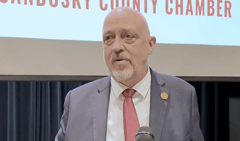
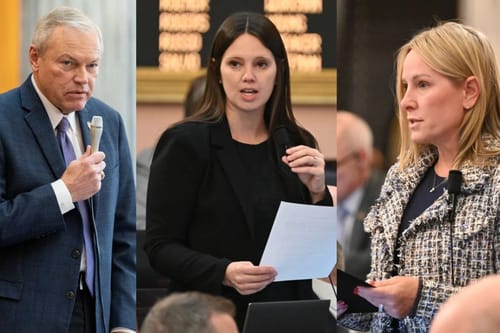
Two incoming Ohio House Republican leaders are dismissing a leaked proposal to expand utilities’ power to seize private land as a special-interest organization’s legislative “wish list,” even as their party’s incoming Senate president has publicly acknowledged helping develop and circulate the legislation.
State Reps. Kellie Deeter of Norwalk and Meredith Craig of Smithville issued nearly identical statements challenging news coverage of the proposed eminent-domain expansion, questioning whether lawmakers had participated in drafting it and accusing reporters of creating unnecessary fear among Ohioans.
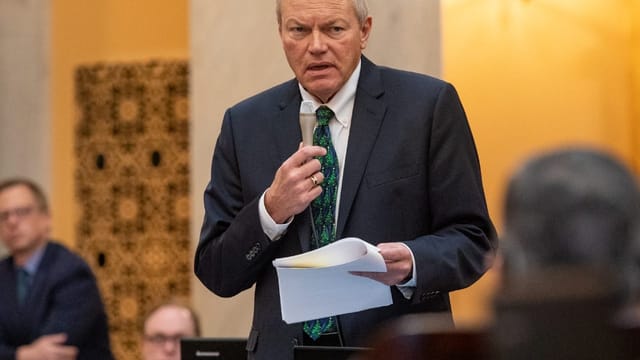
Both statements omitted the documented involvement of Sen. Bill Reineke, R-Tiffin, whom Senate Republicans selected November 10 to lead the chamber beginning in January. Reineke had already acknowledged working on the proposal and told The Advertiser-Tribune that he and others were circulating it to build consensus.
After a Facebook commenter confronted Deeter with information about Reineke’s involvement, the representative acknowledged that she had issued her statement without knowing the information raised in the exchange.
“Mandy Kimberly at the time this statement was made, I did not have that information. My head will be on a swivel, I assure you,” Deeter replied from her official Facebook account.
The exchange came after Deeter had criticized reporting about the legislation and suggested that its origins lay outside the General Assembly. The commenter also alleged that Reineke was working directly with the Ohio Business Roundtable, an assertion that has not been independently established. Reineke’s participation and the business group’s advocacy for the same policy are separately documented.
The two representatives are preparing to assume leadership positions in the Republican-controlled Ohio House. Deeter was selected as assistant majority floor leader, while Craig was chosen as majority whip, according to the House Republican Caucus’s November 18 announcement.
Matching Republican statements leave out Reineke’s role
Deeter’s statement began by challenging descriptions of the leaked legislation and emphasizing that the proposal had not been formally introduced.
“First, a draft proposal is not a bill,” she wrote. “A bill is formally introduced into the legislative process and becomes a public document.”
She then asserted that the proposal reportedly originated with a special-interest organization rather than the State of Ohio or the Ohio legislature. Deeter described legislative involvement as unclear and argued that outside organizations routinely bring proposals to lawmakers without securing their support.
Craig published a longer statement repeating the same arguments in substantially the same order, with multiple passages reproduced almost word for word. Both accused news coverage of confusing a special-interest group’s policy preferences with official legislative action.
“An organization’s legislative wish list is not Ohio policy,” the statements declared. “A draft is not a bill. And an idea being circulated does not mean it has legislative support or that it will have legislative support.”
The unusually close wording establishes that Deeter and Craig used shared messaging. The statements do not identify who prepared or distributed the language, and no evidence has established that Republican caucus leadership directed the effort.
Craig made one notable alteration. Where Deeter suggested the proposal originated outside the Ohio legislature, Craig said it reportedly came from outside the Ohio House Republican Caucus. That narrower claim does not address the involvement of Reineke or other Senate Republicans.
The Statehouse News Bureau reported November 18 that Reineke had worked on the proposal. He defended its infrastructure goals, arguing that faster construction of energy facilities could help lower electricity costs.
Reineke separately told The Advertiser-Tribune that the draft was “a piece of legislation we were sharing to get consensus on.” He said he did not know how it became public through a leak and confirmed that work on it was continuing.
Those acknowledgments directly undermine the suggestion that legislative participation in developing and circulating the proposal was an open question.
Ohio’s own drafting rules establish legislative involvement
The leaked legislation is an official six-page document prepared by the Ohio Legislative Service Commission, the nonpartisan agency that drafts bills for lawmakers. It carries the identifier l_136_2882, the heading of the 136th General Assembly and the commission’s approval-as-to-form stamp.
According to the commission’s 2025 Guidebook for Ohio Legislators, staff draft legislation at the request of lawmakers or legislative staff acting with their authorization. The guidebook specifically explains how outside interest groups can provide proposed language or drafting instructions through legislators.
Once commission staff complete a draft, it is returned to the requesting lawmaker for review and potential introduction.
The document’s blank bill-number field confirms that the eminent-domain proposal had not yet been formally introduced. But its drafting identifier establishes that it had been prepared through the legislature’s official process.
The name of the lawmaker who requested the draft remains undisclosed. Reineke has acknowledged participating in its development and circulation but has not publicly identified the others involved or disclosed who initially requested the legislation.
That distinction is absent from the statements circulated by Deeter and Craig, both of whom emphasized the absence of a formally introduced bill while dismissing concerns about the proposal’s legislative origins.
Republicans reject a narrower proposal than the one actually drafted
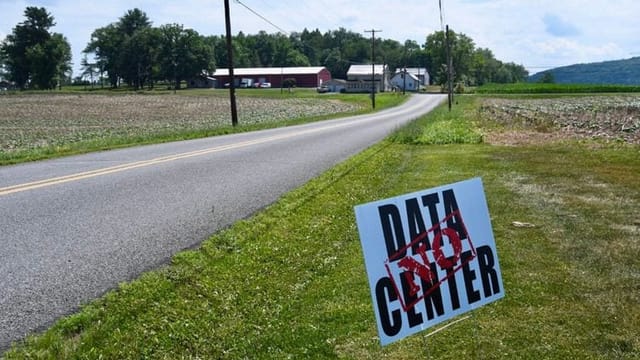
The two House Republicans also framed the controversy around a specific scenario involving private data-center developers obtaining eminent-domain authority for onsite energy production.
“And let me be very clear: Giving private data center developers eminent domain authority by classifying their onsite energy operations as utilities is a nonstarter for me,” Deeter wrote.
Craig repeated that position and pledged to oppose such a proposal if it were formally introduced. She added that she had discussed the issue with unnamed House colleagues who agreed with her.
The actual legislative draft would expand expedited eminent-domain procedures for certain utilities constructing electric transmission lines and natural gas pipelines. Such infrastructure could supply data centers without being located on their property or owned by their developers.
The proposal would amend Ohio Revised Code Section 163.01 to expand the definition of a public utility to include certain entities holding Ohio Power Siting Board certificates for transmission lines, gas pipelines and associated facilities.
Its most consequential change appears in Section 163.06(B), where qualifying utilities would be added to an expedited procedure currently available for specified public road and rail projects.
That provision would permit covered utilities to deposit an independently appraised amount with the court “at the time of filing the petition” and then take possession of the property. The authority would extend to structures on the land.
Property owners would retain their statutory rights to contest a taking and generally appeal an adverse ruling. The proposed process would nevertheless allow a qualifying utility to take possession before the court has resolved a landowner’s challenge to whether the taking is lawful.
Neither Deeter nor Craig addressed that provision in their public statements. Their declarations of opposition to giving data-center developers condemnation authority for onsite energy operations leave unanswered whether they oppose expedited possession for utility transmission lines and pipelines that could serve those developments.
The Ohio Farm Bureau has specifically warned that the proposal could accelerate the taking of private property for infrastructure supporting data centers and other projects.
“Ohio farmers and landowners should not have to fight to protect their property while a utility company is already building on it,” Farm Bureau President Bill Patterson said in a November 16 statement.
Business group pushed the policy before Republican draft surfaced
The Ohio Business Roundtable, an organization representing major corporate executives, publicly recommended a similar change months before the legislative draft was leaked.
Its March energy competitiveness report called for a “Deposit-and-Build Framework for Energy Infrastructure,” arguing that Ohio should streamline construction procedures and align its laws with those of other states.
The organization’s recommendation called for construction after public necessity had been established and appraised compensation deposited with the court. The leaked draft would permit covered utilities to take possession when filing an appropriation petition, before a court necessarily determines whether the taking is justified.
Reineke also described a process involving an initial judicial determination in his interview with The Advertiser-Tribune. The draft contains no such requirement before possession.
The relationship between the Roundtable’s recommendation and the legislative language remains unresolved. The business group advocated the policy, and Reineke has acknowledged helping develop the proposal, but the public record does not identify who supplied the drafting instructions or whether the Roundtable helped prepare the specific language.
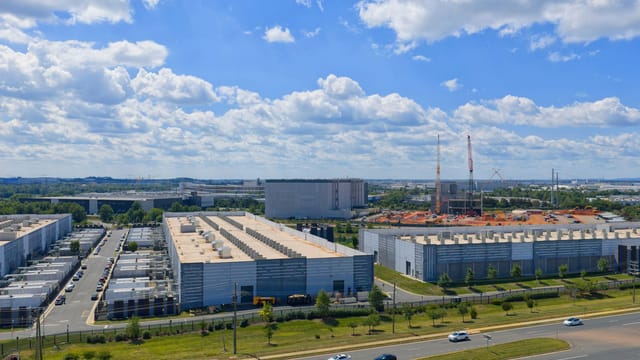
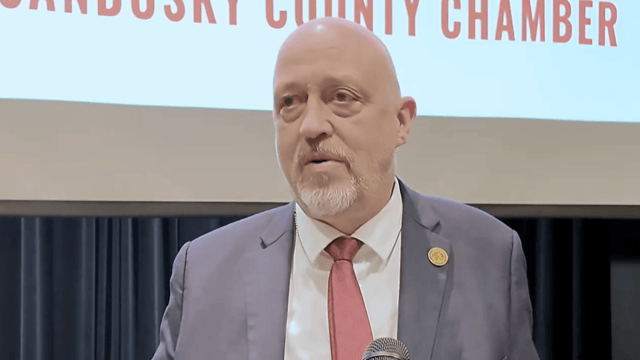
The proposal has emerged just weeks after Ohio voters approved restrictions on data-center development or rejected efforts to facilitate it in 21 local ballot contests across 18 communities. In Reineke’s own Senate district, Upper Sandusky voters approved a data-center prohibition with nearly 77% support on November 3.
The eminent-domain proposal would not directly overturn those local restrictions. Its provisions could nevertheless accelerate land acquisition for qualifying utility infrastructure serving data centers elsewhere.
Republicans face questions as lame-duck session continues
The Ohio Farm Bureau has organized opposition to the proposal, warning that utility companies could obtain possession while landowners are still litigating their property rights.
Evan Callicoat, the organization’s director of state policy, told the Statehouse News Bureau that the Farm Bureau had recently learned of a push to advance the legislation during the General Assembly’s post-election lame-duck session. He called the proposed expansion “egregious.”
The leaked draft has no assigned bill number or publicly identified sponsor. It had not been formally introduced when the statements from Deeter and Craig circulated, and no committee hearing or vote on that document had been announced. Additional legislative sessions remain scheduled before the end of the year.
Deeter has acknowledged that she issued her statement without the information subsequently raised about Reineke. Craig has not publicly identified the House colleagues she said agreed with her, and neither lawmaker has identified who prepared their matching statements.
Both representatives are preparing to join the leadership of a House Republican caucus that will work alongside Reineke’s Senate leadership beginning in January. Their public statements challenge the coverage of a proposal their party’s incoming Senate president has already acknowledged helping develop.
The lawmakers have yet to say whether they oppose the actual provision at the center of the controversy: allowing qualifying utilities to obtain possession of private property when filing an eminent-domain lawsuit, before a judge has ruled on a landowner’s challenge to the taking.