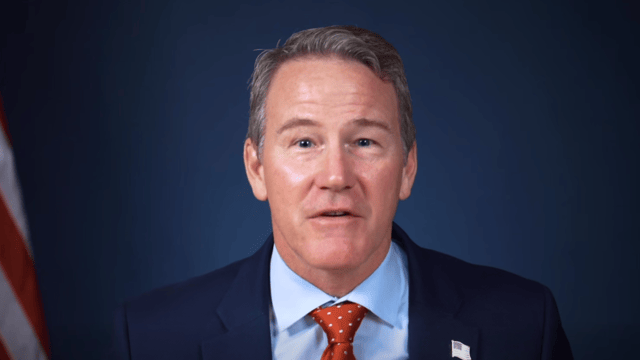

As Ohio House speaker, Jon Husted helped select an eminent domain task force and backed a 2007 law that exempted utilities from restrictions on certain land takings. AEP later invoked the law in court. Now the utility is planning major transmission lines to serve a data center as Ohio landowners confront the threat of eminent domain.
U.S. Sen. Jon Husted voted for an Ohio law that explicitly exempted public utilities from new restrictions on taking private property for commercial development, preserving their ability to use eminent domain to acquire land for power lines. Nearly 20 years later, American Electric Power is planning transmission corridors across southern Ohio to serve a massive artificial intelligence data center, and property owners face the possibility of having land rights taken for the project.
Husted was speaker of the Ohio House when lawmakers developed the 2007 eminent domain overhaul. He appointed House members to a task force studying the issue and joined the Senate president in selecting public members, including a man who would later become a FirstEnergy lobbyist. On June 27, 2007, Husted voted for Senate Bill 7, which passed the House 71-27 and took effect that October.
The legislation restricted the use of eminent domain to transfer property for economic development, but its definition of public use specifically exempted transfers to public utilities, municipal power agencies and common carriers. It also presumed that utility facilities and projects undertaken by public utilities qualify as public uses. That distinction matters today: A transmission line built to deliver power to a privately operated data center can still be a utility project for eminent domain purposes.
The law went further. Under Section 163.09, a public utility that presents evidence that an appropriation is necessary receives a rebuttable legal presumption in its favor. If a state or federal regulator approves the appropriation of the particular property interest, the statute provides an irrebuttable presumption of necessity. Those provisions can change the terms of a court fight between a utility seeking a transmission easement and a landowner resisting it.
Husted’s task force included a future FirstEnergy lobbyist
The process began after the U.S. Supreme Court’s 2005 Kelo decision intensified scrutiny of governments taking private land for economic development. Ohio lawmakers enacted Senate Bill 167, creating a task force to examine the state’s eminent domain rules. The January 24, 2006, Ohio House Journal records Husted appointing Reps. William Seitz, Bob Gibbs and Joseph Koziura and jointly appointing public members with the Senate president.
One of those public members was Ty Pine, then listed as a representative of small businesses. The task force delivered its recommendations in August 2006, and Senate Bill 7 incorporated recommendations from its work the following year. Its final text retained the utility exception even as lawmakers imposed new protections against other economic-development takings. Utilities already held condemnation powers before 2007; Husted’s vote protected their treatment under the new restrictions and supported additional presumptions favoring them in condemnation proceedings.
Pine subsequently became FirstEnergy’s Ohio director of state affairs and helped the utility build legislative support for House Bill 6, the 2019 nuclear bailout law at the center of Ohio’s FirstEnergy corruption scandal. He received a $25,000 bonus after the legislation passed, according to reporting by The Blade. Pine invoked his Fifth Amendment right against self-incrimination in a 2024 regulatory deposition and later testified under a court order in 2025. He has not been charged with a crime in the scandal. Pine was appointed to the task force as a small-business representative years before joining FirstEnergy.
AEP invoked the 2007 law against Ohio landowners
The practical importance of those protections was on display in a dispute involving AEP’s Ohio Power subsidiary. When property owners in Washington County resisted the company’s proposed easements for an electric transmission upgrade, Ohio Power filed eminent domain actions and claimed the benefit of the presumptions in the law Husted supported.
The dispute reached the Ohio Supreme Court in Ohio Power Co. v. Burns. According to the court’s December 2022 opinion, a company right-of-way representative testified that Ohio Power generally sought more property rights in proposed easements than were necessary for a project, then narrowed the demands if the landowner contested them in litigation. In the Washington County case, the company withdrew a request for distribution-line rights after the property owners challenged its necessity.
Ohio Power argued that government approvals entitled it to a conclusive presumption that the disputed easements were necessary. The justices rejected that argument because regulators had approved the transmission project without examining the particular property rights Ohio Power sought to take. The company did receive a rebuttable presumption of necessity based on evidence it presented, but the Supreme Court required a separate determination of the need for each challenged easement term.
FirstEnergy Service Company filed a friend-of-the-court brief urging the justices to reverse the lower court decision in Ohio Power’s favor. The Ohio Farm Bureau Federation supported the landowners. The case did not concern a data center, but it established that an AEP subsidiary had already sought to use the 2007 statutory protections in a real fight over Ohioans’ private property.
Now AEP wants miles of new transmission lines for a data center
AEP’s current expansion would bring the same underlying question — when a utility can compel a property owner to surrender land rights — to a much larger power project. In March 2026, AEP Ohio announced plans for $4.2 billion in transmission infrastructure to serve a planned 10-gigawatt data center campus at the former Portsmouth Gaseous Diffusion Plant near Piketon. The project is part of a broader development involving new power generation and one of the world’s largest proposed artificial intelligence computing facilities.
The Baku-Gavin transmission project alone would build approximately 51 miles of 765-kilovolt line through Pike, Jackson and Gallia counties. Ohio regulators estimate its cost at $1.1 billion. According to AEP’s project information, its steel lattice towers would typically stand around 155 feet tall, with rights-of-way approximately 155 to 200 feet wide. Other proposed routes and power-grid improvements would extend the construction footprint across more of southern Ohio.
Residents in Ross County have also confronted possible routes being studied for connections to the Piketon development. In September, the Chillicothe Gazette reported that landowners Laura Dill Morton and Mason Purdum had received notices that their farmland could be affected by new transmission lines. They described uncertainty about potential routes and the possibility of eminent domain. Those Ross County feasibility-study areas are distinct from the pending Baku-Gavin application, and the reports do not establish that their properties have been condemned.
AEP says the data center developer has committed to paying for the $4.2 billion in transmission investments to help avoid increases in transmission rates for other Ohio customers. That financial commitment does not eliminate the question facing property owners whose land may be needed for transmission corridors: whether they will agree to easements, or whether a utility will seek to acquire those rights through eminent domain.
The Baku-Gavin application remains pending before the Ohio Power Siting Board, which has scheduled a public hearing for October 27 at 6 p.m. at Jackson Middle School Auditorium. The lines have not all been approved, and the specific land interests ultimately needed will depend on routing and regulatory decisions. But the statutory framework utilities can use to pursue those interests was protected and strengthened in legislation Husted supported as Ohio House speaker, long before the state’s data center boom began.