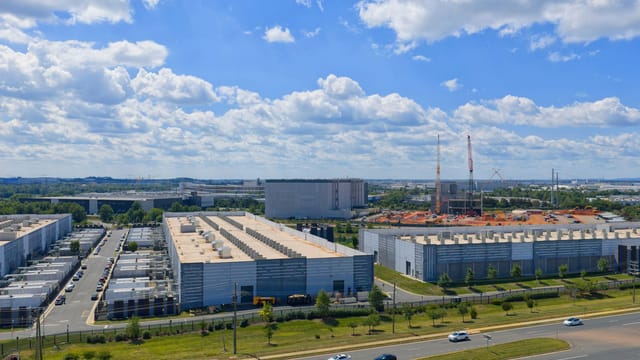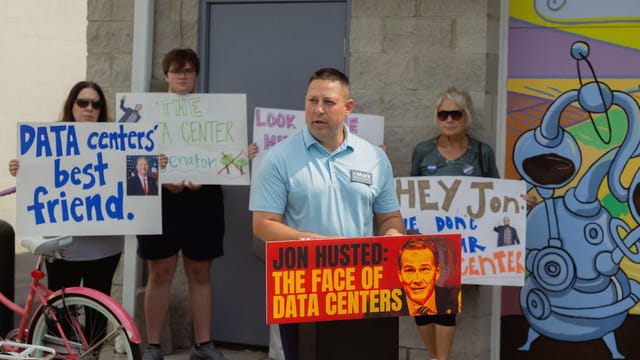
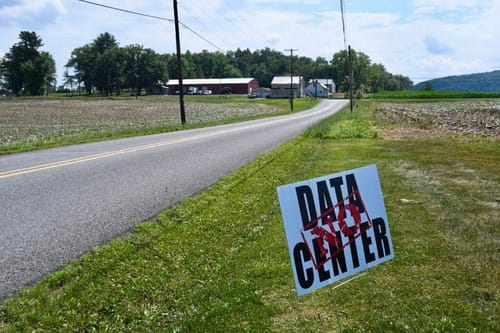

Ohio voters sharply rejected data centers in this year’s election. Around Ohio, 18 communities voted on whether to curb or ban data center developments. In all 18 communities, voters decided that, yes, that would be a good idea.
In most, the results were resounding — like Harlem Globetrotters v. Washington Generals resounding. City leaders in Wilmington, the county seat of Clinton County, asked voters to rezone four parcels to allow data center development. Roughly 80% of voters rejected all four.
In the Lake County Village of Perry, more than 87% of voters backed an initiative requiring data centers that accept tax incentives to take out a bond, operating kind of like an insurance policy, to back up their promises of local tax revenue.
Voters in Piqua prohibited data centers within city limits by a 2-to-1 margin and didn’t stop there. They also recalled three city commissioners — including the mayor and vice-mayor — for approving a Meta data center in November last year.
From Conneaut in far Northeastern Ashtabula County to Trenton in Southwestern Butler County, nine communities passed initiatives modeled on the statewide data center moratorium Conserve Ohio organizers are trying to put on the ballot in 2027. That initiative would amend the state constitution to prohibit any data center drawing more than 25 megawatts a month.
In a press release, Conserve Ohio congratulated communities who voted against data center development, and warned elected officials that “You cannot look away now.”
“The above election results demonstrate that when communities have a say regarding the construction of a hyperscale data center in their local area, they overwhelmingly say no,” the group wrote. “Your oath is invoked. Stop the self-dealing, corporate fealty, and greed. Represent and serve the people who elected you.”
Conserve Ohio urged Ohio citizens to push state lawmakers to pass a 12-month moratorium on any data center development in Ohio during the lame duck session between now and the end of the year.
Upper Sandusky
Angela Huffman is a sixth-generation farmer in Northwest Ohio, and she heads up the national watchdog group Farm Action, which focuses on corporate consolidation in the food and agriculture sector. She explained data centers came onto their radar about a year ago, because of concerns about their impact on farmland.
“And then lo and behold,” Huffman said, “I read in the newspaper back in June of this year that a data center, a nearly $1 billion data center, was proposed here right outside Upper Sandusky, which is about 10 miles from my farm.”
Upper Sandusky is the county seat of Wyandot County, but it’s a small city with a population of less than 7,000 residents. In June, the company Smartland Energy proposed building a 150-megawatt natural gas plant on a 46-acre parcel. The idea was to build the powerplant first and then sell the power directly to a data center client on an adjacent 100-acre parcel.
Smartland emphasized it “would not build, own or run” the data center, and that the eventual end-user would still need city approval and hadn’t been pre-selected.
Huffman and other organizers began collecting signatures to oppose the project, and unlike many petition drives, she said their job was relatively easy.
“Really our challenge was just finding ways to get in front of people,” she said. “They already knew about the issue. They were already concerned about data centers. So fortunately, we didn’t have to first educate or raise awareness and educate about what the problem was. They already knew. We just had to get their names on these petitions in time.”
Huffman noted construction of a Louis Dreyfus Company soybean processing plant was already stretching local infrastructure, and a data center adding to the strain was a daunting prospect.
When Upper Sandusky voters went into the booth last Tuesday, nearly 77% of them approved a city charter amendment banning data centers within city limits.
Looking forward
In a Facebook post last Thursday, Smartland Energy seemingly acknowledged its project doesn’t have a future in Upper Sandusky. The company thanked the community and reiterated its belief in their proposal.
“At the same time,” it stated, “we value and respect the democratic process and the outcome of the charter amendment vote.”
“Our team will take some time to come together, reflect on this process, and discuss the outcome,” Smartland added. “If there is ever anything further to share, this will be the first place we communicate it.”
The drubbing data centers took in Ohio last Tuesday didn’t stop at the state line. Around the country, 47 initiatives were on the ballot to restrict data centers. Election officials are still counting votes for two of those contests, but according to the website Data Centers on the Ballot, 44 jurisdictions rejected data centers and just one welcomed them.
The day after the election, data center industry group Infrastructure for America released what it called a “good actor pledge”. It’s members, including Compass, Digital Realty, QTS and Vantage, committed to operate transparently, invest in their communities, and not be a drain on local power and water infrastructure.
Dan Diorio, who heads up state policy and government affairs for the Data Center Coalition said their industry can advance the issues Americans care about, like jobs and the economy.
“Data centers can play a crucial role in advancing affordability for Americans through job creation, local tax revenue, and bringing investment and opportunity to local communities,” Diorio said.
He added that the industry is committed to learning what communities need and earning their trust. Data center developers are also ready to comply with local standards and deliver “clear benefits” to their neighbors.
“Communities that signal that they are closed for business and investment may miss out on those opportunities,” Diorio said, “relinquishing substantial long-term economic investment, high-wage jobs, and critical tax revenue to neighboring areas or other states.”
To Huffman, the election results underscore the importance of communities having a voice in major developments like data centers. She stressed that she doesn’t oppose AI or development generally, but the way the industry has been operating feels “predatory.”
Between tax abatements for developers, and the lack of local protections or input, “it’s really been tilted in favor of big tech,” she said, “at the expense of Ohio.”
“I think that’s where a lot of the pushback started,” Huffman added. “If this had been more of a level playing field from the start, I don’t think there would have been as much opposition.”
Correction: This story initially stated the Data Center Coalition did not respond, but their response was missed.
Follow Ohio Capital Journal Reporter Nick Evans on X or on Bluesky.
This story is republished from the Ohio Capital Journal under a Creative Commons license. View the original article.