
Ohio state Rep. Tristan Rader wants state regulators to take a close look at a plan to purchase Dayton’s electric utility, AES. The $10.7 billion deal would take the utility private — putting it in the hands of a group with few ties to the region and investments that might cause conflicts of interest down the road.
Rader, D-Lakewood, wants the Public Utility Commission of Ohio to hold hearings in AES’ service territory to allow ratepayers, local governments, and other stakeholders to weigh in before making a final decision.
“This is a consequential decision for the future of Ohio’s electric system,” Rader wrote in a letter to PUCO chair Jenifer French.
“With rates increasing, data-center demand accelerating, and billions of dollars in new grid investment likely ahead, Ohioans deserve the opportunity to ask questions and be heard before control of their electric utility changes hands,” he went on.
A PUCO spokesman acknowledged they’d received the letter and filed it in the case docket.
The Commission set an Aug. 13 deadline for comments in the case, and it has yet to make a final decision on the deal. A staff review, however, indicated the buyers are a “suitable owner for AES Ohio.”
The consortium
The buyers include the Qatari sovereign wealth fund, California’s public employee pension program, a Swedish private equity firm called EQT, and Global Infrastructure Partners, a subsidiary of the largest asset manager in the world, BlackRock. The consortium put up $10.7 billion in cash.
In a March press release, the parties said AES will have “improved access to capital to invest in critical energy infrastructure assets,” and it would “continue to invest prudently in utility assets to meet the growing energy needs of all 1.1 million customers.”
The consortium’s said it intends to leave the utilities’ management team intact and make additional investments in the competitive energy generation market.
The release plainly stated, “this acquisition is not expected to impact customer rates in AES’ regulated utilities.”
The PUCO staff report leans heavily on the consortium’s assurances that it won’t meddle in the utility’s day-to-day operations.
The report notes the company’s rates and management aren’t changing, the company isn’t rebranding, and merger costs won’t get recovered through rates. Customers will use the same website, call the same call center, and receive the same bills.
“Staff believe that a change in ownership has little to no foreseeable drawbacks for AES Ohio,” the report said. The new owners might even give the company more opportunities to invest energy infrastructure, PUCO staff added.
“The benefits of an active investing ownership outweighs the foreseeable drawbacks,” the report said.
It’s a point AES Board chairman Jay Morse brought up when the deal was announced. In the press release, he emphasized the benefits for current stockholders and noted the company had “significant need for capital to support growth beyond 2027.”
Without the acquisition, Morse warned, AES would have likely cut or eliminates dividends and might have issued a “substantial” number of new shares in the company — diluting current stockholders’ stake.
Skeptics concerns
The consortium aiming to purchase AES emphasizes the “enhanced financial flexibility” it will have as a private company, but Rader worries that also mean less transparency.
“It’s a big change,” he said. “Going from a publicly traded company to completely privately held. (It) closes some doors and makes it a little more opaque.”
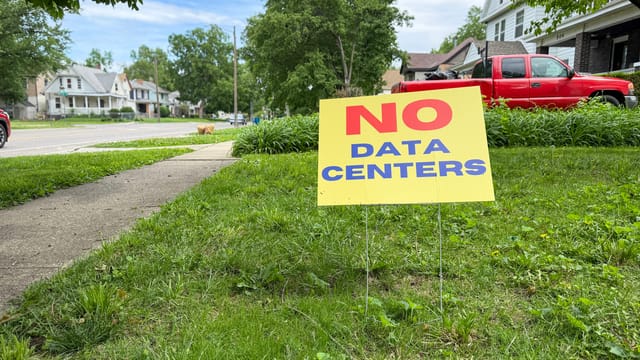
He’s also concerned about conflicts of interest. BlackRock has substantial investments in artificial intelligence and data centers.
AES sees data centers as a significant growth opportunity within its service territory. So what happens when the company that controls the grid also has a stake in one of its biggest customers?
“It feels like, seems like to me, there might be some, if not double dealing, at least some incentives here to give data centers a great deal, (while) at the same time passing those costs on to customers,” Rader said.
“Incentives don’t seem to be quite lined up in my opinion,” he added.
Just east of Dayton, Kim McCarthy chairs the Greene County Democratic Party, and she’s running for a state House seat in November.
By day, she’s an accountant, and she isn’t thrilled about private equity taking over the local utility. She described losing her job in 2021 after a private equity firm bought the local IT company where she was working.
“So, when I heard that private equity groups were looking to purchase AES,” McCarthy said, “I couldn’t help but think, oh wow, they’re just going to hollow out our electrical system.”
As for Rader’s idea to holding public hearings in the Dayton area, McCarthy’s on board, so long as it’s “impactful,” rather than an exercise to “placate the public.”
“Qatar? BlackRock? And no offense to the California pension fund, but what do they care?” she said. “They want to make money. That’s all they want to do. They have no ties to this area, they’re not going to care about the lives that are impacted here.”
And she isn’t the only one skeptical of the consortium’s long-term plans.
In a filing with the PUCO, representatives from the city of Dayton pressed for binding assurances from the utility’s new owners.
If regulators are going to rely on the consortium’s claims to justify approving the purchase, the city reasoned, they should take steps to ensure the consortium sticks to its promises.
Among Dayton’s asks, PUCO should require the new owners maintain AES’ headquarters, senior leadership, and at least 90% of its baseline workforce in the area for the next 20 years.
And while the consortium plans to continue programs investing in local infrastructure and economic development, Dayton argued choosing not to eliminate that work isn’t the same as providing a benefit.
“The city would like to see how the merger improves upon the great work AES is already doing,” the city’s filing stated, “not whether the merger will simply maintain AES’ existing commitments.”
Follow Ohio Capital Journal Reporter Nick Evans on X or on Bluesky.
This story is republished from the Ohio Capital Journal under a Creative Commons license. View the original article.