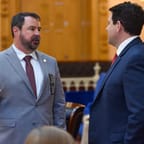
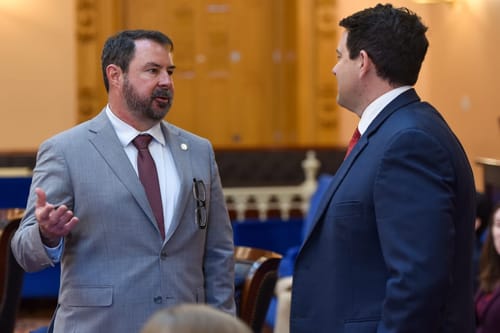
The Republican co-chairing Ohio’s new Joint Data Center Committee — a panel now meeting weekly with a clear mandate to produce legislation before the summer recess — spent the opening months of 2026 at the center of a formal ethics complaint alleging he had concealed financial interests in the energy sector he simultaneously oversees as a Senate committee chair.
Sen. Brian Chavez (R-Marietta), chair of the Ohio Senate Energy Committee, was tapped in May 2026 to co-lead the Ohio Joint Data Center Committee alongside state Rep. Adam Holmes (R-Nashport). The panel — six Republicans and two Democrats — has held multiple public hearings since late May, fielding testimony from community members, environmental researchers, anti-data-center organizers, and lobbyists representing Amazon, Google, Meta, and Microsoft. Ohio House Speaker Matt Huffman (R-Lima) has said he wants lawmakers to pass “some sort of data center legislation” before the summer recess, and said the committee was created for that purpose.
“This is a fact finding effort,” Chavez said when the committee was announced. “We’re just gathering facts and information on what’s happening out there, what reality is. And we intend to disseminate that out.”
But questions about Chavez’s own financial reality had already been raised months earlier.
Ethics complaint alleged hidden business ties
In January 2026, an environmental advocacy group called Washington County for Safe Drinking Water filed a formal ethics complaint with the Ohio Joint Legislative Ethics Committee, alleging Chavez had failed to disclose ownership stakes in at least five oil and gas companies on his 2023 and 2024 financial disclosure forms — a legal requirement for Ohio state senators. Among the undisclosed entities, the complaint said, was DeepRock Disposal Solutions LLC, on whose legal documents Chavez signed as CEO, despite the company never appearing on his required financial disclosures. Buckeye Environmental Network, Save Ohio Parks, and FaCT Ohio co-signed the complaint.
Separately, the complaint alleged, Chavez’s company Chavez Well Service had bid on five state contracts to plug abandoned oil and gas wells since his appointment to the Ohio Senate in December 2023, winning one contract worth more than $200,000, according to the complaint’s review of public records. Those business interests, the complaint alleged, created a direct conflict when Chavez used his Energy Committee chairmanship to advance Senate Bill 219, legislation introduced by Sen. Al Landis (R-Dover) that would revise Ohio’s orphan well plugging program.
Washington County for Safe Drinking Water said Chavez “co-sponsored the legislation, accelerated its movement, and publicly advocated for it in the Energy Committee, which he chairs” — all without disclosing the financial interests the complaint said he held. The complaint alleged those actions violated Ohio Revised Code section 102.03, which prohibits public officials from using their office for private financial gain or voting on legislation in which they hold conflicts of interest.
The complaint expired without a formal investigation
The Ohio Joint Legislative Ethics Committee took no action within the 14-day review window required under state law. The complaint expired without a formal investigation being opened — a procedural outcome, not a determination that the allegations lacked merit.
Senate Republicans characterized the dismissal as a vindication. “This failed publicity stunt was nothing more than a libelous smear campaign against a respected State Senator that was backed by California special interests dead set on killing the oil and gas industry in Ohio,” said John Fortney, spokesperson for the Ohio Senate Republicans.
Washington County for Safe Drinking Water maintained that the procedural outcome left the underlying conflict unresolved. “A healthy democracy depends on accountability, balance, and a commitment to fairness for all,” the group said. Treasurer Dawn Hewitt told the Marietta Times that regardless of the committee’s inaction, Chavez “should not be sitting as chairman of the committee” while holding financial stakes in the industries he regulates.
Chavez then questioned others’ financial independence
Months later, Chavez was appointed co-chair of the data center committee. At the panel’s June 1 public hearing, he questioned a witness who had testified against data center development, asking whether that person had received payment for appearing before the committee. The witness had not. “Several of the witnesses made it clear that they are not funded by anyone,” Chavez told reporters after the hearing. “And I take them at their word.”
The pattern extends to the top of the Republican ticket
Chavez’s unresolved conflict of interest allegations are not the only financial entanglement shaping the policy environment Ohio’s data center hearings are designed to address.
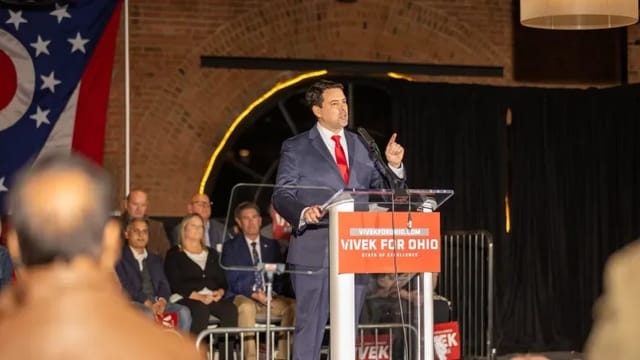
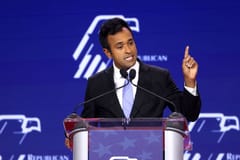
A May 2026 analysis by progressive policy group Innovation Ohio found that GOP gubernatorial nominee Vivek Ramaswamy’s financial disclosure — filed with the Ohio Ethics Commission in April — reveals personal investments spanning every tier of the data center supply chain. The report, titled Vivek Ramaswamy’s Data Center Portfolio: Divided Loyalties, identifies holdings in chip manufacturers, cloud and data center operators, industrial real estate investment trusts, infrastructure funds, and cryptocurrency. As TiffinOhio.net reported, as governor, Ramaswamy would appoint the boards of JobsOhio, the Ohio Power Siting Board, the Public Utilities Commission of Ohio, and the state Tax Credit Authority — the agencies that permit, regulate, and subsidize the data center industry.
“As governor, Ramaswamy’s policies and investments could ensure that he continues to cash in while the rest of us fall behind,” Innovation Ohio President Michael McGovern said. “Even if a data center project or policy isn’t in Ohioans’ best interest — it will almost always be in his.”
Sen. Bill Reineke (R-Tiffin), widely expected to become the next Ohio Senate president in 2027, is among the members appointed to the data center committee.
The joint committee was formed as the Ohio House had already advanced its own data center legislation. House Bill 646 — co-sponsored by state Reps. Gary Click (R-Vickery) and Kellie Deeter (R-Norwalk) to create a formal data center study commission — passed the House unanimously in March and was referred to a Senate committee. Chavez acknowledged his joint committee could supersede it. “This doesn’t necessarily have to replace it,” he said, “but it seems to be the quicker vehicle that we’re going to pursue right now.”
As legislators weigh next steps, a citizen petition drive organized by Conserve Ohio is pursuing a constitutional amendment that would ban large data centers — defined as those consuming more than 25 megawatts of electricity monthly — from operating in the state. The group needs 413,487 valid signatures from at least half of Ohio’s 88 counties by July 1.