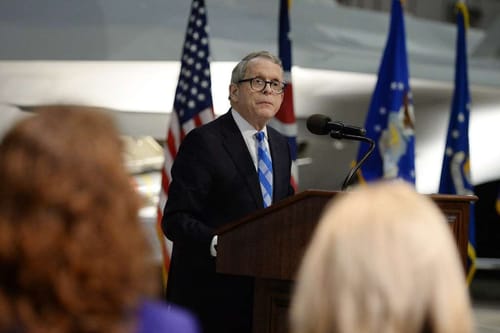

Ohio Gov. Mike DeWine on Wednesday vetoed a bill that would have required absentee voters to verify their identity with a photo ID, calling the measure an unnecessary obstacle for Ohioans who vote by mail.
House Bill 472, sponsored by state Rep. Jodi Salvo (R-Bolivar), would have required absentee voters to either upload a photo ID and electronic signature to a state-built online portal or mail a photocopy of their ID to their county board of elections. In his veto message, DeWine said the requirement would do nothing to stop fraud while making it harder for eligible voters to cast a ballot.
“House Bill 472 would not discourage fraud, would not add any real security, and would create an additional and significant burden for Ohioans who vote by mail,” DeWine wrote. He added: “H.B. 472 is all burden for so little benefit. Therefore, this veto is in the public interest.”
The veto blocks, for now, what would have been a substantial change to how more than a million Ohioans vote. Ohio has required photo ID for in-person and early voting since 2023, but absentee voters currently verify their identity using a signature and either the last four digits of their Social Security number or a driver’s license number. Under H.B. 472, those steps would have remained and a photo ID requirement would have been layered on top, taking effect with the 2027 general election.
A homeless-ID bill that became a voting bill
H.B. 472 did not begin as a voting measure. As originally introduced, the bill was a bipartisan effort to waive fees so Ohioans experiencing homelessness could more easily obtain state identification cards and vital records such as birth certificates. Senate Republicans added the absentee photo ID language late in the process, shortly before the bill cleared the legislature.
The amendment was tied to a separate Republican priority: a proposed constitutional amendment, headed to the November ballot, that would let the state require photo ID for absentee voting. Lawmakers folded the mail-in ID requirement into H.B. 472 in part to satisfy House members who were reluctant to back the ballot measure without also writing the requirement into state law.
The late change appeared to cost the bill support. It had originally cleared the Ohio House with a single dissenting vote; after the Senate added the ID language, the House concurred 60–34 and the Senate passed it 23–10, with Sen. Bill Blessing (R-Colerain Township) joining Democrats in opposition.
The bill’s original Democratic co-sponsor, Rep. Christine Cockley (D-Columbus), asked to have her name removed and urged DeWine to veto it.
“The bill was hijacked by the Senate Republicans and turned into something completely different,” Cockley said. “What started out as a great piece of bipartisan legislation turned into a bill about voting rights.”
The American Civil Liberties Union of Ohio, which had urged a veto, said the late amendment grafted an unrelated voting fight onto a bill meant to help vulnerable residents. “What started as a straightforward, nonpartisan bill addressing fees for birth certificates and IDs for homeless individuals has now been co-opted by election deniers still re-litigating President Trump’s 2020 defeat,” ACLU of Ohio Advocacy Director Collin Marozzi said in a statement before the veto.
DeWine: an ID can’t be matched to a face through the mail
Much of DeWine’s veto message focused on a practical objection. A photo ID works at a polling place because a poll worker can compare the picture to the voter standing in front of them, he wrote — a check that is impossible with a mailed ballot.
Requiring the ID for mail voting, DeWine wrote, “does not provide election officials with any opportunity to verify if the ID picture matches the face of the voter and thereby serves as no additional verification of the voter’s true identity.”
He also argued the bill stacked new steps onto a process that already works, pointing to the existing requirement that absentee voters provide identifying information and a signature. The added requirements, he wrote, “are burdens, nonetheless, and when layered upon the existing steps already required to vote absentee and vote by mail, there would certainly be voters discouraged from exercising their right to vote.”
DeWine cited warnings from election officials and seniors’ advocates that the change would fall hardest on older and less-connected voters. Quoting the bipartisan Ohio Association of Election Officials, he noted that “senior citizens, individuals living in long-term care facilities, voters with mobility challenges, and those with limited access to technology may face additional burdens that could discourage participation or prevent otherwise eligible voters from casting a ballot.” The AARP, he wrote, echoed that concern, cautioning that “increased complexity can make it harder for eligible voters to successfully complete the process.”
The governor also flagged the cost. Building and maintaining the secure online portal the bill required would force the secretary of state to spend significant unfunded money, and county boards of elections would absorb new administrative costs with no added resources — what DeWine called “an unfunded mandate both for the Ohio Secretary of State and for every county in Ohio.”
He reserved praise for one piece of the bill: a provision letting voters apply for absentee ballots online. That reform, DeWine wrote, “is much needed, and I commend the Legislature for passing it. It is unfortunate that it is in a bill that I must veto.”
The same governor signed a ballot deadline restriction in December
The veto lands six months after DeWine took the opposite action on a different voting bill. In December, he signed Senate Bill 293, which eliminated Ohio’s four-day grace period for mail-in ballots and required that all absentee ballots reach county boards of elections by the close of polls on Election Day. That law took effect in March.
DeWine signed S.B. 293 while saying he disagreed with it. “I normally would veto a repeal of this four-day grace period. And, frankly, that’s what I wish I could do,” he told reporters at the time. He said he signed it anyway because a pending U.S. Supreme Court case out of Mississippi could strike down such grace periods nationally, and he did not want Ohio’s rules thrown into question close to the 2026 election.
That sequence has left DeWine, who is term-limited and in his final year in office, drawing an idiosyncratic line on voting law: signing a restriction he said he opposed when he felt cornered by litigation, and vetoing one he viewed as pure cost and obstruction. As far back as 2023, he had said a sweeping package of election changes he signed that year would likely be the last he would approve.
What happens next
Republicans hold supermajorities in both chambers and could override the veto, but the legislature is on its summer recess. Senate Finance Chair Jerry Cirino (R-Kirtland) said he was disappointed by the veto but was unsure whether lawmakers would return to attempt an override.
The fight is unlikely to end with H.B. 472. Ohio voters will decide in November on the constitutional amendment that would allow a photo ID requirement for absentee voting — the same requirement DeWine just rejected in statutory form. The state’s two secretary of state candidates are split on the issue: Republican nominee Robert Sprague, the current state treasurer, backed the mail-in ID requirement, while Democratic nominee Allison Russo, the former House minority leader, urged DeWine to veto it and pointed to drafting errors in the rushed bill.