Ohio Republicans are racing to put a constitutional amendment on the November ballot requiring photo identification to vote — a requirement that has already been Ohio law for more than three years.
The Ohio Senate passed Senate Joint Resolution 10 on a 22–9 vote Wednesday, June 3, just two weeks after the measure was introduced, according to the Ohio Capital Journal. A final vote in the Ohio House could come as soon as Wednesday, June 10, the Statehouse News Bureau reported. If 60 of the House’s 99 members sign off, the question goes before voters this November.
What the amendment would not do is change how a single Ohioan votes. And that gap — between what the measure claims to accomplish and what it actually does — has produced an unusual coalition of opponents, from the ACLU of Ohio and the League of Women Voters to conservative election activists, while Republican leaders deny the charge that the whole exercise is designed to pull their voters to the polls in a difficult midterm year.
The law already on the books
Gov. Mike DeWine signed House Bill 458 in January 2023, and its photo-ID mandate took effect that April. Since then, every Ohioan voting in person — on Election Day or during early voting — has been required to present an unexpired Ohio driver’s license, state ID card, or BMV interim ID form; a U.S. passport or passport card; or a U.S. military, Ohio National Guard, or Department of Veterans Affairs ID card. The 2023 law eliminated the documents Ohioans had used for years, including utility bills, bank statements, paychecks, and Social Security cards.
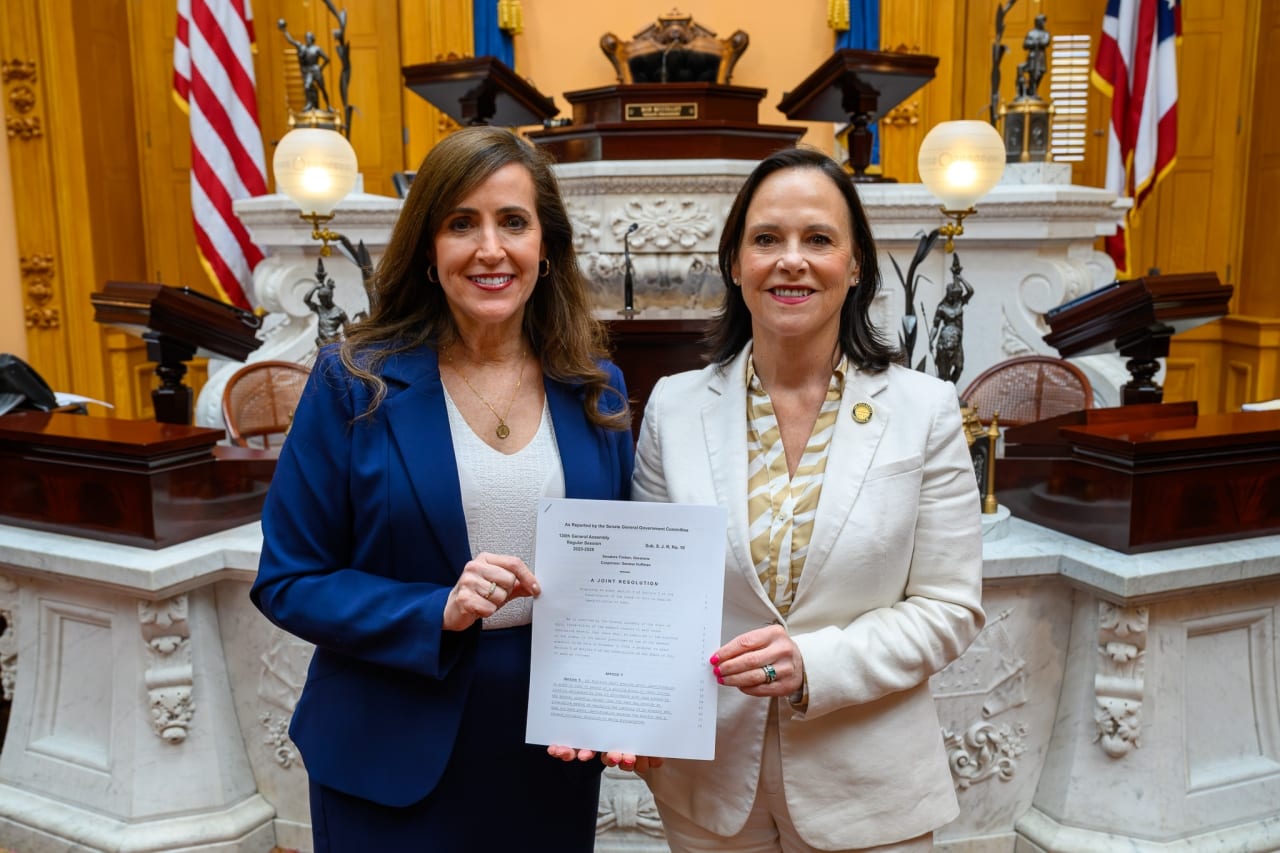
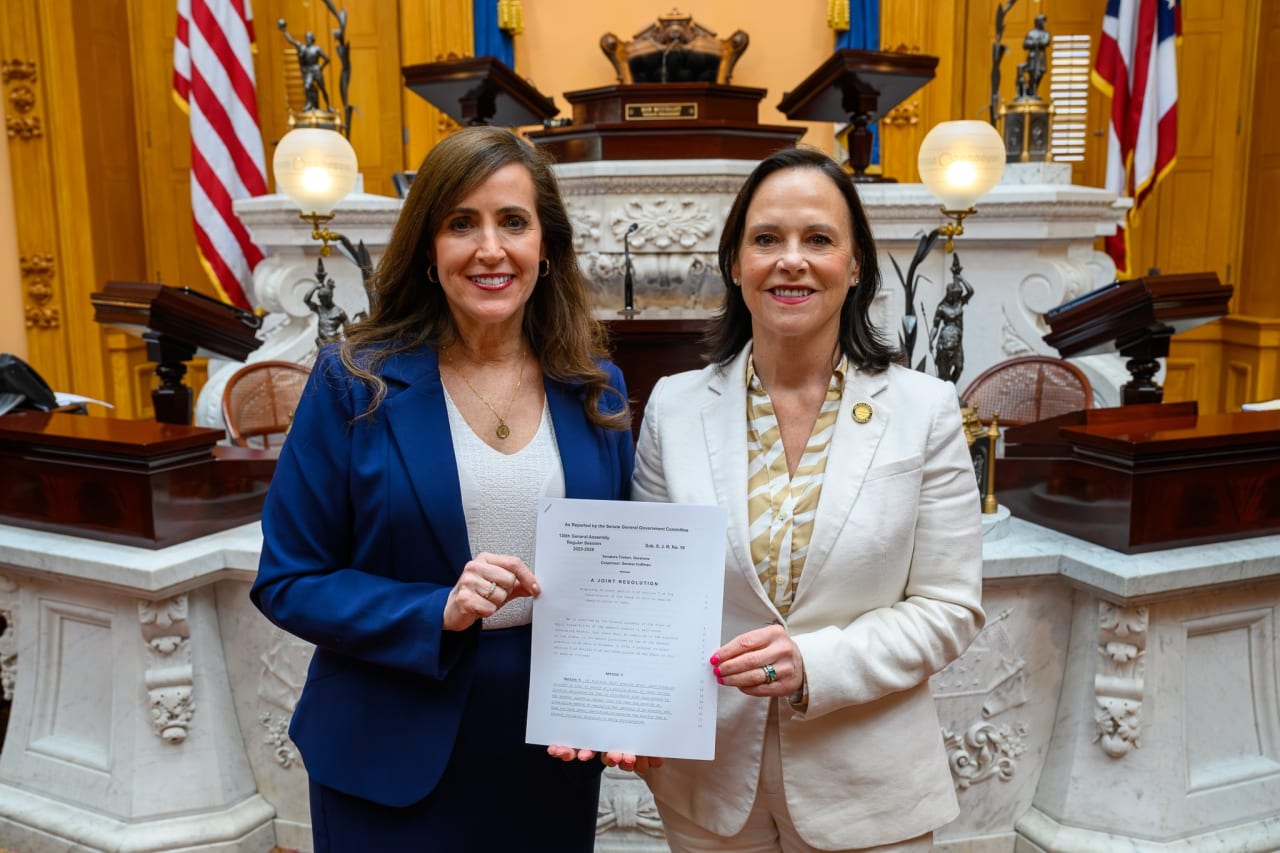
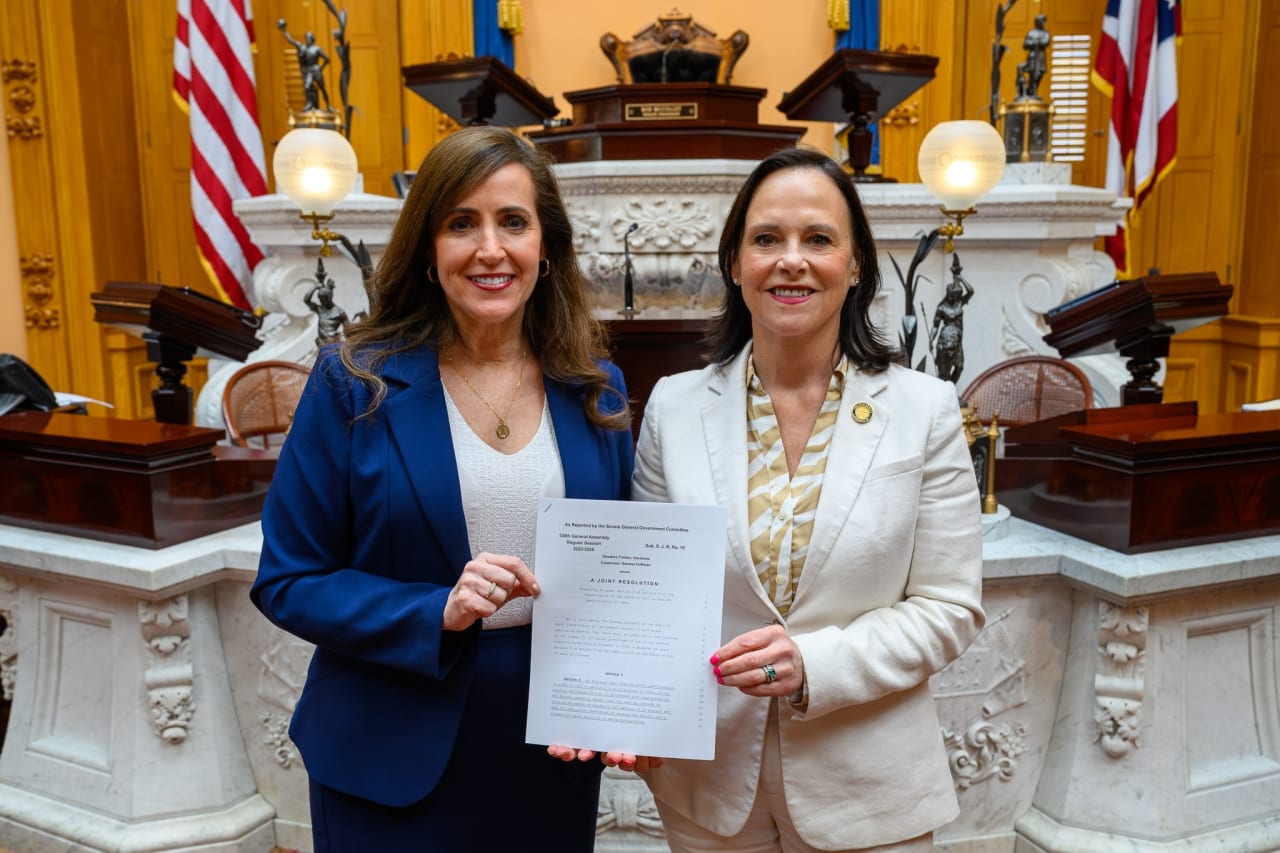
SJR 10 would copy the core of that requirement into the Ohio Constitution, where no future legislature or court could undo it without another statewide vote. Sponsors introduced the resolution in mid-May — Sens. Jane Timken, R-Jackson Township, and Theresa Gavarone, R-Bowling Green, in the Senate, with a companion measure, House Joint Resolution 9, from Reps. Adam Bird, R-New Richmond, and Heidi Workman, R-Rootstown.
“This is about fair and free elections,” Timken said when the resolutions were introduced, according to the Ohio Capital Journal. On the Senate floor, she pointed to Virginia as a cautionary tale: “After several years of operation, surviving judicial challenges, Virginia repealed its photo ID requirements in 2020 after a single seat in the General Assembly flipped.”
The Capital Journal noted what Timken’s Virginia example leaves out: even after that state returned to allowing non-photo documents, a 2021 review by The Virginia Mercury found only about 0.05% of voters in several large localities cast ballots without showing a photo ID.
A fast track with a campaign behind it
The amendment push did not begin in the legislature. Vivek Ramaswamy, the Republican nominee for governor, called in a mid-May Cincinnati Enquirer op-ed for enshrining voter ID in the state constitution, writing that the existing statutory requirement is “fragile.” Days later, Republican lawmakers introduced HJR 9 and SJR 10. Senate President Rob McColley, R-Napoleon — who shepherded SJR 10 through his chamber — is Ramaswamy’s running mate for lieutenant governor.
The resolutions then moved at a pace rarely seen for constitutional amendments. In committee and on the Senate floor, Democrats offered amendments to guarantee a free state ID card, expand the list of acceptable documents, permit future electronic IDs, and allow same-day voter registration. The GOP-majority committee tabled every one, the Capital Journal reported.
“The general response was, well, those provisions are already in statute,” Sen. Willis Blackshear, D-Dayton, said on the floor. “Well, photo ID’s already in statute. So then the question becomes, if we believe photo ID is important enough to enshrine in the Constitution, then why not include those protections?”
Trump turns up the pressure
President Donald Trump injected himself into the fight Monday night, June 8, posting on Truth Social as the House committee weighed the measure:
“Congratulations to the Ohio State Senate for passing Senate Joint Resolution 10, which would require VOTER I.D. in Ohio Elections! Democrats fought hard against this, presumably so they can CHEAT. I am now asking all of my Republican friends in the State House to, also, PASS THIS NOW, and put a Constitutional Amendment on the Ballot so that the Great People of Ohio can vote to enshrine VOTER I.D. in the State Constitution. I will be watching, and am strongly supportive of this Resolution.”
Trump’s claim that the amendment “would require VOTER I.D. in Ohio Elections” describes a requirement that has been in force since April 2023. His assertion that Democrats opposed it “so they can CHEAT” is not supported by the legislative record; Senate Democrats’ objections centered on the omission of the free-ID guarantee and same-day registration, not on photo ID itself, which remains state law regardless of the amendment’s fate.
Gavarone amplified the post on Facebook within hours: “Thank you Mr. President for your support of Senate Joint Resolution 10! I look forward to its swift passage in the House!”
‘Hope that they turn out’
The central question hanging over the effort is why Republicans are spending legislative time and a ballot line on a law that already exists. Critics across the spectrum have an answer: turnout.
“It’s ‘put something on the ballot attractive to certain voters, and hope that they turn out,’” ACLU of Ohio Legislative Director Gary Daniels told News 5 Cleveland statehouse reporter Morgan Trau, in a story published by the Ohio Capital Journal. Daniels testified that the ACLU’s opposition “is much less about the underlying policy issue of photo IDs for voters and much more about taking away valuable policy and legislative time to quickly place an unneeded constitutional amendment on the ballot for purely political reasons.”
There is recent precedent. In 2022 — another midterm year — Ohio Republicans placed a measure on the ballot banning noncitizens from voting in all Ohio elections, even though noncitizens already could not vote in state or federal elections, News 5 reported.
McColley rejected the comparison. “Seeing this as a turnout juicer or anything like that, it’s not really backed up,” he told Trau, pointing to polling showing broad support for photo-ID requirements. After the Senate vote, he predicted the amendment “will pass overwhelmingly.”
House Minority Leader Dani Isaacsohn, D-Cincinnati, said the GOP was putting the amendment forward “politically.” “This is a way to try and distract voters from the fact that their gas is over $5 a gallon,” he said. “You think that Ohioans, when they can’t afford their childcare, their healthcare, their gas, their utility bills, are going to be motivated, instead, to go out and vote for something that is already the law in Ohio.”
Public testimony has run overwhelmingly against the measure. At one committee hearing on HJR 9, 78 people and groups opposed the resolution while a single Ohio group submitted supporting testimony, News 5 reported. In a later Capital Journal tally, just 2 of the more than 80 witnesses who submitted testimony supported the idea — and neither appeared in person. Asked about that lopsided record, House Speaker Matt Huffman, R-Lima, said, “Uh, yes, it means something to me,” before adding: “The number, as we know, often it’s the same set of people who are being invigorated by the same groups to come and testify.”
The fraud the amendment targets is vanishingly rare
Ohio’s own elections data undercuts the security rationale. On the Senate floor, Sen. Kent Smith, D-Euclid, said roughly 22 million votes have been cast in Ohio since 2008 — and 18 voter fraud charges filed in that span. “Phony voting just is not happening very much at all in the state of Ohio,” Smith said. “In-person voter fraud is less common than UFO sightings, or more importantly, Bigfoot sightings in Portage County.”
That tracks with the state’s findings under Republican leadership. Then-Secretary of State Frank LaRose identified possible fraud in about 1 of every 222,000 votes cast in the 2020 election, the Capital Journal reported when HB 458 passed in 2023.
What the amendment leaves out — and what it slips in
When lawmakers enacted photo voter ID in 2023, they included a guarantee that any Ohioan can obtain a free state ID card — a provision tied to the U.S. Constitution’s 24th Amendment ban on poll taxes. That guarantee does not appear in the proposed amendment, a gap voting-rights advocates flagged repeatedly in committee.
“You can easily argue that it is unconstitutional at the federal level to not have free ID,” League of Women Voters of Ohio Executive Director Jen Miller testified, “that if you require something that costs money, that that is a poll tax.” Miller opposes the resolution but told lawmakers that if they proceed, the free-ID language should at minimum be written into the amendment’s text.
Opponents are equally focused on language the resolution adds. Its final section asserts that nothing in the amendment requires lawmakers to allow voting “in any location or manner other than in person at a polling place on the day of an election.” To Steve David of All Voting is Local Action Ohio, that clause reveals the longer game: “Rather than installing protections for Ohio voters, the General Assembly is telegraphing its intentions to restrict early in-person voting and eliminate the no-fault absentee system.”
McColley has denied any such plan, telling News 5: “There are no plans to eliminate early mail-in voting or absentee voting in the state of Ohio. I don’t believe there would even be support in either one of our caucuses to do that.”
Friction on the right — including a familiar face from Tiffin
The amendment has also splintered the activists who usually champion stricter voting rules. Marcell Strbich, a retired Air Force officer who ran unsuccessfully for secretary of state in last month’s Republican primary, testified that the amendment locks in “unequal treatment” because it constitutionalizes photo ID for in-person voters while leaving absentee voters under the current, looser standard of writing identifying information on a ballot envelope.
Among those echoing that argument was Eric Watson of Tiffin, who narrowly lost last month’s Republican primary for the 88th Ohio House District, which covers Seneca and Sandusky counties. Watson told the committee he supports the resolution only if lawmakers “close these loopholes.” “You need to show a government photo ID for many other things,” Watson testified, “so it only makes sense that a government photo ID would also be required for mail-in ballots to help protect one of the greatest privileges we have as a citizen.”
Republican committee members pushed back on the photocopy idea from both directions. Rep. Tom Young, R-Washington Twp., raised data-security concerns: “Before you leave today, give me your driver’s license. I’ll keep it for a while and return it to you, maybe, and store all the data. Is that a good idea?” Committee chair Rep. Sharon Ray, R-Wadsworth, questioned the logic itself: “What are you going to compare the copy to? Do you see how nonsensical that is?”
The split reached the Senate floor, where Sen. Al Cutrona, R-Canfield, voted no from the right. “When you mail in your ballot, you should have to have some type of form of ID. Unfortunately, I don’t see that here, and that raises major concerns for me,” Cutrona said. “I think this is creating a loophole within our own constitution if this is indeed passed.” Rep. Ron Ferguson, R-Wintersville, wrote on X that “The Ohio Senate missed the mark, but we have the chance to salvage it in the Ohio House,” calling for “Photo ID for every voter.”
What happens Wednesday
The House’s general government committee took two hours of testimony Monday, June 8, and adjourned without amending the resolution, the Statehouse News Bureau reported. Ray, the chair, signaled changes are still possible: “I think there’s got to be a little bit more conversation regarding the free IDs.”
A final House floor vote could come Wednesday, June 10. Passage requires a three-fifths majority — 60 votes — and any amendment to the resolution would send it back to the Senate. If the chambers agree, the question goes straight to the November ballot, where the voters Republicans are counting on will decide whether to constitutionalize a rule they have been following at the polls since 2023.