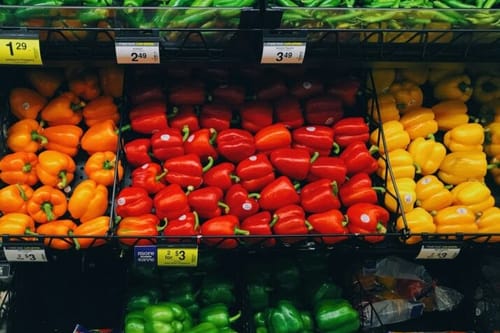

Americans are continuing to feel the effects of President Donald Trump’s complex and ever-shifting tariffs regime in the one place no one can avoid: the grocery store.
Many food items are produced domestically, but those that are not entirely made in the United States, were or are subject to Trump’s tariffs.
“A lot of produce is subject to tariffs — you know, essentially everything sort of a little bit more exotic that we don’t produce ourselves,” Tibor Besedes, an economics professor at the Georgia Institute of Technology, told the American Independent.
Coffee and bananas are perhaps the best example. Neither can be grown anywhere in the U.S. That didn’t stop the White House from slapping tariffs on those products with the initial “Liberation Day” tariffs in April 2025. Those tariffs targeted various countries and ranged from 10% to as high as 145% for some Chinese products.
The Trump administration ultimately exempted those products in November 2025, but that hasn’t eliminated price increases that took place after tariffs were implemented. Coffee was 16% more expensive in July 2026, the latest month for which data is available, than it was in April 2025, according to the U.S. Bureau of Labor Statistics. Bananas were 3% more expensive in that same timeframe, per BLS data.
Besedes said coffee in particular has experienced supply shocks due to droughts and other weather-related issues; tariffs didn’t help with the price, and the price spikes have remained sticky.
“Those supply shocks haven’t abated, and so the price of coffee, even once the tariffs removed, probably went down a little bit. It wasn’t really a noticeable impact,” Besedes said.
Olive oil is another example. While some domestic production exists in California, it only meets about 4% of demand, so more than 95% of olive oil sold in the United States is imported, according to Forbes. European Union countries like Spain and Italy that are producers of olive oil have been repeatedly hit with tariffs.
The Supreme Court struck down Trump’s original “Liberation Day” tariffs in February. Shortly after that ruling, he announced a new tariff of 10% on most countries other than Canada and Mexico under Section 122 of the Trade Act of 1974. Trump’s powers under that law only allowed him to put those new tariffs into place for up to 150 days, and they expired at the end of July.
Just ahead of the expiration of the Section 122 tariffs, the administration announced another round of tariffs of 10%-12.5% on products from 59 countries and the European Union under Section 301 of the Trade Act, which covers countries that engage in forced labor. A coalition of 25 U.S. states is now suing the Trump administration over these new tariffs, demanding they be canceled and refunded. The new tariffs, according to the lawsuit, affect more than 99% of imports to the U.S.
While the federal government does not track pricing for olive oil or other vegetable oils specifically, imported olive oil from the European Union would have been subject to tariffs every step of the way, despite the lack of large-scale U.S. production.
Besedes said these sorts of tariffs, on products that don’t even have American production to support, have little benefit.
“I think the nice way of putting it is it’s misguided,” he said. “The classic rationale for putting a tariff on is you want to protect domestic industry, but if you’re not making that good yourself, there’s not anything to protect, right? And so in that case, it becomes just a classic sales tax that just increases the price to the consumer without really generating anything.”
“If one of the rationales that was stated was to bring back manufacturing and increase domestic employment, well, you can’t do that with tariffs on goods we never produced to begin with,” he said.