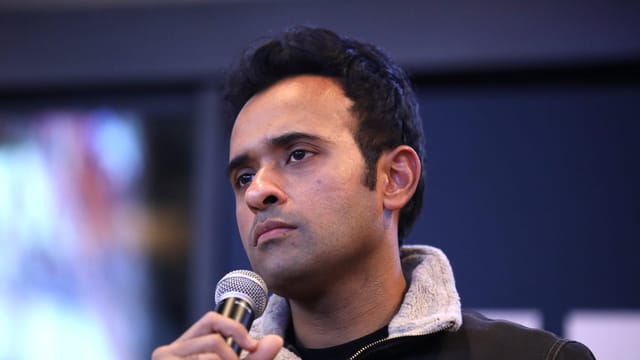
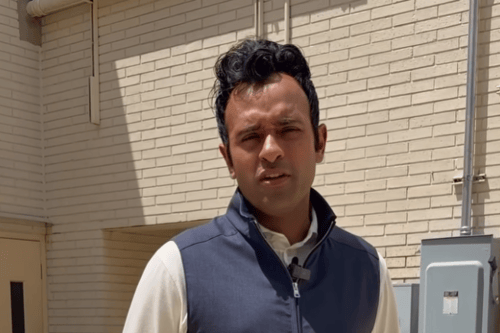

Vivek Ramaswamy has spent years invoking his immigrant parents while arguing that citizenship should carry obligations, that young Americans should demonstrate civic knowledge before voting and that the country should draw harder lines around who becomes an American.
One part of that family story creates a problem he has never seriously resolved. Ramaswamy’s father never became a U.S. citizen. He never took the naturalization civics test. Ramaswamy’s mother did not become a citizen until after Vivek was born. Yet while campaigning for president, Ramaswamy explicitly told voters that young Americans should have to pass the same test that an immigrant “like my parents” had to pass before becoming a citizen.
When NBC News correspondent Dasha Burns later asked Ramaswamy whether his father had actually taken that test, the answer was no. Asked why his father had chosen not to become an American citizen, Ramaswamy gave a three-word explanation: “for familial reasons.”
That answer has followed him because it cuts directly into a standard Ramaswamy created himself. He did not merely advocate legal immigration. He used the naturalization test as evidence of civic readiness, tied his voting-age proposal to what he described as an “absence of national pride,” and repeatedly inserted his own parents into the argument. Then it emerged that only one of those parents had actually gone through the process he was holding up as a model.
The obvious question is what “familial reasons” actually means. There is an equally obvious place to start looking for the answer: India does not permit its citizens to simultaneously hold Indian citizenship and citizenship of another country.
The obvious issue behind “familial reasons”
Ramaswamy’s explanation is vague, but the legal backdrop is not. India’s Ministry of Home Affairs states that Indian law does not allow a person to hold Indian citizenship and foreign citizenship simultaneously. An Indian citizen who naturalizes as an American cannot simply remain an Indian citizen as well.
India created Overseas Citizenship of India status to preserve significant connections for former Indian citizens and people of Indian origin, but OCI is not dual citizenship. OCI cardholders receive benefits including a lifelong multiple-entry visa and certain economic and educational privileges, but they do not have Indian voting rights and cannot hold constitutional offices.
Ramaswamy has said his father chose to retain Indian citizenship. Put those facts together and the most obvious meaning of “familial reasons” is not difficult to understand: becoming an American citizen would have meant surrendering his Indian citizenship and replacing it with a more limited legal relationship to India.
That explanation does not make Ramaswamy’s political problem disappear. It makes the problem sharper.
If family connections, identity, legal ties to another country and the consequences of giving up another citizenship can reasonably outweigh naturalization for his father, then Ramaswamy’s own family demonstrates that the decision to become a U.S. citizen is not a clean measure of civic knowledge, patriotism or commitment to American life. Yet those are precisely the concepts Ramaswamy attached to the naturalization test when he proposed using it as a gatekeeper for young Americans’ voting rights.
The father does not undermine the test because he failed it. He never took it. He chose not to enter the process at all because citizenship carried consequences beyond memorizing the branches of government or identifying a constitutional right.
That distinction goes to the heart of Ramaswamy’s argument.
Ramaswamy said “like my parents.” Only his mother had taken the test.
The most damaging part of the record is not simply that Ramaswamy’s father remained an Indian citizen. It is how Ramaswamy described his own family while selling the citizenship test as public policy.
At the Iowa State Fair in 2023, Ramaswamy told Iowa Gov. Kim Reynolds that there was no reason every high school graduate should not have to pass “the same civics test that an immigrant, like my parents, had to pass in order to become a citizen of this country.”
But his parents had not both passed it.
His father had never taken it.
When Burns confronted him with that fact, Ramaswamy acknowledged it immediately. His mother had taken the test and naturalized after he was born, he said. His father had made a different choice.
That exchange matters because Ramaswamy had already converted his family’s experience into political evidence. “Like my parents” was not an incidental biographical aside. It was part of the justification for asking American citizens to meet a new civic threshold before voting.
Ramaswamy’s formal presidential proposal would have raised the voting age to 25 while allowing adults ages 18 through 24 to vote earlier if they completed at least six months of military or first-responder service or passed the civics test used in naturalization. Implementing it would have required a constitutional amendment because the 26th Amendment guarantees the vote to citizens 18 and older.
Ramaswamy did not present the test merely as an administrative requirement. He argued that his proposal would restore civic duty and national pride. That is what turns the discrepancy in his family story from trivia into a consistency problem.
His father was apparently capable of living for decades in the United States, building a career and raising American children while deciding that maintaining Indian citizenship mattered more than naturalizing. Ramaswamy accepts that choice as rooted in family considerations. At the same time, he wanted an American-born 18-year-old to use that same naturalization exam to prove sufficient civic readiness to vote.
Those two positions can coexist only if the test means something very different depending on who is being judged.
Millions of permanent residents make the same basic choice
The broader data makes that distinction even more important. Ramaswamy’s father is not an anomaly simply because he remained a permanent resident rather than becoming a citizen.
According to the federal Office of Homeland Security Statistics, the United States had an estimated 13 million lawful permanent residents as of Jan. 1, 2025, including about 8.5 million who were potentially eligible to naturalize. In other words, millions of people who had reached the point where citizenship could potentially be available to them had not become citizens.
Naturalization is also common. Federal statistics show that 818,570 people naturalized in fiscal year 2024, including approximately 49,700 people born in India. Census data has likewise found comparatively high naturalization rates among Asian-born immigrants.
Those numbers matter because they expose the weakness in treating the naturalization process as a proxy for civic virtue. Millions pursue citizenship. Millions of people who may be eligible do not. The dividing line can involve family, nationality law, personal circumstances, finances, language, age, future plans or the value someone places on retaining another citizenship.
Ramaswamy’s own explanation for his father concedes exactly that complexity: “familial reasons.”
He nevertheless selected the naturalization test as a mechanism for separating young American citizens who had sufficiently demonstrated civic responsibility from those who had not.
That is the consistency question his father puts squarely in front of him.
The consistency test is separate from whether Ramaswamy’s policies are good policy
There are two different debates here, and collapsing them would make the analysis weaker.
One is whether Ramaswamy’s voting-age proposal was defensible policy. Supporters could argue that citizenship should come with greater civic knowledge and that military service, first-responder work or passing a basic government test demonstrates investment in the country. Opponents could argue that the proposal would strip an existing constitutional right from adult citizens and condition voting on government-approved demonstrations of civic worth.
That policy argument does not have to be settled to evaluate Ramaswamy’s consistency.
The narrower test is whether Ramaswamy applies the meaning he assigned to naturalization consistently. He chose the citizenship test because he said America needed more civic duty and national pride. He invoked immigrants “like my parents” as the people who had already met that standard. Then he acknowledged that his father had not met it because his father had made a deliberate choice not to naturalize.
Ramaswamy could argue that his father does not vote in U.S. elections and therefore has no need to meet a voting qualification. That answers the legal mechanics. It does not answer the rationale Ramaswamy used to defend the qualification.
If passing the naturalization test demonstrates the civic knowledge and national commitment necessary for an 18-year-old American citizen to vote, what does deliberately declining naturalization say about an adult immigrant who has lived in the country for decades?
Ramaswamy’s treatment of his father supplies his own answer: apparently, very little. His father’s decision can be explained by family circumstances and competing national ties without being treated as evidence of deficient civic character.
Once that is accepted, the naturalization test stops functioning as the straightforward measure of civic commitment Ramaswamy presented to voters.
His mother complicates the story in a different way
Ramaswamy’s mother creates a second tension, but it is important to define it accurately.
Vivek Ramaswamy was born in Cincinnati in 1985. Neither parent was a U.S. citizen at the time. His mother later naturalized; his father did not. During the 2026 governor’s race, his campaign told The Toledo Blade that both parents were lawful permanent residents — green-card holders — when he was born.
That status matters. Ramaswamy has advocated denying birthright citizenship to children born in the United States to parents who entered the country illegally. His parents were not in that category. A proposal limited to children of undocumented parents therefore would not describe the circumstances of Ramaswamy’s own birth.
That is the actual distinction, and it should not be blurred.
But once the distinction is made, another fact remains: Ramaswamy himself became an American citizen before either parent had naturalized. His family therefore illustrates that citizenship at birth and parental naturalization are separate questions. His mother could wait until after her son’s birth to become an American; his father could decline U.S. citizenship altogether; their Cincinnati-born son was still an American from birth.
That makes Ramaswamy’s own biography relevant to his broader effort to redefine citizenship, even though his parents’ green-card status places him outside the specific group he has targeted.
TiffinOhio.net examined that distinction in July when U.S. Sen. Bernie Moreno introduced legislation restricting birthright citizenship. Moreno’s bill expressly preserved citizenship for children with a U.S.-citizen or lawful-permanent-resident parent — a line that would preserve citizenship under the circumstances Ramaswamy’s campaign says existed when he was born.
The relevant contradiction is therefore not the simplistic claim that Ramaswamy is trying to abolish the exact rule that made him a citizen. His own parents’ legal status makes that inaccurate.
The stronger contradiction is what his family history says about the political meaning he assigns to citizenship. Neither parent had naturalized when he became an American. One parent never would. Yet Ramaswamy later made naturalization, civic testing and parental immigration status central tools for deciding which rights other people should receive and when they should receive them.
Ramaswamy cannot use half of his parents’ story
The father question would carry far less political significance if Ramaswamy had not repeatedly introduced his parents into his own arguments.
He did. He used them to explain legal immigration. He used them while advocating the civics test. He described the test as something an immigrant “like my parents” had to pass. His family’s path became evidence supporting his view that newcomers should follow a legal, merit-based process and that Americans should take citizenship more seriously.
That makes the missing half of the story unavoidable.
His mother followed the naturalization path Ramaswamy celebrates, but only after he was born. His father did not follow it at all. And the most obvious explanation for the father’s choice points directly to a complexity Ramaswamy’s rhetoric tends to erase: citizenship can involve competing family obligations and competing national attachments that have nothing to do with whether someone knows the answers on a civics exam.
Ramaswamy knows that because it is his explanation for his father.
That is why “for familial reasons” is simultaneously understandable and politically devastating. The phrase gives his father a reason for declining citizenship that Ramaswamy plainly considers legitimate. But once Ramaswamy accepts that naturalization can turn on considerations unrelated to civic commitment, his decision to turn the naturalization test into a measure of civic fitness for American voters becomes much harder to defend on the terms he originally used.
Ramaswamy can argue for a higher voting age. He can argue for a citizenship test. He can argue for restricting birthright citizenship based on a parent’s immigration status. Each of those policies has its own legal and political debate.
What he cannot do coherently is keep presenting his parents as the clean proof of his theory while refusing to grapple with the part of their story that breaks the theory open.
Three words still leave the central question unanswered
The most revealing aspect of the NBC exchange is not simply that Ramaswamy’s father is an Indian citizen. It is how quickly Ramaswamy moved from a sweeping political claim about immigrants “like my parents” to a narrow personal explanation once the factual premise was tested.
His father had not taken the test.
“That’s a choice that he has made for familial reasons,” Ramaswamy said.
His mother had taken it, he added, after Vivek was born.
That clarification fixed the factual record. It did not fix the argument.
Ramaswamy had already told voters that the naturalization test could serve as a measure of civic readiness for American citizens under 25. His own father demonstrated why the decision to naturalize can have little to do with civic knowledge at all. His explanation for that decision points to family ties and a citizenship system in India that forced a real choice between nationalities. Federal data shows millions of other permanent residents who are potentially eligible to naturalize have likewise not done so.
The question is therefore not why V.G. Ramaswamy chose India’s citizenship over U.S. naturalization. The legal and family context makes that choice easier to understand.
The question is why Vivek Ramaswamy took a process that his own father declined for reasons unrelated to civic knowledge, turned its exam into a test of “national pride” for American-born voters, and then invoked “my parents” as proof that the standard made sense.
He has had nearly three years since the NBC interview to square those positions.
His answer is still three words.
“For familial reasons.”
Those words may explain his father. They do not explain Vivek Ramaswamy.