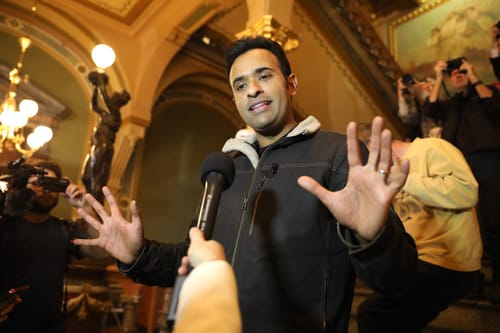
Vivek Ramaswamy wants Ohio to be able to invest public money in Bitcoin. The Republican nominee for governor personally holds the cryptocurrency, has praised a bill that would let the state buy digital assets, and, if elected, would appoint the trustees who help oversee roughly a quarter-trillion dollars in state pension funds.
To a former public-pension official, that combination carries an unsettling echo of Ohio’s past. The last time the state moved public money into an unconventional, hard-to-value asset steered by a politically connected insider, it produced Coingate — one of the worst investment scandals in Ohio history.
Chris Tobe, a financial analyst and former pension trustee in Kentucky, told the Center for Media and Democracy that an Ohio governor holds “great influence” over state funds and warned that Ramaswamy’s crypto ties through his firm Strive could “take the corruption to the next level” — a remark he tied to Ohio’s history of public-money scandals. The American Prospect, reporting in partnership with the group, drew the line directly to Coingate.
The conflict at the center of that warning is established. Ramaswamy holds Bitcoin and Ethereum and retains about a 10% stake in Strive, a firm that has committed most of its treasury to Bitcoin; in January 2025 he praised House Bill 18, then titled the Ohio Strategic Cryptocurrency Reserve Act, as a “thoughtful & powerful bill”; and the crypto industry has poured millions into his candidacy. TiffinOhio.net has detailed his personal holdings and the bill and the crypto money behind his campaign in earlier reporting.
What Coingate was
Beginning in the late 1990s, the Ohio Bureau of Workers’ Compensation expanded beyond traditional stocks and bonds into alternative investments. One was a $50 million fund to buy and sell rare coins and collectibles, run by Tom Noe, a Toledo coin dealer and prominent Republican fundraiser who chaired the Northwest Ohio Bush-Cheney campaign and had sharply increased his political giving before winning the work, according to Toledo Blade reporting and court records.
About $13.7 million ultimately went missing. Noe was convicted in 2006 of theft, money laundering, forgery and engaging in a pattern of corrupt activity, and sentenced to 18 years in prison. The broader scandal produced 19 convictions and a guilty plea from then-Gov. Bob Taft on an ethics charge for failing to disclose gifts. In the years after, the bureau moved to reduce its exposure to high-risk, exotic investments.
The lesson critics draw is structural: Ohio has been badly burned before when public funds flowed into a volatile asset class connected to political insiders. The crypto proposal, they argue, recreates that incentive structure. Ramaswamy and the company he co-founded hold Bitcoin, his largest outside campaign backers are crypto investors, and large institutional buying by a state tends to push the asset’s price up — meaning the people positioned to benefit overlap with the people funding his rise.
Where the comparison breaks down
The parallel has clear limits, and they matter. Ramaswamy has not been charged with or accused of any crime, and House Bill 18 is lawful proposed legislation. Coingate centered on outright theft by a manager who controlled the money directly; the concern raised about the crypto plan is conflict of interest and market exposure, not embezzlement. Bitcoin is also a publicly priced, openly traded asset, unlike the illiquid collectibles whose opacity helped conceal the Coingate losses for years. The comparison is to risk and incentive, not to conduct.
A bill that has stalled — and divided Republicans
House Bill 18 has not advanced. Sponsored by Rep. Steve Demetriou, R-Bainbridge Township, it remains in the House Technology and Innovation Committee, where it has drawn multiple hearings but no committee vote, according to the legislature’s official record. Committee amendments reported by the Ohio Capital Journal broadened the fund to allow more traditional investments such as bonds, added liability protection for the officials overseeing it, and dropped “cryptocurrency” from the fund’s name. As written, the measure is discretionary — it would permit, not require, the treasurer to invest — and limits eligible digital assets to those with a market capitalization of at least $750 billion, a threshold only Bitcoin meets today.
Not all Republicans are convinced. State Treasurer Robert Sprague, who would carry out any such investment, has said there are “issues that we’re trying to work through” on the bill and pointed to the volatility of digital assets. House Speaker Matt Huffman has been blunter, telling reporters, “I’m still scratching my head over cryptocurrency.” Demetriou has defended the idea as a way to “hedge against inflation” and keep Ohio competitive in digital finance.
Ramaswamy has said he wants to be the nation’s strongest pro-Bitcoin governor and has framed digital-asset investment as a way to diversify state holdings. Innovation Ohio, a progressive policy group that has tracked his holdings, counters that steering public and pension money toward Bitcoin would benefit Ramaswamy and his firm while shifting the risk onto Ohio’s teachers, public employees and retirees.
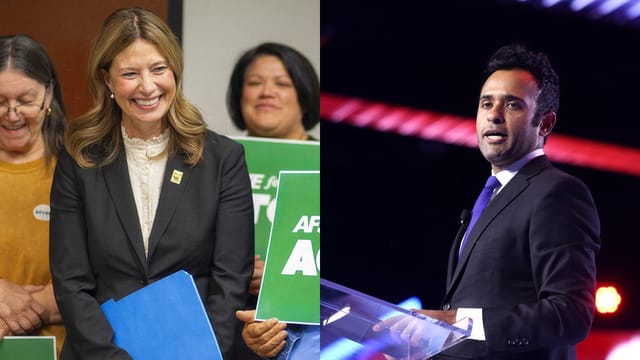
Ramaswamy faces Democratic nominee Amy Acton, a physician and former state health director, in the general election on Tuesday, November 3. House Bill 18 remains in committee.