In the seven weeks after Vivek Ramaswamy won Ohio’s Republican primary for governor, his campaign collected the legal maximum donation — $16,615 apiece — from a tight circle of people with one thing in common: they built the cryptocurrency company that has made the family of President Donald Trump more than a billion dollars.
The donors include Chase Herro and Zak Folkman, the two entrepreneurs who founded World Liberty Financial, the Trump family’s crypto venture; their spouses; and Zachary Witkoff, a World Liberty co-founder and the son of Steve Witkoff, Trump’s special envoy to the Middle East. The chief executive of Paxos, a major stablecoin company, gave the maximum the same day. Together, the cluster routed roughly $116,000 into Ramaswamy’s campaign account, nearly all of it on May 5 — primary day — or the morning after, according to the post-primary campaign-finance report his committee filed with the Ohio Secretary of State ahead of Friday’s deadline.
The donations land at a precise intersection of money and policy. Ramaswamy has said he wants to be “the strongest pro-Bitcoin governor in the nation,” has personally held Bitcoin and Ethereum, and co-founded a company that has bet roughly a billion dollars of its corporate treasury on Bitcoin. The crypto industry’s most politically connected operators — some of them under federal scrutiny in Washington — were writing him maximum checks as he locked up the nomination to run a state he has promised to turn into a haven for their industry.
Who gave, and when
Ohio caps contributions to a statewide candidate at $16,615.67 per election — the ceiling in effect from February 2025 through February 2027. The following donors each gave at or within a rounding cent of that maximum, according to the committee’s filing:
Chase Herro, of Boca Raton, Florida, listed his occupation as “Co Owner WLFI.” He gave $16,615 on May 5. His wife, Jennifer Herro, gave the same amount the same day. Herro is one of the two principal architects of World Liberty Financial, described by DL News and others as a self-styled “dirtbag of the internet” whose résumé includes a stint in prison on drug charges and a string of failed online ventures.
Zachary Folkman, listing an address in Dorado, Puerto Rico, and an employer of “Axiom Management Group,” gave $16,615 on May 5; Alexandria Folkman, at the same Dorado Beach address, gave the same amount the same day. Folkman is World Liberty’s other founding partner. Axiom Management Group is the Puerto Rico limited-liability company that Folkman and Herro co-own and through which, according to corporate disclosures reported by DL News and others, the two collect World Liberty’s founder share of revenue.
Zachary Witkoff, of Miami Beach, listing his employer as “SC Financial,” gave $16,615 the day after the primary, on May 6; Sophi Knight Witkoff gave the same amount the same day. Witkoff is a World Liberty co-founder and the son of Steve Witkoff, the real-estate investor President Trump named as his special envoy to the Middle East.
Charles Cascarilla, of Miami, listing his title as “CEO Paxos,” gave $16,615 on May 5. Paxos is one of the largest issuers of dollar-pegged stablecoins, a corner of the industry whose fortunes turn heavily on federal and state regulation.
Ohio’s primary was held Tuesday, May 5. Ramaswamy won the Republican nomination that night. The campaign’s filing shows 16 maximum-level contributions dated that day — the single biggest day for max-out gifts in the entire post-primary period — with the Witkoff donations following the next morning.
What World Liberty Financial is
World Liberty Financial is the decentralized-finance company at the center of the Trump family’s move into crypto. Founded in 2024 by Folkman, Herro, Zachary and Alex Witkoff, and Trump family members, it issues a stablecoin called USD1 and a governance token, WLFI. A Trump business entity owns a controlling stake and, under the company’s own disclosures, is entitled to 75 percent of net proceeds from token sales, with 12.5 percent each going to the Witkoffs and to Folkman and Herro.
By the company’s and outside reporting’s accounting, the venture has been extraordinarily lucrative for the families behind it. A Wall Street Journal analysis found World Liberty generated at least $1.4 billion for the Trump and Witkoff families since late 2024 — more cash in 16 months than Trump’s real-estate business produced in eight years — with the Witkoffs alone earning at least $200 million.
It has also drawn sustained scrutiny in Washington. Senators Elizabeth Warren and Jeff Merkley demanded the company preserve its communications with federal agencies over a $2 billion Emirati-linked transaction that used its stablecoin; the chairman of the Senate Permanent Subcommittee on Investigations opened a preliminary inquiry into potential conflicts of interest in the Trump crypto ventures; and the ranking member of the House select committee on China sought records about a reported deal giving an Abu Dhabi royal’s representatives a 49 percent stake. Herro and Folkman, separately, are the subject of a fraud lawsuit by an investor in their previous venture, Dough Finance, which collapsed after a 2024 hack; the case is set for trial in Miami federal court. The lawsuit is a civil matter, and Herro has not been found liable.
The policy the money sits next to
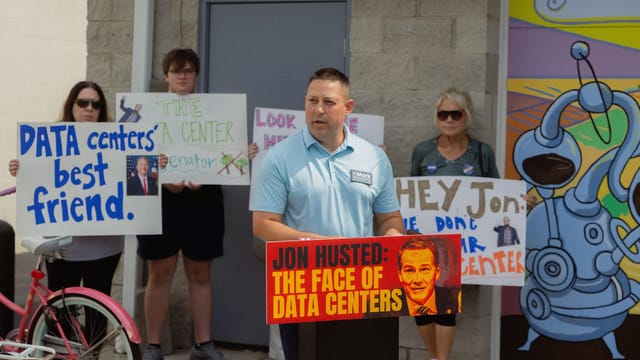
Ramaswamy has made crypto and the data centers that support it a centerpiece of his campaign, and as governor he would sit close to decisions that could move the price of the assets he and his donors hold.

The clearest mechanism is House Bill 18, the Ohio Strategic Cryptocurrency Reserve Act. The measure would let the state treasurer invest up to 10 percent of certain interim state funds — including the general revenue fund and the rainy-day fund — in digital assets, and it amends the statutes governing Ohio’s five public pension systems to address their investments in crypto-linked exchange-traded products. The bill restricts eligible assets to those with a market capitalization of at least $750 billion, a threshold that as a practical matter only Bitcoin meets. In January 2025, while still co-leading the federal Department of Government Efficiency, Ramaswamy publicly praised the bill on X as “a thoughtful & powerful bill.”
Ohio’s five pension systems hold roughly a quarter-trillion dollars in assets. The governor does not control them outright, but appoints an investment-expert trustee to each board — and a provision slipped into the 2025 state budget shifted the teachers’ pension board toward a majority of government appointees. A governor also shapes the broader policy climate and the posture of the treasurer, who would decide whether to buy crypto at all under HB 18. Chris Tobe, a financial analyst and former Kentucky pension trustee, told the Center for Media and Democracy that an Ohio governor holds “great influence” over state funds, and warned that Ramaswamy’s crypto ties could create conflicts at the intersection of public-pension oversight and personal financial interest.
Any large institutional buyer entering the Bitcoin market tends to push its price up. That is the through-line connecting the policy to the donors: the people funding Ramaswamy’s campaign are in the business of selling, holding, and building on the digital assets a Ramaswamy administration could steer Ohio toward.
Ramaswamy’s own stake
The candidate is not merely an ally of the crypto industry; he is an investor in it. His April financial disclosure with the Ohio Ethics Commission shows he personally holds Bitcoin and Ethereum and retains a roughly 10 percent stake in Strive, Inc., the firm he co-founded that has converted most of its corporate treasury into Bitcoin. As of May, TiffinOhio.net has reported, Strive held more than 15,000 Bitcoin worth roughly $1.1 billion — a bet that has cost the company hundreds of millions on paper, since it bought in at an average price well above recent levels. Every increase in Bitcoin’s price moves both the company and its co-founder closer to recovering those losses.
The crypto-founder donations are the latest entry in a pattern this newsroom and others have documented across Ramaswamy’s investment portfolio: holdings and backers concentrated in the very industries — crypto, data centers, the power needed to run them — that he has pledged to champion as governor and that the state he seeks to lead would regulate, subsidize, and, under HB 18, potentially invest in.
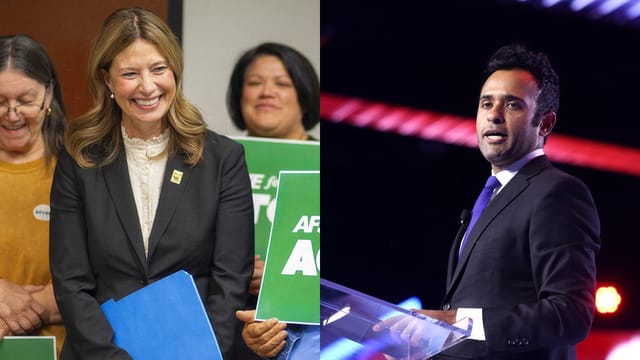
Ramaswamy won the May 5 Republican primary with more than 82 percent of the vote and faces Democrat Amy Acton in the general election on Tuesday, November 3.