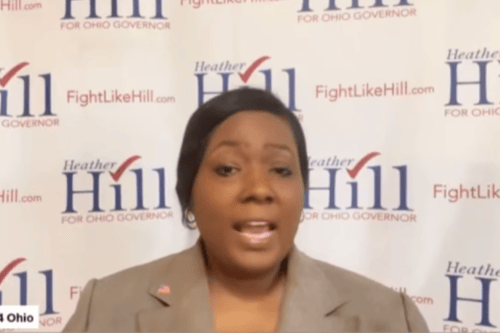

Heather Hill, the Republican gubernatorial candidate ruled ineligible for Tuesday’s primary ballot, alleged in a Wednesday Facebook post that the election was “stolen,” citing what she said were unverified reports that she received 23% to 25% of the vote as a withdrawn candidate.
“If this is true, HEATHER HILL won the Republican primary and they stole it from us, Ohio!!” Hill wrote in a post to her campaign page. “I have been told by several sources that I received 23% to 25% of the vote as a withdrawn candidate – does anyone have a way of verifying this?”
Hill provided no source for the figure and no county-level data to support it.
Her claim conflicts with both the official tabulation and Ohio law. Unofficial results from the Ohio Secretary of State’s office show Vivek Ramaswamy and his running mate, Senate President Rob McColley, with 673,902 votes (82.47%), and Casey Putsch and Kimberly Georgeton with 143,257 votes (17.53%), out of 817,159 total votes cast. Hill’s ticket is not included in the statewide tally.
The omission is by design. After Hill’s running mate, Stuart Moats, filed paperwork on April 22 to withdraw from the race, Secretary of State Frank LaRose declared Hill ineligible under a state statute that does not permit replacement of a lieutenant governor candidate within 70 days of a primary unless that candidate has died. LaRose’s office notified all 88 county boards of elections that votes cast for Hill and Moats would not be counted.
Where county boards have publicly tabulated the withdrawn ticket as a separate line item, the share has fallen far short of Hill’s claim. Ashtabula County’s unofficial results report the Hill/Moats ticket at 5.39% of votes cast in that county’s Republican gubernatorial contest.
Hill sued LaRose in an attempt to be reinstated, arguing that the law’s silence on withdrawal — as opposed to death — created a gap that should be resolved in her favor. On May 4, the Ohio Supreme Court unanimously dismissed her case. The court — six Republicans and one Democrat — sided with LaRose and Attorney General Dave Yost, with justices writing that allowing a late replacement could invite “last-minute political maneuvering” in future races.
“The decision that we made was based in exactly what the law says: You can’t be a candidate for governor if you don’t have a candidate for lieutenant governor,” LaRose told WDTN-TV after the ruling. “My job is to follow the law. We did that. The Ohio Supreme Court affirmed that, and so she’s not a candidate for governor and any votes for her won’t count.”
Hill and Moats had publicly feuded in the days leading up to his withdrawal. On April 18, Hill posted on Facebook that she would replace Moats over “irreconcilable differences” and later accused him of using a racial slur — an allegation Moats denied. Moats filed his withdrawal four days later.
Hill’s name and Moats’s name remained on the printed ballots Tuesday because counties had already produced and distributed them, but votes for the ticket were not tabulated in the statewide totals.
Ramaswamy will face Democrat Amy Acton, the state’s former health director, in the November general election.