
Svante Arrhenius, a Swedish physics professor, is best known for his development of the pH scale for acids and bases. He was also interested in heat-absorbing gases in the atmosphere.
He gave a lecture in early 1895 in which he “linked climatic change to long-term variations in atmospheric carbon dioxide levels, CO2.”
He deduced that carbon dioxide emissions from combustion of fossil fuels would have an impact on warming of the Earth’s surface.
Eunice Foote, another scientist of those times, discovered that a glass tube of CO2 absorbed infrared heat whereas a tube of oxygen did not.
This experiment helps us to understand that some gases, like methane, water vapor, carbon dioxide, and fluorinated gases, are indeed climate changing gases as they absorb infrared energy and heat up Earth’s atmosphere.
These early discoveries led to what is known as climate science.
This field of research is rooted in studies, experiments, and facts collected during the past 120 years.
Yet a majority of Republicans, including the current president, insist that climate change is a hoax, going as far as reversing the 2009 Endangerment Finding (the finding that greenhouse gas emissions, including carbon dioxide, are air pollutants under the Clean Air Act and they contribute to pollution that endangers public health or welfare).
Even ExxonMobil scientists concluded decades ago (late 1980s and early 1990s) that CO2 absorbs heat and increases atmospheric temperatures, but company spokesmen denied, challenged, and obscured this science.
Elected officials who deny climate change get an F in physics.
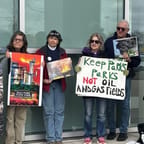
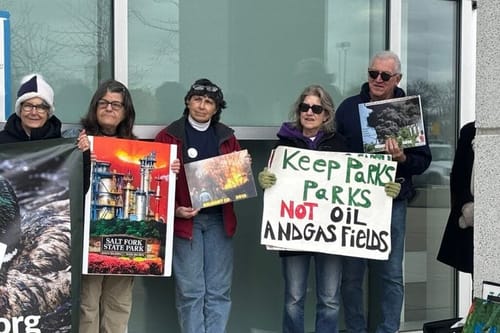
For over three years, Ohio citizens have tried in vain to stop the leasing of Ohio’s State parks and wildlife areas to out-of-state oil and gas companies.
If Ohioans had been able to submit public comments for H.B. 507, the bill that opened up the public lands to fracking, they would have said NO to fracking of our public lands. But H.B. 507 was passed during a lame duck session in December 2022, with no public input.
The Oil and Gas Land Management Commission (OGLMC), a five-membered commission appointed by Gov. Mike DeWine, are responsible for approving state lands for fracking.
The OGLMC is primarily made up of lawyers. No one on the OGLMC has any significant background in health or science. Science is not guiding the decisions to frack our parks; money is.
On March 31, 2026, the OGLMC decided to lease more than 8,000 acres at Egypt Valley Wildlife Area and more than 500 additional acres at Salt Fork State Park, during a meeting that lasted less than twenty minutes.
They ignored that facts that fracking results in: billions of gallons of water use, excessive noise, truck traffic, light pollution, radioactive brine wastes, habitat fragmentation, and air and water pollution. All will negatively impact our parks.
The OGLMC are supposedly guided by the statute ORC 155.33, which says the commission can “approve or disapprove” lease nominations on the basis of nine considerations, including economic benefit, environmental impact, geological impact, impact on visitors, and public comments and objections.
Considering the number of leases “rubber stamped” since this process began, it raises the question of what is really considered behind closed doors.
During a January meeting this year, Theresa White, head of the commission, said nothing legally requires the commission to explain its decisions.
The OGLMC and Gov. DeWine deserve an F in ecology and health.
Since the passage of S.B. 52, many Ohio counties are vetoing utility-scale renewable projects.
Unfortunately, they are being misled by anonymously funded groups spreading misinformation about rural renewable energy projects.
A recent report claimed these groups have ties to fossil fuel proponents. The much needed economic benefits renewable projects could bring to communities and farmers are lost.
Wind power occupies very little land and these leases help the farmers maintain a viable economic plan for their families. The blades extend vertically and the size at the base is almost negligible, which makes wind power compatible with other uses of the land at the same time.
I have stood beside wind turbines in Iowa and West Virginia and the noise is negligible.
According to the Department of Energy, wind power is one of the lowest-priced energy sources, with land-based utility-scale costs often under $30/MWh.
It stimulates rural economies through tax revenue, job creation (over 125,000 in the U.S. in manufacturing and maintenance), and stable, long-term land-lease payments to farmers and ranchers.
The Nottingham Solar project (a 120-megawatt (MW) solar energy farm located in Athens Township, Harrison County) will pay the county approximately $800,000 yearly in tax revenue.
Over the 35-year life span of the project, it is expected to generate over $29 million, replacing property that previously generated only about $400 a year.
These leases provide rural families revenue, stability and the ability to retain ownership for generations to come.
The Ohio Department of Health did their own study on solar farms and photovoltaics in 2022 which showed that there are “no public health burdens” from solar materials, heat, glare, end of life disposal, noise, electromagnetic fields and crystalline silicon.
According to the Great Plains Institute, in no area of the United States does the amount of both existing and potential solar in a county surpass 0.5% of the county’s total land.
Why are township trustees and county commissioners with little to no science education permitted to make decisions for entire counties by banning solar and wind power and infringing on private property rights?
Local officials get an F in renewable energy education.
Communities all around the state of Ohio are expressing their concerns over the exponential expansion of data centers into their communities.
Some of the concerns expressed by communities located close to data centers include: the noise, water usage, acres of land transformed into industrial centers, exposure to air pollution from power generation, high voltage transmission lines cutting through communities and farmlands, and probable increases in their utility bills due to the increases in power consumption.
Data centers require large quantities of water for cooling purposes.
A single data center can consume up to 5 million gallons of water per day and operate 24/7/365.
Yet, from “2017 to 2024, Ohio provided $2.5 billion in tax incentives to attract and expand data-center projects, according to estimates included in a September report produced for the Ohio Chamber of Commerce Research Foundation.”
Most data centers will only employ a handful of people.
Ohio elected officials get an F in cost/benefit analysis when it comes to data centers.
The same elected officials that do not believe in climate change want citizens to pay ethanol plants, power plants and other polluting industries $85/ton for carbon dioxide emissions they capture from their processes.
This procedure is called carbon capture and sequestration (CCS) and it is very energy and water intensive as well as expensive.
Ohio’s elected officials are considering H.B. 170, a bill that will push Ohio to take over the regulations of carbon capture wells (Class VI wells) from the United States EPA.
The wells will be used to inject dangerous CO2 gas at 1000 psi into the bedrock under our farms, forests, and communities.
Once again, the ODNR would be the sole authority in permitting and regulating these wells.
Currently the proposed sites for the wells are in areas where there is ongoing fracking and an abundance of old mines and orphan oil and gas wells. These activities can result in a fracturing of the caprock, resulting in possible pathways for CO2, a known asphyxiant, to escape.
To date, all CCS projects globally can capture only 0.17 percent of industry emissions. Carbon dioxide pipelines will be required to transport the pollutant across the state.
This will put our communities at risk, and the state legislators may use eminent domain to run pipelines across private lands.
Our local fire departments lack the training and equipment needed to address any accidents like the one which occurred in Satartia, Mississippi.
Carbon capture is a give-away for the fossil fuel industry.
Once again, Ohio’s elected officials get an F in environmental economics and health.
Last but not least we must give all elected officials, including federal, state, and local, a big red F for allowing the oil and gas industry to spread oilfield brine wastes across Ohio’s roads and inject it into our communities via Class II wells.
This waste is not only radioactive but contains other toxic components like carcinogenic hydrocarbon liquids and bromine salts.
Elected officials in Ohio are ignoring science and technology as they do the bidding of the fossil fuel industry. They are failing to keep the citizens of the state safe.
This story is republished from the Ohio Capital Journal under a Creative Commons license. View the original article.