
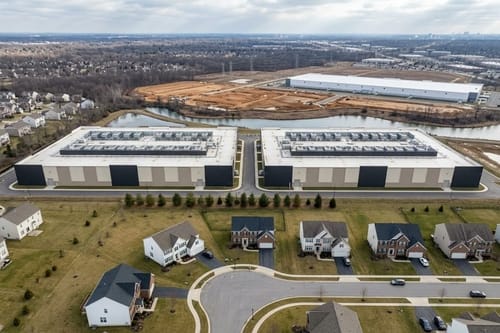

For the past couple weeks, the hottest discussion topic in Wyandot County has been data centers.
It shouldn’t come as a surprise, given that a company has expressed interest in potentially building one north of the city of Upper Sandusky.
Since news first broke about the potential data center, people have been quick to share their opinions on the internet. A post showing the initial headline and first few paragraphs of my first story about a data center being discussed at an Upper Sandusky planning commission meeting had nearly 500 comments and 266 shares just in the past 10 days.
People are riled up, but why? I thought it would be a good idea to share a bit about data centers in my column today.
Data centers are the fundamental physical infrastructure of the modern digital economy. They house the servers, networking equipment and storage systems that power the internet, cloud computing and artificial intelligence. Without them, everyday online services — from streaming media and e-commerce to banking and social media — would cease to function.
So yes, they’re important, and as things like generative AI become more and more prevalent in our society, data centers are increasingly necessary — but they come at a cost.
The first is the drain on resources.
Data centers require continuous, high-volume electricity. The surge in AI processing has caused some modern hyperscale facilities to consume as much power as a small city. Early data centers that tapped into the local electric grid consumed a massive amount of electricity and caused electric rates to spike drastically.
The initial proposal for a data center in Upper Sandusky would not connect to the electric grid, so it wouldn’t have that problem. Instead, a 150-megawatt natural gas power plant is being proposed to be built on 50 acres of land. The energy produced by the power plant would feed a data center on the remaining 100 acres of the property, with neighboring properties also being allowed to tap into the produced electricity.
Some data centers also utilize a significant amount of water to help cool their servers. A representative from Smartland Energy said the proposed data center in Upper Sandusky would use a maximum of 100,000 gallons of water per day, which would not require any additional expansion of the city’s current water treatment plant. Drought prone areas like the western united states would have bigger water issues.
Pollution is another concern. Natural gas power plants are over twice as efficient for the environment compared coal plants, but they still produce 800 to 900 pounds of carbon dioxide per megawatt hour of energy created. They also are not zero-emission, as a significant amount of nitrous oxide and unburned methane can be released into the environment.
The water used to cool data centers also can get polluted. As cooling systems for data centers operate, trace amounts of metals like zinc, lead and copper can leach from system components into the water. Data centers also use chemicals like biocides to prevent mold and algae and corrosion inhibitors to maintain their cooling systems, which can end up in wastewater.
Noise and light pollution also can be a problem. The constant hum of cooling systems, industrial HVAC units, and backup generators can generate disruptive noise levels, sometimes reaching up to 100 decibels. Furthermore, some large facilities require continuous 24/7 exterior lighting which creates localized light pollution that can disrupt the body’s circadian rhythms and disturb migration patters of wildlife.
Perhaps the most interesting thing to keep an eye on with data centers is the tax deals they have with the state of Ohio. To offset some of the above negative effects, data centers should provide a significant amount of tax resources to the communities they are built in as well as increased jobs and local infrastructure.
The proposed data center and power plant would bring approximately 100 permanent jobs and improved natural gas and internet infrastructure, but what about taxes?
Massive tax abatements for data centers are becoming a serious problem for the state of Ohio.
Republican lawmakers established a tax exemption in the early 2010s to lure technology companies to Ohio. At the time, they didn’t foresee the modern hyperscale and electric-intensive data centers that would be required to facilitate the artificial intelligence and cryptocurrency boom.
For facilities that cost $100 million or more to build, the exemption allows developers to waive up to 100% of Ohio’s 5.75% sales tax for up to 15 years. The proposed data center in Upper Sandusky was estimated to be a $600 million investment (with an additional $300 million for the power plant).
Last year alone, tax breaks for data centers cost the state of Ohio nearly $1.6 billion in potential tax revenue. Local tax revenue is affected as well. Approximately $166.8 million was lost from local sales tax revenue in 2024 in Ohio.
Some data centers come with benefits. A school district in Louisiana was able to give its teachers $50,000 bonuses with the windfall of sales tax that came with a massive data center in the school’s district.
So the question residents of Wyandot County need to ask themselves is simple. Does this proposed data center come with huge tax abatements? If so, how does the local community actually benefit in any way from its existence?