Southeastern Ohio has a serious problem underground. Now that problem is reaching the surface and threatening our drinking water.
As a petroleum geologist, my job is to understand the rock layers deep underground and how fluids move through them.
In Washington County, Ohio, toxic, radioactive waste from failed fracking waste disposal wells is surfacing where it should never be — near homes, farms, natural gas wells, streams, and schools. State leaders need to treat this like the emergency it is.
Fracking wastewater is not ordinary water. It carries heavy metals, toxic chemicals, and radioactive material — not things that people, animals, plants, or waterways should be exposed to.
Safely injecting it underground requires rock that is deep, porous, and sealed off from drinking water and the surface. This means a reservoir with room for the waste, a trap to keep it enclosed, and a seal that ensures it cannot escape.
In Washington County, those basic conditions do not appear to exist, and the consequences are now measurable.
The evidence indicates there are fractures allowing the injected wastewater to flow up into shallower layers and to the surface.
What’s unfolding in Southeastern Ohio is a manmade geological disaster, and it is getting worse.
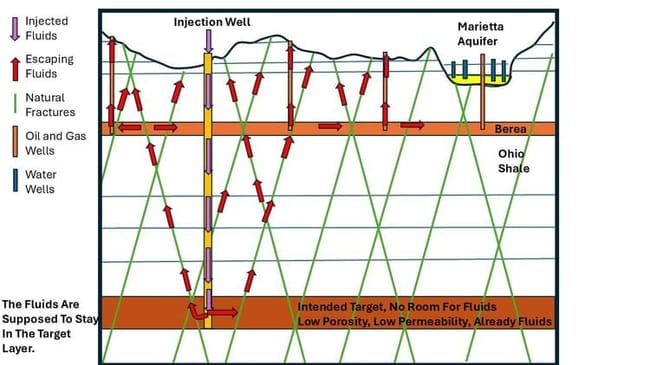
The evidence: rising pressure and invaded wells
The clearest warning sign is pressure. Fluids underground flow from high pressure towards low pressure.
Gas wells producing from a shallower layer, the Berea Sandstone, have seen pressures climb from roughly 50 pounds per square inch (psi) to more than 350 psi in under a year, to the point where they are in danger of blowing out.
That is a dangerous signal. Producing gas wells lose pressure over time as they deplete — they don’t gain it. The rising pressures mean something is pushing fluid into these layers.
Tests indicate that that something is fracking wastewater. It has infiltrated more than 100 gas wells in the area, some over five miles from the disposal wells themselves, destroying gas production and the livelihoods of the well operators — our neighbors and friends — who depend on it.
This toxic waste also threatens our drinking water sources.
Two things the state must do now:
First, take control of the pressure. The state needs to take over both the injection wells and the invaded gas wells and begin actively drawing fluids out.
Pulling pressure down creates a low-pressure sink that draws contaminated fluid back away from the surrounding aquifers and producing wells, stranding it before it can migrate further.
Once the spread is under control, the dozens of well operators and landowners who have already lost their livelihoods will need to be compensated.
Second, protect the drinking water. This is the piece that should alarm everyone, because it isn’t a local problem — it’s a regional one.
The migrating waste threatens the freshwater aquifers supplying drinking water to more than a dozen communities: Beverly, Lowell, Devola, Marietta, Belpre, Little Hocking, Coolville, and Cutler, Ohio, along with Williamstown, Boaz, Vienna, Parkersburg, Blennerhassett, and Lubeck, West Virginia.
That’s more than a hundred thousand people whose water supply stands to be impacted by this problem.
A first step, but not enough
Recently, the Ohio Department of Natural Resources finally acted, requesting voluntary suspension of operations at four injection wells.
After months — arguably years — of inaction in the face of residents begging for help on the issue, that acknowledgment matters.
But “voluntary” and “four wells” are not proportional to a problem spreading across a region.
There seems to be an inability to face the fact that there is a catastrophic escape of the waste — indicating a total failure of the fracking waste injection program.
The governor should declare a state of emergency in the impacted part of Washington County.
The cost of waiting
This will cost money. Waiting will cost far more.
If radioactive brine reaches the drinking-water aquifers, cleanup costs could jump from millions of dollars to hundreds of millions — or billions.
Families, farmers, small operators, and entire towns would pay for a failure they didn’t cause.
Communities across the region are united on this because the stakes are simple — clean water, safe homes, and honest government.
Ohioans should be able to trust that state agencies will act when the facts are in front of them.
Washington County is sounding the alarm. Columbus needs to listen — before our drinking water is tainted by toxic waste.
Stop the injection. Lower the pressure. Protect the aquifers. Do it now.
This story is republished from the Ohio Capital Journal under a Creative Commons license. View the original article.