
This month, Gov. Mike DeWine officially proclaimed June 1 to June 7 as Ohio State Parks Week, celebrating the natural beauty, outdoor recreational opportunities, and award-winning excellence of Ohio’s 76 state parks.
“These parks belong to all of us, and they offer every Ohioan a chance to connect with nature, spend meaningful time outdoors, and appreciate the landscapes that make our state special,” DeWine said.
These would be wonderful words — if Ohio wasn’t the only state to frack its own state parks, thanks to Ohio House Bill 507, which DeWine signed in 2023.
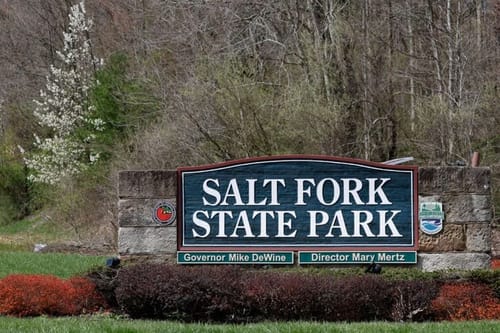
Since then, Ohio’s Oil and Gas Land Management Commission has approved fracking parts of Salt Fork State Park, as well as parts or all of six wildlife areas: Valley Run, Zepernick, Keen, Leesville, Jockey Hollow, and Egypt Valley. All told, almost 24,000 acres of Ohio state parks and wildlife areas have been approved or nominated for fracking.
Ohio Senate Bill 219, now sitting on DeWine’s desk, would make this problem much worse. DeWine vetoed many of these provisions when they were slipped into the state budget bill last year. Now they are back, and he faces a choice between signing the bill or vetoing these provisions again.
47 pages of favors for the oil and gas industry
Sponsored by Sen. Al Landis, R-Dover, with a long list of Republican co-sponsors, Ohio Senate Bill 219 is framed as an overhaul of the law governing oil and gas wells.
In reality, it is 47 pages of favors for the oil and gas industry — starting with speeding up fracking of Ohio’s parks and wildlife areas.
If passed, S.B. 219 would:
-
Give the Oil and Gas Land Management Commission only 90 days to decide on a nomination to frack public lands; currently they have 180 days.
-
Require the commission to put approved nominations out for bid immediately; currently they do that next calendar quarter.
-
Require the commission to select the “highest and best bid” within 60 days; currently there is no deadline.
-
Require the state agency that manages the land to execute a lease within 30 days; currently there is no time limit. These leases are more complex than a standard lease due to safeguards needed to protect our public lands
S.B. 219 favors oil and gas companies that frack public land even further, such as by:
-
Giving an oil and gas company the option to extend a lease to frack public land for five additional years instead of three years under existing law.
-
Giving an oil and gas company that has a lease to frack public lands up to 60 days to pay any advance royalties or bonuses, instead of 10 days under existing law.
-
Suspending royalty payments and time limits on leases to frack public land if the land has to go through a federal approval process. This applies to Zepernick and Leesville wildlife areas.
-
Suspending royalty payments and time limits on leases to frack public land if litigation of any kind is filed, until a final nonappealable court order has been issued. Conceivably a litigant would have to appeal all the way to the U.S. Supreme Court to obtain a final nonappealable order – yet the oil and gas company would be allowed to continue drilling operations with payments suspended throughout this process.
As if all that is not enough, Senate Bill 219 would also cut into the Ohio Department of Natural Resource’s ability to regulate fracking operations by:
-
Requiring ODNR to write its own administrative rules for oil and gas operations, instead of relying on the state Administrative Procedures Act, which could weaken regulations and make enforcement more difficult.
-
Curtailing ODNR’s authority to deny requests for expedited review of permit applications. If an oil and gas company requests expedited review, the department would have to grant that for up to 10 permits per year.
-
Prohibiting ODNR from charging an oil and gas company more than the costs specifically outlined in the lease. Potentially the state could not fine companies that do not follow the rules or make companies pay to clean up after a spill, leak, or accident.
-
Allowing an oil and gas company to negotiate “surface use” of state land — meaning they could frack IN our state parks and public lands. DeWine ordered “no surface use,” meaning frack wells must be located outside state parks and wildlife areas, but that could easily change under a new administration.
What will DeWine do?
Gov. DeWine is right: Ohio’s state parks and public lands belong to all of us. Ohio is one of only a handful of states that do not charge admission to their state parks – which were recently named the best state park system in the nation.
S.B. 219 puts all of this at risk. DeWine previously vetoed many of S.B. 219’s provisions from the budget bill — but at that time he had line-item veto authority because it was an appropriations bill.
Now his choices are different: he can sign the bill; he can do nothing and let it become law in 10 days; or he can veto the bill and send it back to the legislature, which could try to override.
As he makes this crucial decision, we hope DeWine takes into account the need to protect Ohio’s state parks and public lands, the wishes of its citizens, and our duty to preserve the environment for future generations.
This story is republished from the Ohio Capital Journal under a Creative Commons license. View the original article.