

When Ohio Gov. Mike DeWine held a press conference earlier this month to say the death penalty should be abolished in the state, the news bulletin landed with a thud.
With six months left before the 79-year-old walks off into the sunset, the impact of his belated call to action on capital punishment is negligible. He knows it.
Persuading right-wing supermajorities in the Ohio Statehouse to end the death penalty or, failing that, getting a statewide public vote on the issue anytime soon is a nonstarter.
Just months ago, Ohio House Speaker Matt Huffman declared he would vigorously oppose getting rid of state executions. Ohio Senate President Rob McColley said he could not imagine his Republican caucus repealing the death penalty law.
Ditto for the Republican candidate for governor McColley is running with, Vivek Ramaswamy.
Even the new attorney general DeWine appointed last month to finish former AG Dave Yost’s term swiftly rejected his benefactor’s argument. Andy Wilson did say he was grateful the governor had not commuted the sentences of the 113 inmates on death row in Ohio — which DeWine could still do to prevent their executions after he leaves office.
But surely the seasoned politician had no expectation that his party would be receptive to his latest directive when it broadly supports the death penalty as a tool for retributive justice.
So why tilt at windmills with a parting appeal to abolish it as a conscience-clearing move to no other end?
And why did DeWine wait until he was almost out the door to take a public stand against capital punishment? He had eight years to do something.
Yes, DeWine has maintained an unofficial moratorium on state executions throughout his governorship.
It has been clear from Day One of his administration that the longtime proponent of the death penalty changed his mind about it.
Given his evident aversion to state-sanctioned killing, it seems dubious that DeWine had a sudden epiphany about the subject.
Well-established data on the death penalty has consistently shown that it had no proven deterrent effect on violent crime.
Extensive research across criminology, economics and law also concluded as much in study after study.
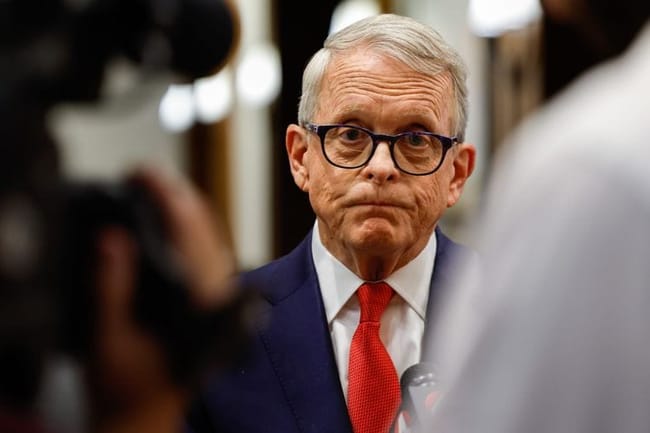
Yet DeWine wants us to believe that only now did he reach the same conclusion that reams of empirical studies have underscored for ages; there is no credible evidence that the death penalty reduces homicide rates.
The governor suggested the analytics of capital punishment as a non-deterrent prompted his demand to scrap the death penalty as a prudent, if not moral, course.
DeWine explained his change of heart on the death penalty as a “cumulative” process that had only recently crystallized into certain opposition. (You will forgive me if I don’t quite buy DeWine’s ‘Road to Damascus’ story about his overnight metamorphosis on the death penalty).
Ohioans may agree or disagree with the governor’s position, but few expect anything to come of it. GOP lawmakers have no intention of fulfilling the governor’s legacy bucket list.
DeWine’s eleventh-hour pitch for abolishing the death penalty was a performance for publicity. Another all-show-no-go passion project that draws attention but goes nowhere.
Daytonians are nodding. They gave up waiting for DeWine to “do something!” on commonsense gun control after the 2019 mass shooting in their city.
He gave impassioned assurances to spearhead sweeping gun reform measures through the General Assembly which went nowhere. But DeWine did sign every gun rights absolutist bill that loosened gun regulations drafted to protect the public.
Ohioans love their state parks and thought their governor did, too. He never missed an opportunity to grandstand on park enhancements.
But when it came to safeguarding Ohio’s treasured natural resources, DeWine sided with fossil fuel polluters itching to drill in state parks and wildlife preserves in 2023.
Ohio Senate Bill 219, which awaits his signature in 2026, is an even worse giveaway to outside gas producers that cuts corners to drill inside state parks, weakens environmental regulations, cuts local leverage and more.
DeWine could give another gift to the oil and gas industry at the expense of public lands even as he showcased Ohio’s 76 state parks as the best in the nation.
The governor also signaled that he’s done signing voting restrictions that Republican lawmakers regularly send to his desk.
But he could cave to Trumpian right-wingers on another deeply flawed mail-in voting bill (Ohio House Bill 472) rushed through the legislature at the last minute that would make it harder for many eligible voters, especially seniors, the disabled, students, and Ohioans in rural areas to vote by mail?
DeWine could veto egregious voter suppression or in-park drilling—or quietly sign off his acquiescence in a Friday night news dump to avoid publicity.
But he wanted to generate attention with his staged press conference about the death penalty. And the national media noticed.
A red state governor calling for an end to state executions doesn’t happen every day.
DeWine banked on glowing coverage that portrayed him (wrongly) as a moderate Republican.
His record of enacting extreme legislation — from abortion bans and fracking in state parks, to permitless conceal carry, relentless voting barriers, and the most corrupt energy bill ever — belies his constructed image as a measured Midwest conservative willing to go the mat for what he believes.
I guess the lame duck governor might yet surprise with a warranted veto or sustained commitment to repeal Ohio’s death penalty.
But if past is prologue, he won’t.
This story is republished from the Ohio Capital Journal under a Creative Commons license. View the original article.