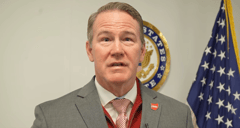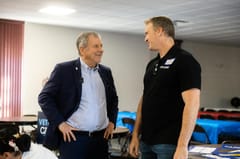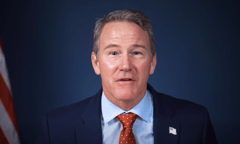
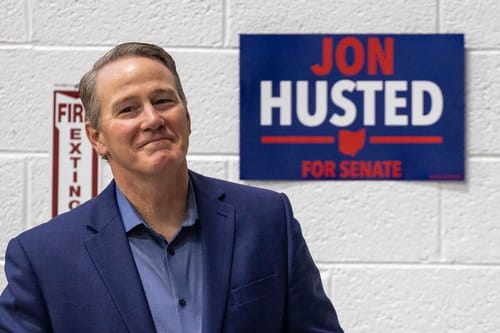
U.S. Sen. Jon Husted says he had no meaningful role in the legislation at the center of Ohio’s $60 million bribery scandal. The public record keeps disagreeing.
New reporting from The Associated Press adds previously unreported text messages and fresh dark money documentation to a growing evidentiary pile that undercuts Husted’s long-standing denials. The new disclosures land as the criminal case against two former FirstEnergy executives heads to a fall retrial in Akron — and as national Senate Republicans move to shield Husted’s seat with the largest single-state PAC commitment of the 2026 cycle.
A $79 million show of concern
Earlier this month, Senate Leadership Fund — the principal super PAC aligned with Senate Republican leadership — announced plans to spend $79 million supporting Husted in his expected November matchup against former U.S. Sen. Sherrod Brown, the Democratic frontrunner. The figure represents roughly a quarter of SLF’s $342 million initial commitment across eight contested Senate races, and exceeds the PAC’s planned spending in Michigan ($45 million), Georgia ($44 million) and New Hampshire ($17 million).
Husted was appointed to the seat on Jan. 17, 2025, by Gov. Mike DeWine to fill the vacancy created by JD Vance’s resignation ahead of his inauguration as vice president. He faces no Republican primary challenger on May 5.
The Sept. 28 calendar collision
On April 1, Summit County Common Pleas Judge Susan Baker Ross formally declared a mistrial in the state bribery case against former FirstEnergy CEO Chuck Jones and former senior vice president Michael Dowling after jurors deadlocked following nine days of deliberation. According to the AP, Baker Ross has scheduled the retrial to begin Sept. 28 — roughly a week before early in-person voting begins in Ohio’s Nov. 3 general election.
Husted testified remotely as a defense witness during the first trial in March. The AP reports he could be called to testify again in the retrial.
“None”
In November 2021, Jones and Dowling — by then fired from FirstEnergy — identified Husted in a shareholder lawsuit as an individual “likely to have discoverable information” about the scheme. Asked at the time to describe his role in the passage of House Bill 6, the nuclear bailout at the heart of the scandal, Husted answered: “None.”
He has reiterated that position repeatedly as additional evidence has emerged.
In 2024, asked about text messages between FirstEnergy executives describing his involvement, Husted told reporters: “I don’t know what you’re talking about. We weren’t involved. Texts to other people — texts to other people shared amongst themselves — have nothing to do with me. And I wasn’t involved in that conversation.”
In a January 2026 interview with NBC4 Columbus, Husted said: “My role was very clear. I wanted the nuclear power plants to remain operational.” He added that the legislation was “about keeping those plants open and keeping the lights on for millions of Ohioans.”
What the record shows
Public records and evidence produced in multiple criminal proceedings describe a pattern of contact between Husted and the central figures in the bribery scheme that does not align with a “none” description of his role.
Husted’s official calendars, obtained by the Ohio Capital Journal through a public records request and reviewed by the AP, document multiple meetings and phone calls with former FirstEnergy CEO Chuck Jones, former Ohio House Speaker Larry Householder, and former Public Utilities Commission Chair Sam Randazzo during the period in which HB 6 was drafted, passed, signed into law, and defended against a referendum effort. Federal prosecutors have described Jones, Householder and Randazzo as the three figures at the center of the scheme.
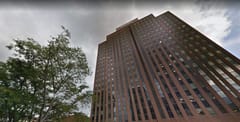
Evidence introduced in the state criminal case established that on Dec. 18, 2018, Husted and then-Gov.-elect DeWine dined at the Athletic Club of Columbus with Jones and Dowling. Prosecutors allege Jones and Dowling drove from that dinner to Randazzo’s home, where the central $4.3 million bribery arrangement was negotiated. On Feb. 4, 2019, DeWine appointed Randazzo to chair the Public Utilities Commission of Ohio.
A Jones text entered into evidence described DeWine and Husted as having been “forced to perform battlefield triage” to salvage Randazzo’s appointment when a 198-page dossier warning of his FirstEnergy ties threatened to derail it.
A separate Jones text identified “State Official 2” — later confirmed to be Husted — as among those “fighting to the end” for a more generous bailout.
The $600 million reaction
Among the details the AP surfaced as not previously reported is Householder’s reaction inside a June 2019 exchange in which Jones sent Dowling screenshots of a conversation with Householder about extending the nuclear subsidies from six years to 10. The bill charged Ohio ratepayers $150 million a year in nuclear surcharges.
“Ugh, that adds $600M,” Householder wrote about the cost of the extension Jones said Husted was seeking.
“Husted called me 2 nights ago and was supposed to get it in the Senate version,” Jones replied.
“He’s not a legislator,” Householder responded, referring to Husted, who was lieutenant governor at the time.
“I know but he said Senate leaders would listen,” Jones wrote. “He didn’t deliver.”
Dark money, and what FirstEnergy called it
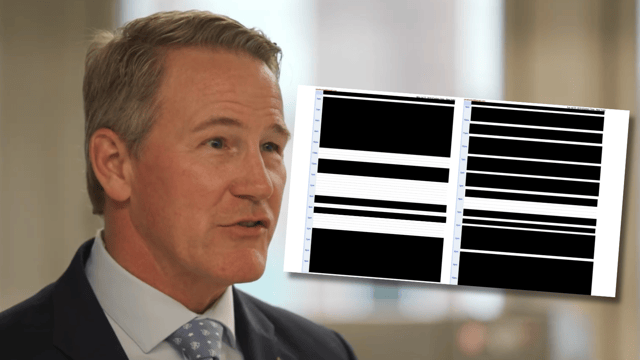
The AP also disclosed DOJ interview notes from longtime Ohio lobbyist Neil Clark — a co-defendant with Householder in the original federal racketeering case who died by suicide in 2021 — in which Clark told federal agents that FirstEnergy and its subsidiary FirstEnergy Solutions funneled dark money to nonprofits that benefited both Husted and DeWine. Clark specifically identified Freedom Frontier as one of those groups.
Freedom Frontier is the same organization that received a $1 million contribution from FirstEnergy in 2017, according to documents obtained in public records requests. FirstEnergy’s internal records designated the contribution’s purpose as “Husted campaign.” Husted was running in the Republican primary for governor at the time.
Clark separately referred to Husted as FirstEnergy’s “golden boy” in materials previously reviewed by reporters covering the case.
Campaign finance rules generally prohibit candidate campaigns from coordinating with the kind of nonprofit groups, including Freedom Frontier, that can raise and spend unlimited money without disclosing donors. A Husted campaign spokesperson told reporters in 2024 that “the Husted campaign never received this donation and is not affiliated with any of these groups.”
The Naples fundraiser
Internal FirstEnergy communications from 2017 and 2018, which the AP reports are evidence in a U.S. Securities and Exchange Commission investigation, include discussions among Jones, Dowling and others about attending Husted events as far back as 2016. The communications also reflect Dowling’s concerns about dark money contributions becoming public, and discussions of contributing under alternate names.
In July 2018, as Jones and Dowling planned a DeWine-Husted fundraiser in Naples, Florida, the two discussed contributing under one name while covering event costs under another — so there would be, in the words of the communication, “no cost billed to (the) campaign.”
Prior coverage and what’s next
TiffinOhio.net has previously reported on Husted’s April 2019 scheduled phone call with Randazzo two days before HB 6 was introduced, and on the $663 annual increase in average Ohio residential electric bills since HB 6 took effect in 2019.
Husted has never been charged with or accused of any crime in connection with the scandal.
Asked by the AP to respond to the new reporting, Husted declined further comment through his spokesperson, Josh Eck, who said the senator “has commented extensively with the media and given testimony under oath and doesn’t have anything additional to add.”
The retrial of Jones and Dowling is scheduled to begin Sept. 28 in Akron.