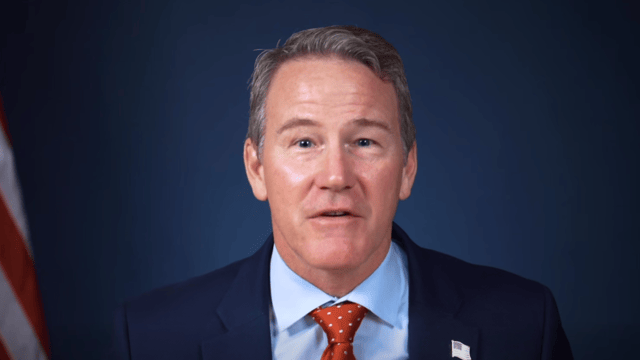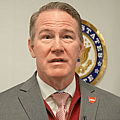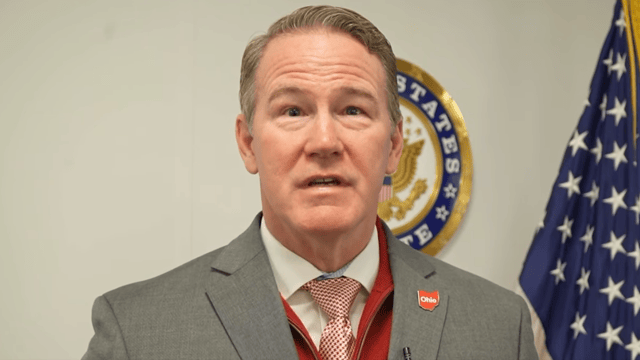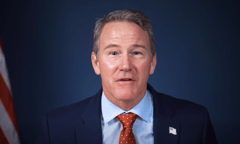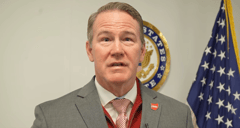
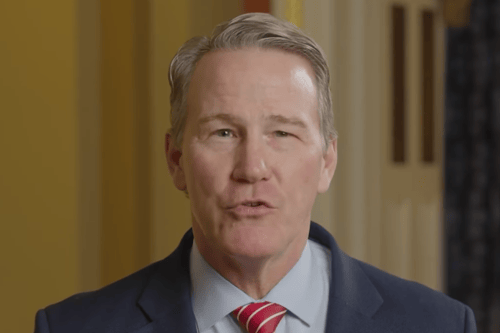
U.S. Sen. Jon Husted, who is running to keep his Senate seat in Ohio’s 2026 special election, allegedly played a central role in passing a utility bailout law that sits at the heart of the state’s largest-ever corruption scandal — and that has contributed to Ohio households paying $663 more per year for electricity in the years since.
The financial toll is direct and documented. When House Bill 6 took effect in October 2019, the Public Utilities Commission of Ohio recorded the average monthly residential electric bill at $89.19 — $1,070.28 annually. By January 2026, that figure had climbed to $144.47 per month, or $1,733.64 per year. The difference: $55.28 per month, $663.36 per year.
What makes those numbers politically significant isn’t simply that rates went up. It’s who was involved in making the law happen — and what that company was doing for Husted at the same time.
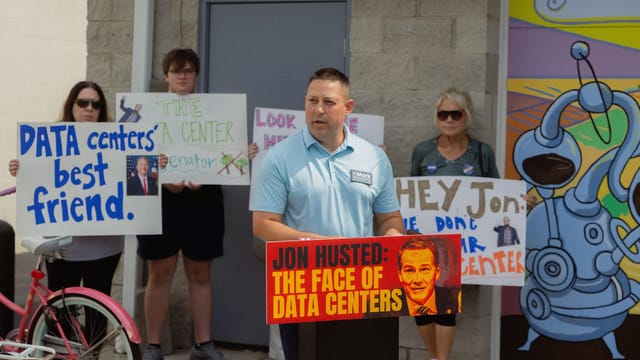
Husted allegedly led the charge — for a company paying him
Text messages and internal emails released in 2024 show that Husted allegedly led the charge with now-indicted FirstEnergy executives to pass the bill, according to the Ohio Capital Journal. A FirstEnergy email stated that Gov. Mike DeWine “left the details of H.B. 6 to others — John [sic] Husted and Danny,” referring to Husted and Dan McCarthy, DeWine’s legislative director and a former FirstEnergy lobbyist.
On July 1, 2019 — while the bill was moving through the legislature — FirstEnergy Senior Vice President Michael Dowling texted CEO Chuck Jones: “Just had long convo with JHusted just now. All is well. JH is working on the 10 years. He’s afraid it’s going to end up being 8.” Jones later texted a subsidiary executive that Husted and others were “fighting to the end” on the bill’s nuclear subsidy provisions. Dowling separately described Husted as “highly engaged.”
A FirstEnergy lobbyist involved in the corruption case called Husted the company’s “golden boy.” There’s a documented reason for that: according to Cleveland.com reporting, FirstEnergy funneled $1 million in dark money to a nonprofit backing Husted’s 2017 campaign — part of the same corrupt scheme that led to federal indictments.
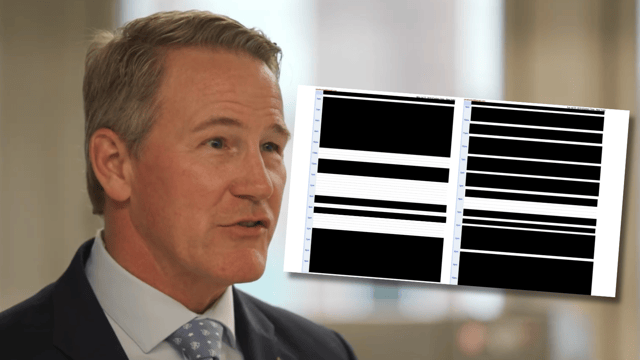
Official calendars reviewed by TiffinOhio.net revealed at least eight previously unreported meetings between Husted and key HB 6 figures, including a scheduled phone call with Sam Randazzo — the utility attorney later indicted on federal charges of accepting a $4.3 million bribe from FirstEnergy — two days before the bill was introduced in April 2019. The meetings span the full arc of the bill’s passage: from its introduction through its signing and into the period when FirstEnergy was working to defeat a referendum that would have repealed it.
Court filings have identified Husted as “State Official 2” in connection with the scandal. A January 2026 court filing reported by Signal Ohio identified him as a potential defense witness in the upcoming criminal trial of Jones, who faces felony charges including bribery, money laundering, and federal racketeering. Husted has not been charged with any crime.
Despite the documented record, Husted has repeatedly denied meaningful involvement. When asked in 2022 what role he played in the legislative process, he replied, “none.” When confronted in 2024 with the FirstEnergy text messages, he told reporters, “I don’t know what you’re talking about, we weren’t involved.” In a January 2026 interview with NBC 4 Columbus, he said his role “was very clear” and that he was “happy to talk about what my role was at any time.”
The corruption case behind HB 6
House Bill 6 passed in 2019 and authorized a $1 billion ratepayer-funded bailout of the state’s nuclear power industry, with monthly surcharges paid by every Ohio residential electricity customer. Federal authorities later revealed it was secured through a nearly $61 million bribery scheme — described by U.S. Attorney David DeVillers as “the largest bribery money laundering scheme ever perpetrated against the people of the state of Ohio.”
Catherine Turcer, executive director of the government watchdog group Common Cause, called it “the largest pay-to-play, bribery, corruption, money-laundering scheme ever.” Former FirstEnergy executives who were fired in October 2020 subsequently named Husted and dozens of other officials as having information relevant to federal shareholder litigation. The Cincinnati Enquirer reported that the case had “bloomed into the biggest public corruption case in Ohio history.”
$683 million extracted from Ohio ratepayers
HB 6 required Ohio residential utility customers to pay a monthly surcharge of between $1.30 and $1.50 — depending on whether their utility is owned by AEP, AES Ohio, Duke Energy, or FirstEnergy — to subsidize the Ohio Valley Electric Corporation’s aging coal and natural gas plants, according to Canary Media.
From 2020 through August 14, 2025, Ohioans paid $527,808,043 in OVEC subsidies specifically under HB 6’s Legacy Generation Rider. When OVEC subsidies collected under prior PUCO authority going back to 2017 are included, the total paid by Ohio ratepayers reaches $683,261,008, according to a memorandum prepared by energy consulting firm RunnerStone for the Ohio Manufacturers Association. The single largest HB 6-era collection came in 2024, when ratepayers paid more than $191 million.
| Year | OVEC Subsidies Collected | Authority |
|---|---|---|
| 2017 | $42,868,858 | PUCO |
| 2018 | $27,447,386 | PUCO |
| 2019 | $85,136,721 | PUCO |
| 2020 | $89,571,982 | HB 6 |
| 2021 | $143,992,009 | HB 6 |
| 2022 | $28,240,270 | HB 6 |
| 2023 | -$20,044,595 | HB 6 |
| 2024 | $191,043,642 | HB 6 |
| 2025 (through Aug. 14)* | $95,004,735 | HB 6 |
| Total paid to date | $683,261,008 | |
| Aug. 15–Dec. 31, 2025 | $44,284,435 | Avoided via HB 15 |
| 2026–2030 | $369,292,031 | Avoided via HB 15 |
| Total avoided through 2030 | $413,576,466 |
*The Legacy Generation Rider was eliminated effective August 14, 2025 under House Bill 15. Source: RunnerStone memorandum prepared for the Ohio Manufacturers Association, Aug. 4, 2025
The Ohio legislature ultimately passed House Bill 15 to end the Legacy Generation Rider effective August 14, 2025 — a move the RunnerStone analysis estimates will save Ohio ratepayers an additional $414 million through 2030. But the $683 million already extracted from Ohio electricity customers to prop up uncompetitive coal plants cannot be undone.
Electric bills up $663 a year — and still climbing
According to PUCO’s January 2026 Unit Costs data, the average Ohio household now pays $144.47 per month for electricity — $1,733.64 annually, based on the commission’s standard estimate of 750 kilowatt hours of monthly residential usage. When HB 6 took effect in October 2019, that same household paid $89.19 per month, or $1,070.28 per year.
The increase — $55.28 per month, $663.36 per year — reflects the full period since the law took effect. Not every dollar of that increase is attributable to HB 6 alone; broader factors including fuel costs, infrastructure investment, and general utility rate adjustments have also driven electricity prices higher nationally during this period. The HB 6-specific OVEC surcharge accounts for $1.30 to $1.50 of the monthly bill. What the full rate trajectory does reflect, however, is the cost environment created in part by a law that Husted’s own party has since acknowledged was born of fraud — and that Husted allegedly drove forward for a company that was paying to advance his career.
A live campaign issue
Husted was appointed to the U.S. Senate in January 2025 by Gov. DeWine to fill the seat vacated by Vice President JD Vance, abandoning what had been a widely anticipated run for governor. He formally filed for the 2026 special election in December 2025 and faces a likely general election matchup against former U.S. Sen. Sherrod Brown, who lost his seat in 2024 and has announced he will seek to return. The race is expected to be among the most expensive Senate contests in the country.
According to reporting by U.S. News & World Report, Democrats have already signaled that Husted’s unresolved ties to the HB 6 scandal will be a central campaign issue.
His connections to the scandal’s broader financial network have continued to draw scrutiny. As TiffinOhio.net previously reported, Husted accepted $116,892 in contributions from Les Wexner across 21 separate donations spanning 2001 to 2025 — including a $3,500 contribution on July 3, 2025. On September 10, 2025, Husted voted to block the public release of Jeffrey Epstein files, just two months after that contribution. On February 10, 2026, the DOJ released a previously redacted FBI document naming Wexner as an Epstein co-conspirator. Eight days later, Wexner confirmed the donations under oath during a congressional deposition, acknowledging that approximately $117,000 in contributions to Husted was plausible: “It is.” Wexner has not been charged with a crime; his legal team has stated that federal prosecutors told his counsel in 2019 that he was neither a co-conspirator nor a target.
Husted’s campaign has said it will donate Wexner’s contributions to charity but has not specified the amount or which organizations would receive the funds. Husted’s office did not respond to a request for comment by the time of publication.