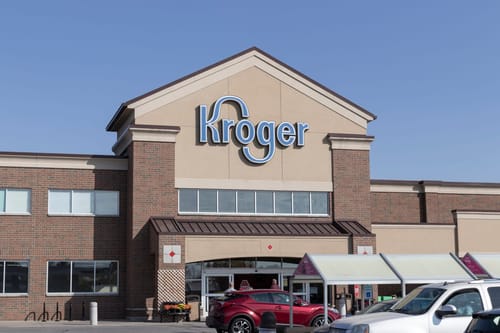

An analysis of government inspections and a survey of customers find that incorrect prices are frequent in the stores of Ohio-based grocery chain Kroger. It said they’re usually in the store’s favor.
Cincinnati-based Kroger is the third-largest grocery chain by sales in the United States. It has been accused of using its size to avoid competition and to use other tactics to drive up prices.
For example, in a 2024 trial to block a proposed merger with Albertson’s, the Federal Trade Commission presented testimony from a Kroger executive who said the company hiked the price of milk and eggs above the rate of inflation.
The case also involved testimony from a former employee who accused Kroger of jacking up prices in neighborhoods where it didn’t have much competition.
Last May, the Center for Responsible Food Business, a nonprofit that advocates ethical practices in the food industry, launched a campaign, Kroger’s Pricing Problem.
As part of it, the group compiled reports from government inspections of Kroger stores to see if prices on the shelves were what customers were charged at the register.
It “obtained government records covering 389 price inspections at 101 Kroger stores across nine Ohio jurisdictions between 2022 and mid-2026.”
Of those, 15% failed, and 474 were overcharges compared to 170 undercharges — nearly a three-to-one ratio. In Butler County, half of the stores failed, the report said.
It added that minorities and seniors seemed particularly likely to be victims of incorrect pricing.
“One Kroger on Siebenthaler Avenue in Dayton, for example, failed three separate government price inspections, and complaints in the same records allege ‘senior abuse’ over the storeʼs pricing,” the report said.
“According to U.S. Census Bureau survey data, the storeʼs ZIP code is 77% Black, and one in four of its residents lives below the poverty line.”
Asked about the report, a Kroger spokesperson said the company places a priority on getting prices right.
“Our customers know that Kroger associates work hard every day to provide great service and value,” the spokesperson said in an email. “Across millions of transactions in Ohio, we take pricing accuracy seriously and work quickly to correct any issue when it is brought to our attention.”
The spokesperson added that the Center for Responsible Food Business cherry picked data and customer comments.
“This misleading report combines selective data with unverified claims and does not accurately reflect the experience of customers in our stores every day,” the email said.
Some who identified themselves as Kroger workers told the Center for Responsible Food Business that understaffing made accurate pricing nearly impossible.
“I work at Kroger and the problem with items ringing up wrong is because they cut hours they donʼt have enough people doing tags, meaning when a new ad comes out they have to take down the old ones and they (the company) only gives you 1 maybe 2 people to do the WHOLE STORE in 8 hrs,” a person identifying as a Kroger worker in Texas wrote as part of the group’s survey.
As part of its campaign, the group solicited complaints through TV ads and an online porthole.
“We’re tired of getting ripped off at the register,” the appeal said. “Aren’t you? Tell us your story.”
Many of the responses were from people who said that when they double-checked, they weren’t charged the price that was advertised.
“Among the most common grievances in the submission dataset is that the price on the shelf, in the weekly ad, or on a digital coupon is not the price charged at the register,” the report said. “Five hundred fifty seven testimonials (29%) describe this issue.”
It added, “These counts should be read as a floor rather than an estimate of prevalence. A shopper who does not compare the shelf price to the receipt has no way of knowing an overcharge occurred, and most shoppers do not make that comparison on a routine basis.”
This story is republished from the Ohio Capital Journal under a Creative Commons license. View the original article.