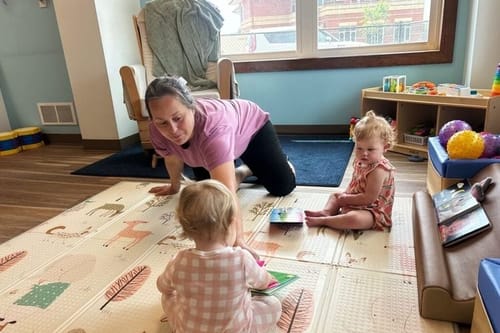

Affordability is on the minds of many Ohioans this election season, whether it’s groceries, utility bills, housing, or farming costs. Childcare affordability and the high cost of living for families are concerns across the political spectrum in Ohio, new research shows.
Childcare is among the issues Ohioans have seen as a struggle for years when it comes to access and cost, and something the legislature has been attempting to navigate as well.
“When families are talking about the cost of living, we can’t separate childcare from groceries, housing, transportation, utilities, even gas,” said Tami Lunan, director of the childcare-focused Caring Economy Organizing Project within the Ohio Organizing Collaborative.
“When you start to layer in all those costs, you create a harsher reality for parents who are trying to stay in the workforce.”
Researchers and advocates in Ohio and the U.S. have been watching the childcare industry as it’s developed, and the cracks in the system brought on by funding gaps and workforce shortages. They recognize the immense need for a childcare system that works for families and for the businesses themselves.
Ohio-specific polling commissioned by advocacy group Groundwork Ohio and the national early childhood advocacy group First Five Years Fund, showed “significant agreement across party lines about the problem.”
The polling, released at the end of August, showed 64% of Ohio voters saw lowering the cost of living as one of the most important issues facing the state.
“Ohio’s next governor and legislature cannot control every cost putting pressure on working families,” the polling report stated. “Childcare is different. State policy can make a difference in what families pay, whether they can find care and whether parents can work.”
Ohio voters of all parties agree that quality childcare “is a crisis or a major problem,” with 76% of all voters agreeing to that statement.
Of those polled, 62% of Republicans found the childcare crisis to be a major problem, along with 78% of independents, and 94% of Democrats.
Of the voters who were parents paying for childcare, half of them said childcare costs “prevent them from saving money or getting ahead financially,” according to the polling, with more than a third of parents polled cutting back on other “household essentials” to afford childcare.
One in five Ohioans said they are delaying having children because of the cost.
The economic strength of a sturdy childcare industry was appealing to most voters polled, with 74% of voters agreeing that “increasing access to high-quality childcare will strengthen Ohio’s economy and workforce.”
“Ohio is working hard to attract employers, grow its economy, and fill available jobs,” the researchers stated. “Workers need somewhere safe and reliable for their children to go while they work. Childcare has to be part of that economic strategy.”
First Five Years Fund also recently released national polling taken in July of this year, which showed 82% of voters listed childcare as part of the “affordability crisis,” with nearly 40% saying their ability to work is impacted by decisions related to childcare.
The polling was consistent with previous surveys done by the group in January, when 80% of voters said the “inability of working parents to find affordable childcare is a ‘state of crisis’ or a ‘major problem.’”
The issue spanned partisan groups nationwide similar to the Ohio numbers, with 94% of Democrats agreeing childcare was in crisis, along with 81% of independent voters, and 65% who identified as Republicans.
The fund found a 29% increase in childcare prices between 2020 and 2024 “due to increased operational costs and competing wages from other service sectors,” an increase of more than 7% over the the prices of other goods and services.
The average cost of childcare in the U.S. is $13,000 per year, or more than $1,000 a month, according to the First Five Years Fund research.
Ohio’s average was similar to the national average, according to the research, at $13,780 per year.
Eligibility for the Publicly Funded Child Care program in Ohio currently goes up to 145% of the federal poverty line, a level the state has maintained in the state operating budget despite calls from childcare advocates to raise the line to 160%, if not 200% for all Ohio children.
With the level staying at 145%, Ohio has one of the lowest eligibility limits in the country.
The state budget did include other options, like the Child Care Cred Program, a measure to share the costs of childcare between participating businesses, its employees in need of childcare, and the state.
The Child Care Choice Voucher Program was also funded with $50 million from the federal Temporary Assistance for Needy Families block grant, allowing for more access to childcare to those who fall outside the Publicly Funded Child Care limits.
In Ohio, First Five Years Fund identified a 13% gap in supply of childcare services, with decreases in the number of licensed childcare centers and family childcare homes in the state.
The gap exists as Ohio has more than 800,000 children aged five and under, with 67% of those children in households where all parents are working.
The fact that Ohio changed how Publicly Funded Child Care providers are paid is having a major impact on the ability for parents to get childcare and for facilities to stay afloat, according to Lunan.
Payment by the state for PFCC providers is dependent on the number of hours of childcare they provide in a week, from the lower “hourly” category, to the highest, full-time childcare.
In the most recent state operating budget, the Ohio General Assembly changed the payment categories for PFCC providers, so payment made in the “hourly” category comes from 10 hours or less of childcare.
The change raised the threshold of payments in that category from the previous state threshold of seven hours or less.
Budget documents said the modified categories meant there “would likely be a reduction in payments,” something Lunan and other childcare advocates agreed with, saying it would “negatively impact an entire industry.”
Part-time childcare is now considered any time between 10 and 33 hours per week, and full-time childcare is considered 33 hours or more of weekly childcare.
“That one change has had such a huge impact on who has access to care, is it affordable, and then it’s also really impacting the providers, because there are a lot of centers who are closing,” Lunan said.
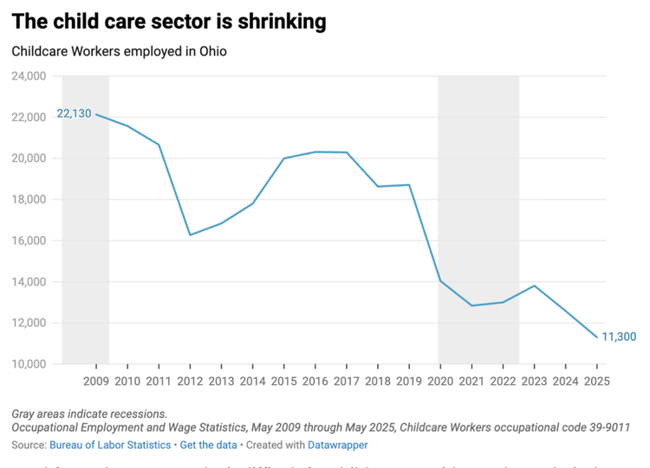
Statewide research group Policy Matters Ohio said with nearly one in three Ohioans living in a childcare desert, workforce shortages are the difference between access to childcare and closed doors.
“Even where childcare centers are easy to access, many are operating at less than their full capacity because of this workforce shortage,” Heather Smith, researcher for the organization, wrote in a report.
The First Five Years Fund report recommended prioritizing federal funding to the Child Care & Development Block Grant, and also to Head Start programs and childcare tax credits nationwide to bring much needed support.
Groundwork Ohio, Lunan and Smith see other things the state can be doing, including support from the newest governor, whoever that may be, to increase eligibility for Publicly Funded Child Care and push to fill childcare funding gaps.
There’s also a bill currently active in the Ohio General Assembly that would give free childcare to those who work in the childcare sector.
Ohio House Bill 484 is a Republican-sponsored bill that would establish a pilot program under the Ohio Department of Children and Youth, providing Publicly Funded Child Care to employees of childcare facilities, regardless of income level.
The bill would use $20 million in state funds toward the pilot.
“Passing this legislation would not only provide current childcare workers with necessary financial relief … it would also draw more workers to the sector,” Smith said in a Policy Matters report on the bill.
H.B. 484 was introduced nearly a year ago, and has since been referred and re-referred to House committees. It currently sits in the House Finance Committee.
While the bill is led by members of the supermajority GOP in the General Assembly, it’s unclear whether the bill will be brought up before the end of the year.
After the November election, the legislature will start its “lame duck” session, in which the General Assembly must wrap up any priority business by the end of December.
Any measures not passed before that date will have to be reintroduced and start the process again in the new year, with a new General Assembly.
Lunan sees all the options as part of the values the state should hold to develop a new generation of Ohioans.
“We actually are responsible for children developing into good citizens, and good stewards of our state, and when we invest in those dollars up front, we know that the impact will be felt years down the line,” Lunan said.
This story is republished from the Ohio Capital Journal under a Creative Commons license. View the original article.