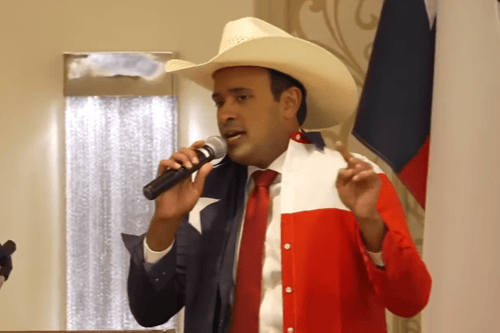
Vivek Ramaswamy says he was “just a shareholder” when Strive Enterprises, the financial firm he co-founded in Ohio, moved its headquarters from Columbus to Dallas.
But one day before Strive announced that move, the company’s own regulatory filing identified Ramaswamy as something much more specific: “the majority shareholder of Strive Enterprises, Inc.”
Five months later, after Strive had moved its headquarters to Texas, the company was still identifying Ramaswamy the same way.
And subsequent SEC records show Ramaswamy and an affiliated family trust controlled all of Strive’s Class A voting stock before the company’s 2025 merger.
That leaves out a major part of the story Ramaswamy has told Ohio voters about his relationship with the company when it left the state.
Ramaswamy said he was ‘just a shareholder’
During a July 2025 appearance on the Better Bad Ideas podcast with Teamsters President Sean O’Brien, Ramaswamy was confronted about Strive leaving Ohio for Texas.
Ramaswamy emphasized that he had stepped down from the company’s board when he launched his 2023 presidential campaign and said CEO Matt Cole made the relocation decision independently.
“I’m not on the board. I’m not. I’m just a shareholder of the company at this point.”
Ramaswamy said Cole “makes a decision independently” and added that he was “not mad at him for it,” arguing that Texas offered a more favorable business environment.
He then used Strive’s departure as part of his case for running for governor.
“For me, it’s one of the eye opening experiences of why I’m running for governor.”
Ramaswamy’s campaign repeated that argument in June 2026. Communications director Connie Luck told WHIZ that Ramaswamy had stepped down from the board before Strive left Ohio and said the company’s departure was “one of the events that motivated him to run for Governor.”
But stepping off Strive’s board did not make Ramaswamy an ordinary shareholder.
One day before Strive announced the move, Ramaswamy was its majority shareholder
A Strive Asset Management regulatory filing dated Oct. 31, 2024 — one day before the company publicly announced its relocation to Dallas — described the ownership structure this way:
“Strive is principally owned by Vivek Ramaswamy, the majority shareholder of Strive Enterprises, Inc.”
On Nov. 1, Strive announced that it was moving its corporate headquarters from Ohio to Dallas.
The announcement said Strive was launching a wealth management business in Texas and relocating its headquarters there as part of the expansion.
Ramaswamy was quoted directly in the announcement.
He did not object to the company leaving Ohio. He praised Strive’s development and said:
“I wish the team great success in the next stage of Strive’s incredible journey.”
Months later, while explaining the move politically, Ramaswamy would describe himself merely as “just a shareholder.”
Strive’s own filing shows he was its majority shareholder.
After Strive moved to Texas, Ramaswamy was still the majority shareholder
The description was not a one-time disclosure.
A March 31, 2025 Strive Asset Management filing, issued about five months after the relocation announcement, again identified Ramaswamy as the majority shareholder of Strive Enterprises.
By then, the filing listed Strive Asset Management at its Dallas address.
The headquarters had changed.
Ramaswamy’s status as majority shareholder had not.
SEC records show Ramaswamy and his family trust controlled all of Strive’s Class A voting stock
Later SEC filings provide even more detail about Ramaswamy’s ownership.
A 2025 SEC registration filing concerning Strive’s merger with Asset Entities disclosed that before completion of the merger, Ramaswamy and an affiliated trust controlled all of Strive’s Class A Voting Common Stock.
The filing identified 2 million Class A voting shares outstanding as of Dec. 31, 2024.
Ramaswamy personally held 1.6 million of those shares — 80% — while the Ramaswamy 2021 Irrevocable Trust held the remaining 400,000 shares.
Together, Ramaswamy and the affiliated trust accounted for 100% of the company’s Class A voting shares.
That ownership structure is considerably more significant than the phrase “just a shareholder” suggests.
Ramaswamy personally recruited the CEO he later pointed to
Ramaswamy has also placed responsibility for Strive’s move on CEO Matt Cole.
But Ramaswamy himself has acknowledged that he personally recruited Cole.
During the same July 2025 interview, Ramaswamy said:
“There’s a new CEO who actually I recruited from California, moved to Ohio, including his family, and he’s the CEO of the company.”
Ramaswamy said Cole later made the decision to move the company independently.
But even after stepping down from the board, Ramaswamy remained Strive’s majority shareholder, according to the company’s own filings.
Ramaswamy was still publicly involved with Strive shortly before the move
Ramaswamy also continued appearing publicly with Strive after stepping down from its board.
On Sept. 20, 2024 — roughly six weeks before the Dallas announcement — Strive promoted a video featuring Ramaswamy alongside Cole to unveil a Strive-sponsored race car.
The appearance does not show who made the headquarters decision. But it adds to a record that looks very different from the detached role suggested by “just a shareholder.”
Ramaswamy praised the move before citing it as motivation to run for governor
There is another tension in Ramaswamy’s account.
He has repeatedly presented Strive’s move from Ohio as an example of why the state needs different leadership and as one of the experiences that pushed him toward a gubernatorial campaign.
Yet when Strive announced the move in November 2024, Ramaswamy publicly wished the company “great success.”
And when discussing it in July 2025, he explicitly said he was “not mad” at Cole for moving the company.
He instead defended the business rationale, saying Texas offered a more favorable environment for that type of company.
None of that prevents Ramaswamy from later deciding that Strive’s departure illustrated problems he wanted to address as governor.
But his repeated description of himself as “just a shareholder” omits the defining fact about his ownership at the time: he was the majority shareholder of the company he founded when Strive announced it was leaving Ohio.
That is not an inference from a political opponent.
It is how Strive described Vivek Ramaswamy in its own regulatory filings.