Jack Windsor has built his public profile by digging through other people’s records. The conservative radio host and founder of the Ohio Press Network has investigated old domestic incidents involving political figures, questioned who finances news organizations and made credibility a recurring subject of his reporting and commentary.
His own court records tell a story Windsor has been far less eager to discuss. His former wife accused him in 2018 of threats, confinement, controlling behavior and violence before Windsor agreed to a domestic violence civil protection order that remained in place for nearly two years. Separate records show a conservative political activist and his wife put $150,000 into one of Windsor’s media companies, later won a $185,457.60 judgment when the debt went unpaid, and were preparing to question Windsor under oath about his property when he filed for Chapter 13 bankruptcy.
The bankruptcy was Windsor’s second known filing. His current schedules reported more than $305,000 in liabilities, while Media Dynamics Group — the company that received the $150,000 — was reported as having no income or expenses during the previous six months and just $4 in its bank account.
The records do not establish that every allegation made by Windsor’s former wife was true; the protection-order case ended by consent rather than judicial findings on each accusation. But they also do not support Windsor’s public claim that allegations against him were “proven untrue in court or later retracted.” The court files reviewed by TiffinOhio.net contain no such finding or retraction.
Together, the domestic-relations and bankruptcy cases offer a striking look at the record behind a man whose professional identity is built around investigating the records, finances and private controversies of others.
An investigative brand built on other people’s records
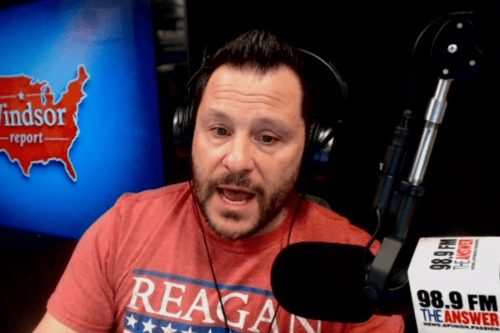
Windsor is founder and editor-in-chief of the Ohio Press Network and hosts The Windsor Report on 98.9 FM The Answer in Columbus. His station biography describes him as an “entrepreneur, strategist and consultant” whose career includes broadcast journalism and investigative reporting. His Facebook presence has been branded “Jack Windsor — Investigative Reporter.”
That investigative work frequently reaches beyond public policy and into personal records. On Aug. 13, Windsor’s radio show aired a segment titled “WINDSOR INVESTIGATES — The Amy Acton-Bexley police department call log-part 1,” based on records obtained by the Ohio Press Network. The report focused on a 2019 domestic disturbance at Democratic gubernatorial nominee Amy Acton’s home and emphasized that Acton’s adult daughter had called 911.
Days later, Windsor returned to domestic records in another segment involving a 2019 911 log and a separate 2013 domestic-disturbance report. His program archives those reports alongside other segments branded “Windsor Investigates.”
Windsor has taken a similarly aggressive approach to media financing. On Aug. 21, his program aired a segment titled “THE MACHINE-PART TWO-THE MONEY AND THE PIPELINE,” examining the financial network Windsor says sits behind Ohio journalism. Its description began with the question, “Who funds it and how it flows.”
State and federal court records provide an unusually detailed answer to that question for one of Windsor’s own media ventures.
His ex-wife alleged threats, confinement and violence
On March 1, 2018, Windsor’s then-wife filed a petition for a domestic violence civil protection order in Delaware County Common Pleas Court. A magistrate issued an ex parte protection order that same day. Windsor was served March 5, an attorney entered an appearance for him, and Windsor filed for divorce that day.
The allegations in the petition were extensive. According to the court records obtained and reviewed by TiffinOhio.net, Windsor’s wife alleged that he isolated her from friends and relatives, monitored her movements and communications, prevented her from working and controlled access to her email and social-media accounts.
She alleged that Windsor blocked doorways and kept her inside rooms during arguments, sometimes for hours. She accused him of throwing a dishwasher across a kitchen, punching and damaging her vehicle and shoving her from behind into a kitchen. A handwritten entry in the filing alleged that Windsor hit her daughter in the face.
The petition also described repeated contact after the couple separated. Windsor’s wife alleged that during one three-day period he called 48 times, left eight voicemails and sent 15 emails. She accused him of telling her, “You will be mine forever,” and threatening to kill any man who came between them.
Those accusations remained allegations. The court did not issue findings determining whether each incident occurred, and TiffinOhio.net found no criminal prosecution arising from them in the municipal courts searched during its reporting. The proceeding was a civil protection-order case, not a criminal prosecution.
What happened next, however, is established by the docket.
The divorce was over before Windsor agreed to the protection order
Windsor’s divorce was finalized May 24, 2018. The protection-order case did not end with the divorce. A full hearing was held June 27, and two days later Windsor agreed to a consent agreement and domestic violence civil protection order that remained effective until March 1, 2020.
The timing is important because Windsor later characterized the allegations to TiffinOhio.net as part of a difficult divorce. But the divorce itself had been final for more than a month when Windsor, represented by counsel, agreed to the protection order.
When TiffinOhio.net asked Windsor about the case, he emphasized that he had never been criminally charged or convicted in connection with the allegations and said “many things said were proven untrue in court or later retracted.” He described renewed scrutiny of the case as a “grotesque obsession of online trolls” attempting to stop him from investigating wrongdoing.
The docket reviewed by TiffinOhio.net contains no ruling finding his former wife’s allegations untrue. It contains no dismissal of her petition and no filing retracting the accusations. The case ends with the consent domestic violence civil protection order Windsor agreed to.
Then there is the money behind Windsor’s media business
In September 2022, James F. Kerg Jr. and his wife, Theresa, agreed to provide $150,000 to Media Dynamics Group LLC through a convertible promissory note. Kerg was then serving on the Shelby County Board of Elections and has a long history in Republican politics; he now sits on the board of the conservative advocacy organization Ohio Value Voters.
Windsor signed the note on behalf of Media Dynamics Group. He also signed a separate continuing guaranty, making himself personally responsible if the company failed to pay.
The note matured Dec. 31, 2024, without payment. The Kergs first sued Windsor personally in Franklin County Common Pleas Court in September 2025. That case stalled after certified mail sent to the address listed for Windsor was returned as not deliverable as addressed.
Eight days after that mailing was returned in January, the Kergs filed a second lawsuit against Windsor and Media Dynamics Group. This time they invoked a cognovit provision Windsor had signed as part of the commercial agreement, allowing judgment to be entered without the ordinary notice and trial process if Ohio’s statutory requirements were satisfied.
Judge Sheryl Munson found that those requirements had been met. On Jan. 30, she entered judgment holding Windsor and Media Dynamics Group jointly and severally liable for $185,457.60, plus post-judgment interest and collection costs.
TiffinOhio.net first detailed the loan, judgment and bankruptcy earlier this month.
Creditors moved to examine Windsor’s property
Winning the judgment did not produce payment, so the Kergs moved into collection proceedings. On March 13, a magistrate ordered Windsor to appear in Franklin County court at 9 a.m. April 24 for a judgment-debtor examination, where he would be required to answer questions under oath concerning his property.
Windsor filed for Chapter 13 bankruptcy on March 31, 24 days before the examination was scheduled to take place. Federal bankruptcy law imposed an automatic stay that halted the state collection proceeding before Windsor appeared for the examination.
The sequence does not establish that Windsor filed bankruptcy for the purpose of avoiding testimony; Chapter 13 debtors are legally entitled to seek bankruptcy protection. It does establish that the filing came after the judgment, after collection began and after a court ordered him to appear for examination of his property, and that the bankruptcy prevented that scheduled examination from going forward.
More than $305,000 in reported liabilities
Bankruptcy required Windsor to provide a detailed accounting of his finances. His initial filing ran 94 pages and reported more than $305,000 in liabilities.
Those scheduled debts included approximately $185,458 associated with the Kerg judgment, about $69,800 owed to the U.S. Department of Education, $30,000 to the Internal Revenue Service and $4,100 to Gongwer News Service, the subscription news service that has covered Ohio state government for more than a century. Windsor also listed credit-card and collection debts.
The petition identified Media Dynamics Group, Red Straw Marketing, Windsor Brands and Windsor’s own name among business or trade names associated with him.
His disclosures for Media Dynamics Group were particularly revealing. Windsor reported that the company the Kergs had financed with $150,000 had received no income and paid no expenses during the previous six months. He valued his ownership interest in the company at $1,750 and reported $4 in its Huntington bank account.
It was not Windsor’s first bankruptcy
The 2026 case also disclosed an earlier bankruptcy. According to a court-generated notice of prior filings reviewed by TiffinOhio.net, Windsor filed a Chapter 7 case in northern Ohio in October 2005 and received a discharge in February 2006.
The earlier case was filed more than 20 years before his current proceeding and did not prevent him from seeking Chapter 13 protection again. But it means the current financial collapse is Windsor’s second known trip through federal bankruptcy court — a notable part of the record for a public figure whose current station biography promotes him not only as an investigative reporter but as an entrepreneur and business strategist.
A plan proposing roughly five cents on the dollar
As of TiffinOhio.net’s Aug. 3 review of the bankruptcy docket, five creditors had filed six claims totaling $216,037.05. Kerg’s $189,197.41 claim represented about 88 percent of that amount.
The Chapter 13 plan Windsor filed in April proposed payments of $890 per month for five years, with general unsecured creditors receiving 5 percent of their allowed claims. If Kerg’s claim were allowed in full, the plan approved on those terms and Windsor completed it, that would produce a distribution of approximately $9,460 on the nearly $189,200 claim.
Roughly five cents on the dollar.
That figure reflected Windsor’s proposal as it stood during TiffinOhio.net’s Aug. 3 docket review, not a final guaranteed recovery. At that time, Chapter 13 trustee Faye D. English had objected to confirmation, seeking tax returns, profit-and-loss statements and business bank records, and had separately challenged some property Windsor claimed as exempt. Two confirmation hearings had been continued, and no plan had been approved as of that review.
Fourteen questions about Windsor’s finances went unanswered
Before publishing its Aug. 3 investigation, TiffinOhio.net sent Windsor 14 written questions concerning the $150,000 financing, his personal guaranty, the resulting judgment and information reported in his bankruptcy filings. He responded twice before the deadline without answering any of them.
Windsor first asked to arrange a telephone conversation. Then, at 4:59 p.m. on Aug. 3 — one minute before TiffinOhio.net’s 5 p.m. deadline — he asked for an extension and sent questions of his own concerning TiffinOhio.net’s ownership, financing and staffing.
Less than three weeks later, Windsor was using his radio program to investigate the ownership and financing of other news organizations. His Aug. 21 segment promised to trace “the money and the pipeline” behind a purported $27 million newsroom network and asked his listeners, “Who funds it and how it flows.”
The segment remains publicly available through The Windsor Report.
The record behind the watchdog
None of Windsor’s financial problems makes the allegations made by his former wife true, and a civil protection order entered by consent is not a criminal conviction. But Windsor’s own public statements make the underlying records more consequential than either case would be in isolation.
He told TiffinOhio.net that allegations in his domestic case had been “proven untrue in court or later retracted.” The court record reviewed by TiffinOhio.net shows neither. Instead, it shows Windsor agreeing to a domestic violence civil protection order more than a month after his divorce was finalized.
He has used his investigative platform to examine old domestic incidents involving others. He has demanded transparency about who finances news organizations and how money moves through them. His own court record shows a political activist and his wife financing his media company with $150,000, a personal guaranty signed by Windsor, a $185,457.60 judgment when the debt was not paid and a bankruptcy filing before creditors could examine his property under oath.
That bankruptcy reported more than $305,000 in liabilities. The company that received the Kergs’ money was reported with no recent revenue and $4 in its bank account. It was Windsor’s second known bankruptcy.
And when TiffinOhio.net sent the self-described investigative reporter 14 questions about those financial records, he did not answer one.