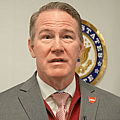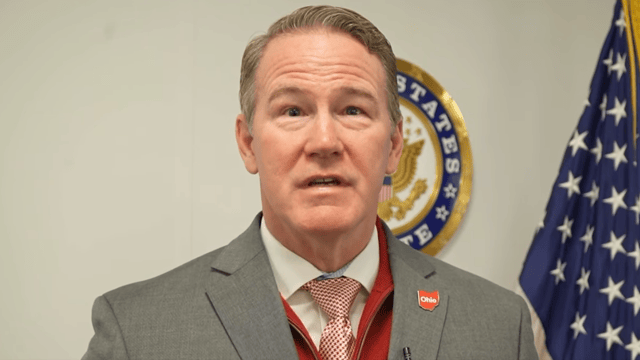
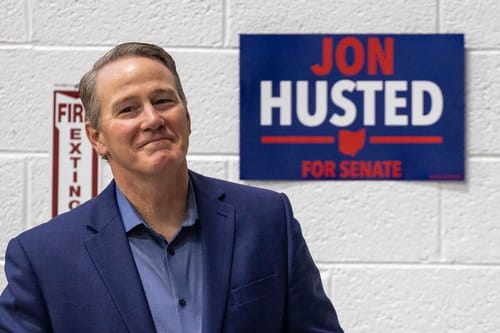
U.S. Sen. Jon Husted’s first term in the Ohio Statehouse has been pulled into the November campaign over a question that reaches into every county in northwest Ohio: who is legally on the hook when a nursing home resident is injured or dies.
In a report that aired this week, NBC4 in Columbus reported that Husted, as a state lawmaker, cosponsored a bill to shield Ohio nursing homes from liability, including in wrongful death and abuse cases, and that he has since accepted more than $1 million in campaign contributions from the nursing home industry, its executives and lobbyists.
Husted’s office pushed back in a statement to the station, though its response addressed the federal budget law rather than the state legislation. Nursing homes did not receive a net cash infusion or additional federal dollars under H.R. 1, the office said, adding that the law actually made it easier for states to move toward home- and community-based care.
The station separately reviewed Husted’s most recent campaign finance report and found that more than a dozen nursing home PACs or lobbyists have given at least $34,000 to his Senate campaign so far.
The example came from Norm Wernet, president of the Ohio Alliance for Retired Americans, a labor-affiliated group that advocates for home- and community-based care for aging Ohioans and argues the nursing home industry lobbies against it. Wernet told the station that big-dollar giving distorts state policy, saying $100 million campaigns exert a corrupting influence and do not address the changes Ohio needs.
“It is wrong to see that somebody like Senator Husted, when he was in the legislature, would co-sponsor a bill that, in fact, avoided the liability on the nursing homes,” Wernet said, according to a transcript of the segment circulated by the Ohio Democratic Party. He called it one example of how politicians keep drawing industry support.
What the 2002 law did
Neither the broadcast nor the station’s written report named the bill. Ohio legislative records identify it as House Bill 412, enrolled as Amended Substitute House Bill 412 in the 124th General Assembly and titled “Residential care facilities—liability.” It took effect Nov. 7, 2002. Husted, elected to the Ohio House in 2000, was one of 45 House members listed as cosponsors, alongside 10 senators. Then-Rep. Bill Seitz was the primary sponsor.
Rex Damschroder, then a Fremont Republican in the Ohio House whose district covered Sandusky County and part of Seneca County, was also among the cosponsors.
The law rewrote how Ohioans sue nursing homes in three ways.
It added nursing homes and residential care facilities to the state’s legal definition of a “medical claim,” which cut the deadline for filing suit from the two years that applies to ordinary negligence to one year, with an outer bar of four years. It also folded lawsuits brought under Ohio’s nursing home residents’ rights law into that same definition. Those are the claims families bring over care inside a facility, and they can be filed by an estate after a resident dies.
It set new rules for punitive damages. When a jury weighs punitive damages against a nursing home, the law directs it to consider whether the home can afford to pay, whether the award is enough to deter future conduct, and whether the home would still be financially able to provide housing, personal care and skilled nursing care.
And it restricted the use of state inspection findings in court. The results of Ohio Department of Health inspections of nursing homes, including statements of deficiencies, generally cannot be used or admitted as evidence in court proceedings, with narrow exceptions. The act created a parallel restriction for the Medicaid surveys that regulators run on nursing facilities.
Democrats push the segment into the Senate race
The Ohio Democratic Party circulated the segment Friday, along with a clip the party posted to its own YouTube channel, and a statement from senior communications adviser Tony Wen.
“Jon Husted said Ohioans’ work ethic is broken and championed legislation to slash Social Security and Medicare — and now reporting reveals he protected the abusive nursing home industry after taking more than $1 million from its lobbyists. Jon Husted sided with special interests over Ohio seniors, and he can’t be trusted.”
The work ethic reference points to a January radio interview in which Husted, discussing his Upward Mobility Act, said the country’s work ethic is broken and that the federal government pays people more to stay home than to work. TiffinOhio.net covered those remarks and the criticism that followed.
Husted went on to lead the Ohio House as speaker from 2005 to 2009, served in the Ohio Senate, became secretary of state in 2011 and later served as lieutenant governor, according to his official Senate biography. He was appointed to the U.S. Senate in January 2025.
Medicaid, the long-term care bill payer
The dispute lands on top of the federal budget law Husted voted for. The Senate passed H.R. 1 on a 50-50 vote on July 1, 2025, with the vice president breaking the tie. Husted was recorded in favor.
Medicaid is the primary payer for long-term nursing home care in Ohio, which is why cuts to the program and the fight over home- and community-based services run through the same set of facilities. The law reduces federal Medicaid and CHIP spending by $911 billion over a decade. A Public Citizen analysis published in March identified nine Ohio hospitals at heightened risk of closing or cutting services, and an Urban Institute projection found Medicaid work requirements could strip coverage from as many as 356,000 Ohioans, on top of roughly 113,000 who lost Affordable Care Act coverage after enhanced tax credits expired. States can direct Medicaid dollars toward home- and community-based care, but those services are optional, and analysts expect them to be squeezed first as funding tightens.
Seneca County residents have already seen what strain inside a nursing home looks like. In June, an HVAC failure at Spring Creek Nursing & Rehabilitation Center in Green Springs forced a full-day evacuation involving more than 30 agencies, with ventilator-dependent and bariatric residents moved to Bellevue Hospital. Statewide, a Signal Ohio investigation this summer documented wrongful death suits and regulatory penalties against facilities in one large Ohio chain, with families alleging thin staffing led to fatal falls and pressure ulcers.
The most expensive Senate race in the country
NBC4 reported that the Democratic Senate Majority PAC will spend $64 million backing Democrat Sherrod Brown and that the Republican Senate Leadership Fund is investing $79 million behind Husted, in what is expected to be the most expensive Senate contest in the nation.
Brown has his own organized-interest money. The station reported that his most recent filing shows $220,500 from 33 labor union PACs. His campaign said most of his money comes from more than 80,000 small-dollar donors and said that while Husted fights for special interests, Brown fights the rigged system, pointing to nearly $700,000 Husted has taken from insurance companies. Brown outraised Husted by roughly two to one in the second quarter.
Wernet, for his part, spent years in the labor movement raising money for his national union to back political campaigns. Asked about that, he told the station it seems to be the only way workers can get a voice in a difficult time.
Husted and Brown meet on the ballot Tuesday, Nov. 3.