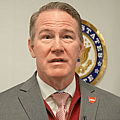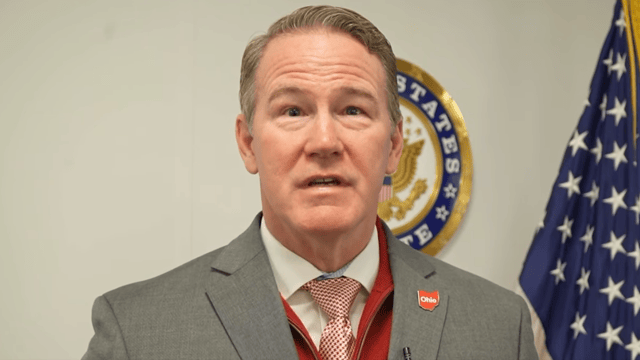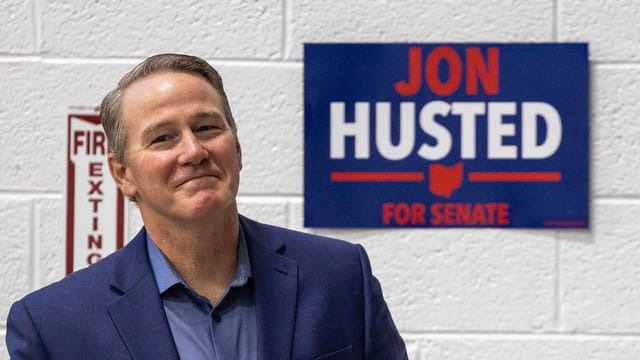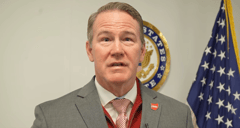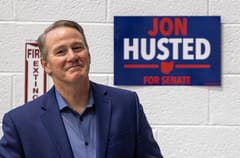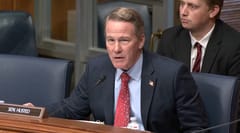
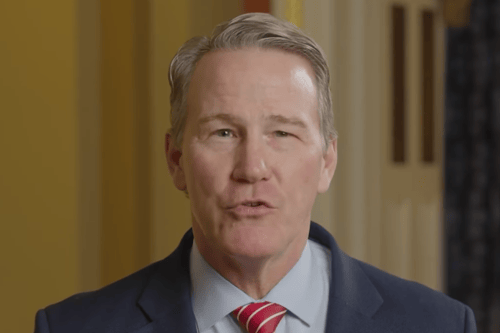
Jon Husted was one of 14 statewide candidates invited to sit in front of Ohio’s disability community on Thursday and answer questions written in advance. He didn’t show up. That evening, the Republican senator’s account posted photographs of him shooting clay targets.
The Ohio Disability Candidates Forum ran from noon to 4 p.m. on Aug. 20 at the Fawcett Center in Columbus. Organized by the Ohio Olmstead Task Force and billed as nonpartisan and cross-disability, it paired the Republican and Democratic nominees for every statewide office on the November ballot — governor, lieutenant governor, attorney general, secretary of state, auditor, treasurer and U.S. Senate. Questions were set ahead of time so each candidate could lay out a disability policy platform. Organizers provided ASL interpreters, CART transcription and a universal changing station, and asked attendees to come fragrance-free.
Husted was listed. So was his opponent, Democrat Sherrod Brown.
At 3:10 p.m., according to a screenshot of the event’s question-and-answer channel reviewed by TiffinOhio.net, an attendee asked whether Husted and Republican governor nominee Vivek Ramaswamy were joining the program. Event staff answered that they were not, and that both “were unable to participate.”
At 8:19 p.m., Husted’s verified account posted: “It’s National Shooting Sports Month! It was great to be at the Black Wing Shooting Center in Columbus today with fellow Ohio sportsmen and hear about the issues that matter most to them.” The Black Wing Shooting Center is at 3722 Marysville Road in Delaware, Ohio, north of Columbus.
The vote behind the empty chair
The forum mattered because of a vote Husted cast last year.
Husted voted for the One Big Beautiful Bill Act, the Republican reconciliation law that carries the largest Medicaid reduction in the program’s history. KFF estimates the law strips roughly $33 billion in federal Medicaid funding from Ohio over the next decade, about a 13% cut against the state’s current spending baseline, according to analysts who briefed the Health Policy Institute of Ohio. An Urban Institute analysis projects that new work-verification rules could cost as many as 356,000 Ohioans their coverage by 2028, on top of roughly 113,000 who already dropped Affordable Care Act plans after premium tax credits expired.
The requirements take effect Jan. 1, 2027. Roughly 769,000 Ohioans will have to document 80 hours a month of work, school or community service, and advocates say the state still has not resolved basic questions about how people will prove it.
More than 45,000 Ohioans with disabilities receive Medicaid waivers, the mechanism that lets people be cared for at home instead of in an institution. Those waiver services are optional under federal law, which is why disability advocates have spent the past year warning that squeezed state budgets will reach for them first. Nationally, families are already bracing for a return to institutional care. In Ohio, a Public Citizen analysis identified nine hospitals at heightened risk of closing or cutting services.
‘Nothing in this bill that would impact them’
Husted has repeatedly told Ohioans the cuts will not reach disabled people.
In July 2025, as the bill moved through Congress, he told News 5 Cleveland that people with disabilities would not be affected. “There’s nothing in this bill that would impact them,” he said. A spokesperson told NBC4 the same week: “Disabled Americans, children, and their caretakers are at no risk for losing benefits because of this bill.”
Later that month, in a statement posted on his Senate website, Husted said there were “whoppers of a lie” circulating about Medicaid, and said the law would leave Ohioans with more health care resources than ever.
The work requirements he defends are the specific provision disability groups flag as the risk. The Center for American Progress found that the 80-hour rule reaches at least 2.6 million adults nationally who have difficulty working because of disability or illness but do not receive Supplemental Security Income or Social Security Disability Insurance, and therefore do not qualify for an automatic exemption. People in that group keep coverage only if they navigate the paperwork correctly.
On a Columbus radio show in November, Husted called the Medicaid changes purposeful and said, according to Heartland Signal: “So I love fighting for those things. I love doing that kind of stuff.”
The pattern predates Washington
Husted’s record on disability benefits did not start with last year’s vote. It started when he ran the Ohio House.
In April 2005, three months into his speakership, Husted led the House budget proposal that eliminated the Disability Medical Assistance program. The program paid for prescription drugs and doctor visits for 15,000 very low-income adults, described at the time as destitute and chronically ill. The same proposal cut off Medicaid coverage for 25,000 working-poor parents — families earning between 90% and 100% of the federal poverty line.
The following March, Husted voted for Senate Bill 7, an overhaul of Ohio’s workers’ compensation system that made it harder for injured workers to qualify for benefits and shortened how long they could collect them.
The law required objective medical evidence that a workplace injury had substantially aggravated a pre-existing condition, rather than a worker’s report of increased pain, and limited treatment for that aggravation to whatever it took to return the condition to its prior state. It narrowed the standard for permanent total disability, overturning an Ohio Supreme Court ruling that had counted the loss of a single limb as the loss of two body parts. And it capped nonworking wage-loss compensation at 52 weeks; under the previous system, a worker could draw on a 200-week allowance whether or not they had returned to work. The House passed the bill 58 to 37, and it became law.
The hug and the vote
In June 2025, Columbus attorney Sarah Bloom Anderson brought her 14-year-old daughter Audrey to Husted’s Washington office to ask him to protect Medicaid. Audrey has PURA Syndrome, a chromosomal disorder, and relies on a waiver that pays for a full-time caregiver at home. Husted hugged her. His office posted the photo. Not long after, he voted for the bill.
Bloom Anderson recounted the meeting four months later at a Brown campaign roundtable in Columbus, one of the screened, small-group events the Democrat has built his campaign around. Signal Ohio reported her words: “You can’t hug my daughter, look her in the eyes and tell her Medicaid won’t be cut,” she said, “and then sign that bill.”
Brown has run much of his campaign on that terrain, including a December meeting in Toledo with residents who said they could no longer afford their premiums.
An award, and a sponsor
Three years ago, Husted stood in front of a camera as lieutenant governor and handed CareSource the 2023 Governor’s Inclusive Employer Award for its record of hiring people with disabilities.
“Governor DeWine and I have made working with Ohioans with disabilities an important priority in our administration,” he said in the ceremony video. “We want to connect employers with Ohioans with disabilities in a way that helps everyone.”
CareSource is a listed fiscal sponsor of Thursday’s forum. Its logo sits on the event page, a few inches above the roster of candidates that included Husted’s name.
Ohio votes Nov. 3.