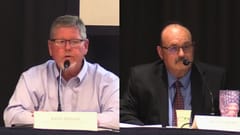
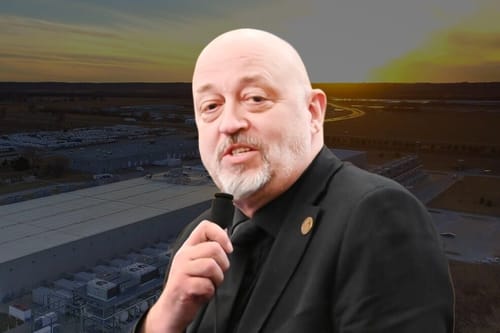
State Rep. Gary Click (R-Vickery) voted for a state budget that more than doubled the number of signatures Ohio residents need to challenge local zoning decisions — and separately co-sponsored a bill that would investigate whether community opposition to data centers is driven by “foreign propaganda.”
Together, the two measures represent a pattern: weakening the tools communities use to fight unwanted development while casting the people who use them as potentially illegitimate.
The zoning change was embedded in House Bill 96, the state’s $200 billion biennial operating budget, which Gov. Mike DeWine signed into law on June 30, 2025. Among the bill’s hundreds of provisions was a measure raising the petition threshold for township zoning referendums from 15% to 35% of the number of electors who voted in the most recent gubernatorial election. For municipalities and limited home rule townships, the threshold jumped from 10% to 35%.
In practical terms, the change means Ohio residents now need more than twice as many signatures to force a public vote on zoning decisions made by local officials — decisions that can open the door to data centers, landfills, high-density housing developments, and industrial projects.
The Ohio Township Association opposed the provision and asked DeWine to veto it. He did not. The OTA, which represents more than 5,200 elected officials from Ohio’s 1,308 townships, had previously negotiated the 15% threshold down from a proposed 25% during the 2023 budget cycle. The 2025 budget blew past that compromise entirely.
The groups that supported the higher threshold were developer-aligned organizations. The Ohio Realtors called the change a way to “remove a barrier to new housing construction projects.” NAIOP, the commercial real estate development association, praised it for improving “predictability for developers in their planning process.” The Building Industry Association described it as reducing “the chances of unexpected project delays.”
Click served on the conference committee that finalized the budget. The zoning threshold increase was not a standalone bill he introduced — it was one of many provisions in a massive spending package. But Click voted for the final product, and neither he nor his office has publicly objected to the provision.
HB 96 also exempted zoning amendments related to megaprojects — defined as developments creating at least 700 jobs and $700 million in investment — from the referendum process entirely. For projects of that scale, Ohio residents now have no petition mechanism at all.
The data center bill
The zoning threshold change took effect in September 2025. Four months later, in January 2026, Click co-sponsored House Bill 646 with Rep. Kellie Deeter (R-Norwalk), a bill creating the Data Center Study Commission within the Ohio Department of Development.
The bill directs the commission to study a range of legitimate concerns about data center development: environmental impact, effects on the electrical grid, water usage, noise and light pollution, impacts on farmland, and effects on the local economy. But tucked into the list of required study topics is a provision with no equivalent in the bill’s other sections: the commission must also examine “reports of foreign propaganda intended to create opposition to data centers.”
The provision places community opposition to data centers on the same footing as environmental or infrastructure concerns — but frames it as a potential national security threat rather than a legitimate exercise of democratic participation.
The Reason Foundation, a libertarian policy organization, submitted testimony to the Ohio Senate recommending the “foreign propaganda” provision be deleted from the bill. The group noted that the commission’s report “must studiously avoid the appearance of bias” and that the provision could undermine public trust in the commission’s findings.
HB 646 passed the Ohio House unanimously on March 19, 2026, with 97 votes and no opposition. It is now pending in the Ohio Senate.
Local relevance
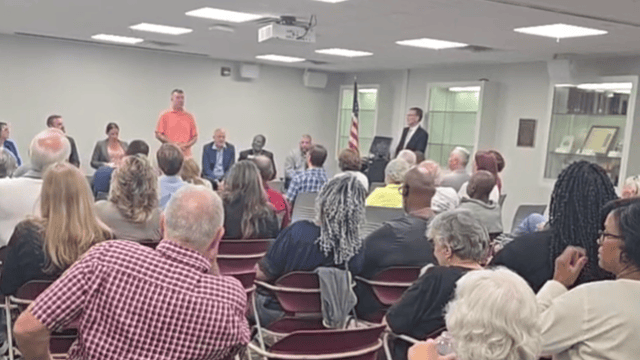
The data center issue is not abstract in Click’s district. In October 2025, residents of Woodville Township in Sandusky County packed a township meeting to discuss a potential data center project on approximately 450 acres of industrial land. No formal zoning requests had been filed at that time, but neighbors had already been approached about selling property.
Aligned Data Centers broke ground on a 129-acre campus in neighboring Perkins Township (Erie County) in early 2026, with plans for four buildings totaling 96 megawatts of capacity. The $200 million-plus project is the first hyperscale data center in northwest Ohio.
Click himself acknowledged the local stakes when HB 646 passed the House. “This legislation originated in the heart of the 88th district, in response to my constituents,” he said in a statement released by the Ohio House Republican caucus.
But critics see a contradiction: Click says he is responding to constituent concerns about data centers, while his legislative record includes voting for a budget that made it harder for those same constituents to challenge zoning decisions — and co-sponsoring a bill that could label their opposition as foreign-influenced.
The pattern
The timeline tells a straightforward story. In June 2025, Click voted for a budget that raised the bar for zoning referendums from 15% to 35%, over the objections of the Ohio Township Association. In January 2026, he co-sponsored a bill that would investigate whether opposition to data centers is foreign propaganda. In March 2026, he voted to pass that bill out of the House.
At no point in that sequence did Click introduce, co-sponsor, or publicly support legislation that would strengthen residents’ ability to challenge unwanted development in their communities.
Attempts to reach Click’s office for comment were unsuccessful.
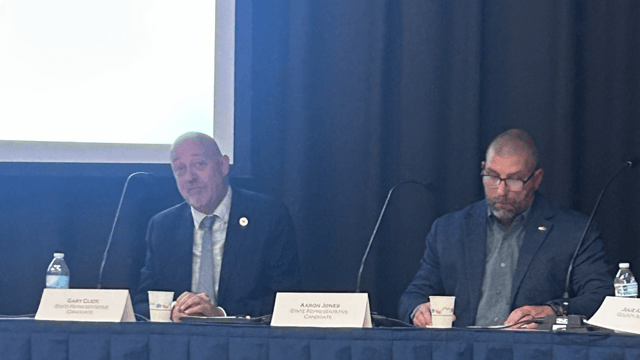
The 2026 primary election for the 88th Ohio House District is scheduled for May 5. Early in-person voting begins April 7. Click faces challenger Eric Watson in the Republican primary, with Democrat Aaron Jones running in the November general election.