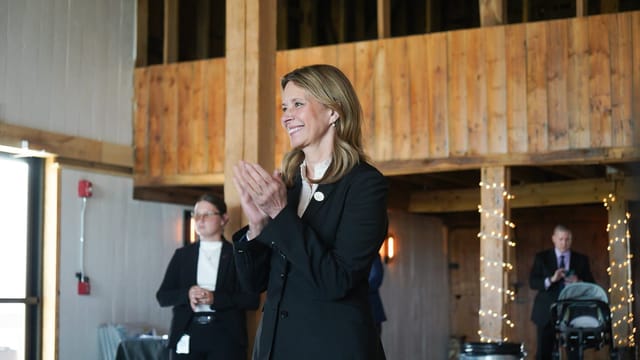
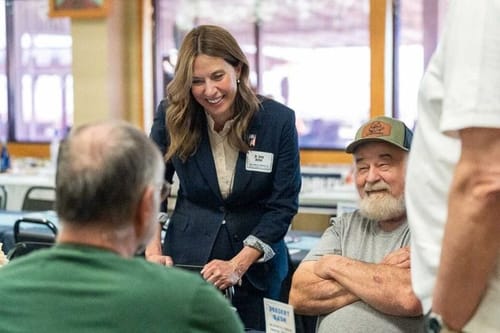
As Primary Election Day this upcoming Tuesday inches closer, Democratic governor candidate Dr. Amy Acton hosted an affordability roundtable in Cincinnati last week to discuss housing, health care, and energy.
Acton sat down with seven community members inside Bond Hill restaurant Brunch de Lux as she fielded questions from college students, parents, and business owners about rising costs of living.
Affordability is one of the most pressing issues coming into this year’s midterm election, where 45% of Ohio’s renters are paying more than they can afford on rent, according to the Coalition on Homelessness and Housing in Ohio.
Acton began by mentioning the rollout of her affordability agenda, titled ActOn, which she said will be informed by the experiences of Ohioans like those participating in the discussion.
Acton said she plans to introduce a tax cut for lower and middle income individuals as a part of her plan.
“We have had tax breaks for people at a million plus, and we are trying to do something for everyone else,” Acton said.
Paul McMillan, a roundtable participant and owner of Brunch de Lux, said the rising cost of living not only puts a strain on the restaurant’s customers but also makes it more difficult to pay their employees a livable wage.
“We want our employees to make more, we see what we are paying them and we know that those wages are not necessarily liveable wages,” McMillan said.
“Put something in place for us to be able to, as small business owners, be able to pay our employees more and it be sustainable.”
McMillan also emphasized the inaccessibility of health care, citing his own experience with being diagnosed with rheumatoid arthritis.
He said he thought his insurance would take care of his medical costs, until he was rejected for showing prior signs of arthritis five years ago.
He asked Acton to put a plan in place that will lower health care costs and ensure people with preexisting conditions are still covered.
Acton said access to quality health care is getting harder and harder, especially since Americans pay twice as much for health care as other countries.
“That is why in our affordability rollout, we’re working on some of the issues we can grab right away,” Acton said. “One of the big things we are very passionate about is helping forgive medical debt.
According to Acton’s website, she also plans lower health care premiums and prescription drug prices.
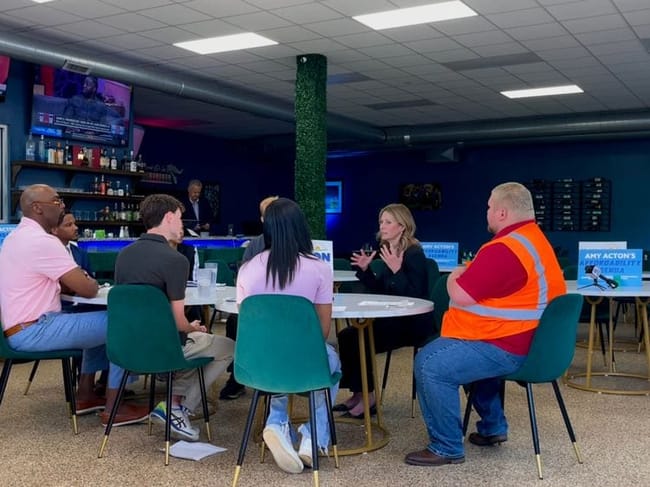
“We have a lot to do in health care,” Acton said. “We have to leverage the buying power of the state. Medicaid is a huge part of our budget to affect our private insurers. So we are going to be using every lever we can within a state, and we are going to be advocating federally to get the right thing for Ohioans.”
Sausha Parma, a roundtable participant and new mother, said she feels as though she has done everything right in terms of finances, and still experiences the strain that comes with rising costs of living.
“I still feel the brunt of rising costs,” Parma said. “My mortgage is paid off, my car is paid off, I don’t have a lot of these expenses that most people do. So we would think that I could potentially be ahead, savings should be up, but it’s not because our wages aren’t rising at the same rate inflation is.”
Energy bills and child care costs were a large part of the discussion, which Acton said she will fight hard to address as it is a part of everyday life.
Acton pointed to her data center policy in ActOn, another hot button issue for Ohio voters in the midterm.
Data center growth within the state is raising concerns from critics about potential increases to energy bills due to the massive wattage and power investment needed to run the plants.
“Data centers that are coming as a part of the AI battle, we know they are here,” Acton said. “We know they are here, but there are ways to do it.”
She said there are ways to “make data centers work for Ohio and not the other way around,” and pointed to her commitment to have the centers pay for their own energy usage.
“We have to be bold and forward about how we want to do energy in Ohio,” Acton said.
Acton’s opponent, Republican front runner Vivek Ramaswamy, posted on X that data centers were “good,” despite the strain they will put onto the state’s electric grid.
“I’ll unshackle energy production in Ohio, from fossil fuels to nuclear energy, without apology,” Ramaswamy posted.
According to his website, Ramaswamy plans to “streamline” energy project permits and slash regulations so projects continue to be built.
This story is republished from the Ohio Capital Journal under a Creative Commons license. View the original article.