
Temporary protected status remains in effect for Haitians living in the United States for now, but this is not the time to celebrate, Ohio lawmakers and advocates said.
“Let’s be very clear, this fight is far from over,” said Yola Lamarre, an advocate with the Haitian Community Network. “Let the verdict of the judge be an invitation to lean forward and not lean back in complacency.”
In a Monday night decision, U.S. District Court Judge Ana C. Reyes blocked the Trump administration’s attempt to end Temporary Protected Status for about 330,000 Haitians living in the United States.
Temporary Protected Status (TPS) is a federal program that allows people from specific countries destabilized by conflict or natural disasters to live and work in the United States for a set period of time. TPS for Haitians was set to end Tuesday before the judge’s decision paused that action. The Trump administration is expected to appeal the ruling.
“This is not a victory,” said Nadia Jean-Jacques, a member of the Columbus Commission on Immigrant and Refugee Affairs. “This is just the beginning. The fight has just begun.”
State Rep. Dontavius Jarrells, D-Columbus, said he is proud the judge blocked the Trump administration ending TPS for Haitians.
“That matters, but it does not bring closure for these families,” he said. “It does not bring peace.”
About 30,000 Haitians with temporary status live in central Ohio and an estimated 12,000 to 15,000 Haitians call Springfield home, with a mixture of temporary protected status, citizenship, and other legal statuses.
“Today is a temporary win that means Haitian immigrants get to continue to go to work, their babies can continue to go to school, but it also means that they will continue to live in fear,” said Rep. Latyna Humphrey, D-Columbus. “So today is a temporary win, but it also means that we are going to continue to fight.”
Deporting Haitians in Springfield would eliminate roughly $300 million in annual spending from Clark County, with an estimated economic loss projected to exceed $400 million.
“If we let TPS fail, if we let TPS expire, this will economically devastate our communities,” Humphrey said.
Springfield experienced a shrinking population for decades as manufacturing jobs disappeared, but Haitian immigrants have increased Clark County’s workforce by more than 10,000 workers. About 60,000 people live in Springfield and Haitians make up about a quarter of the population.
Jean-Jacques is asking the Trump administration and Congress to extend TPS for Haitians.
“We urge our leaders to create permanent solutions for Haitian immigrants who have lived here for years,” she said.
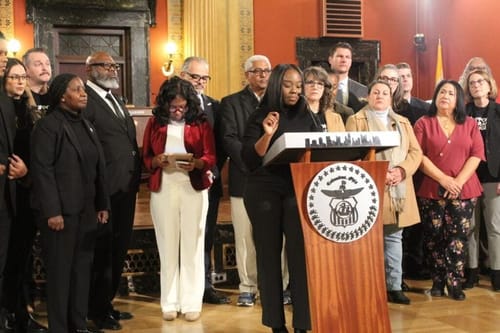
Columbus Mayor Andrew Ginther said the city’s police officers will not stop to question or detain someone to determine a person’s immigration status.
“The City of Columbus resources will not be used for deportation or immigration enforcement,” he said during a Tuesday press conference. “That is the federal government’s responsibility. … We will not deny essential city services based on immigration status.”
State Rep. Munira Abdullahi, D-Columbus, reminded immigrants they have a place in Ohio.
“We are choosing love,” she said. “We are choosing strength over fear.”
Follow OCJ Reporter Megan Henry on X.
This story is republished from the Ohio Capital Journal. View the original article.