

Ohio Gov. Mike DeWine, a Republican, called the federal policy of removing Haitian immigrants from the country “a mistake” on Thursday, hours after the U.S. Supreme Court cleared the way for the Trump administration to end Temporary Protected Status for hundreds of thousands of Haitian and Syrian nationals.
In a statement issued June 25, DeWine said the 6–3 ruling in Mullin v. Doe means more than 10,000 Haitians living legally in Ohio through TPS — most of them in the Springfield area — “will now be here illegally and will be subject to immediate deportation.”
“Today’s decision is a legal decision. As I have stated in the past, the policy to remove these individuals from this country is a mistake,” DeWine said. He added that the Haitians “were working and contributing to our community and economy yesterday,” but that “today it is now illegal to employ them.”
DeWine described conditions in Haiti as dire. “The violent gangs run most of the country. The government barely functions. And, the economy is in shambles,” he said. He pointed to the federal government’s advisory against traveling to Haiti and to the Federal Aviation Administration’s prohibition on U.S. carriers flying there because of the danger of aircraft being fired on by gangs.
“Changing the immigration status of these individuals is not in the best interest of the United States nor Ohio,” DeWine said.
What the court decided
The Supreme Court ruled Thursday that the TPS statute bars federal courts from reviewing most challenges to the termination of the program, and that a claim by Haitian plaintiffs that the termination was motivated by race was unlikely to succeed. Justice Samuel Alito announced the judgment of the court. The decision reversed lower-court orders that had paused the terminations and cleared the way for the Department of Homeland Security to end protections for roughly 350,000 Haitians and 6,000 Syrians.
The case reached the court after then-Secretary of Homeland Security Kristi Noem moved in 2025 to terminate the designations for both countries. The court’s opinion notes that Haiti’s designation was set to end following a November 2025 notice. The current homeland security secretary, Markwayne Mullin, is the named party in the consolidated cases.
In a dissent joined by Justices Sonia Sotomayor and Ketanji Brown Jackson, Justice Elena Kagan wrote that the TPS holders had asked only to remain in the country while their case continued, and parted with the majority over a ruling she said would expose them to severe harm. The terminations are set to take effect within weeks unless the lower courts intervene, according to legal groups representing TPS holders.
What it means for Ohio
TiffinOhio.net has reported that an estimated 12,000 to 15,000 Haitians live in Springfield — a mix of TPS holders, citizens and people with other legal status — part of roughly 30,000 people with temporary status across central Ohio. Local officials and economists have estimated that deportations would remove hundreds of millions of dollars in annual economic activity, including about $300 million a year in Clark County.
DeWine has been among a small number of Republicans to oppose the administration’s effort to end Haitian TPS, and he has previously argued that stripping the workers of legal status would damage Ohio’s economy. The DeWine family also has personal ties to Haiti: the governor and his wife, Fran, helped support a school there named for their late daughter, which closed in 2024 because of gang activity.
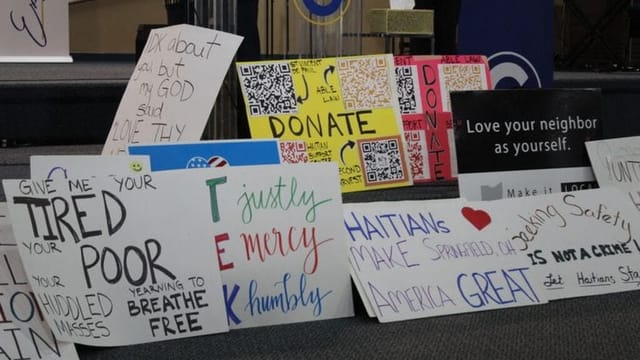
Hours after the ruling, hundreds of people gathered in Springfield to support Haitian residents, with clergy, attorneys and community leaders urging families to prepare legally for possible deportation.
Background
Congress created Temporary Protected Status in 1990 to provide short-term relief for people who cannot safely return to their home countries. Haiti was first designated in 2010 after a devastating earthquake, and the protection was extended in 2021 after the assassination of Haitian President Jovenel Moïse. Although intended as a temporary measure, TPS designations have in practice lasted for years.
Ahead of the decision, immigration attorneys and Springfield faith leaders had warned that a ruling against TPS holders would immediately strip work authorization and protection from deportation. The U.S. House voted in April to extend TPS for Haitians through 2029, but that measure has stalled in the Senate.