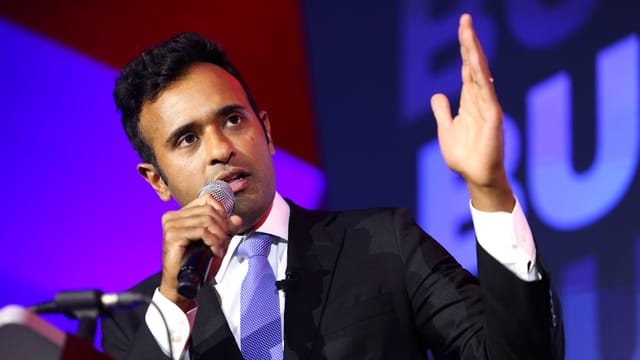

Vivek Ramaswamy has built much of his political identity around a simple proposition: Americans should advance on merit, not identity.
He has attacked affirmative action as institutional racism, spent years crusading against diversity, equity and inclusion programs and wrote a book subtitled Identity Politics, the Death of Merit, and the Path Back to Excellence.
But when Ramaswamy was a wealthy young hedge-fund investor preparing to attend Yale Law School, he accepted $50,000 from a fellowship for which his own identity was indispensable.
Ramaswamy was awarded a Paul & Daisy Soros Fellowship for New Americans in 2011. The fellowship was created specifically for immigrants and children of immigrants. Ramaswamy, born in Cincinnati to parents from India, qualified because of his family’s immigrant background.
Without that background, his Harvard degree, academic record, professional accomplishments and Yale admission would not have been enough to make him eligible.
That makes Ramaswamy’s own history difficult to reconcile with the sweeping case he now makes against affirmative action, DEI and institutions taking identity into account when distributing opportunity.
The competition was merit-based. Eligibility was not identity-blind.
Ramaswamy has defended the fellowship by emphasizing that it was merit-based. That is true, but incomplete.
The Soros fellowship selected accomplished candidates competitively. But before merit could determine who won, immigrant background determined who was allowed to compete.
Michigan Technological University described the eligibility rules for the competition in September 2010, shortly before the application deadline that produced the 2011 class of fellows. Applicants had to be green-card holders, naturalized U.S. citizens or qualifying children of naturalized citizens. George Washington University likewise described “New American” status as an eligibility requirement and said applicants had to provide documentary evidence that they met it.
Ramaswamy met that requirement. His official fellowship biography identifies him as “the child of immigrants from India” and says the fellowship was awarded to him in 2011 to pursue his law degree at Yale.
The distinction matters. The program did not simply consider every graduate student in America and choose Ramaswamy because he had the strongest résumé. It first created an applicant pool based on immigrant-family status, then used merit to choose winners from within that pool.
A candidate identical to Ramaswamy in every relevant academic and professional respect, but born to two U.S.-born parents, could not have received the same consideration.
That is an identity-based preference. It was not race-based affirmative action, and the fellowship’s current rules explicitly state that race and ethnicity are not considered when choosing among eligible candidates. But in the broader sense of affirmative action — deliberately expanding opportunity for members of a defined group because of their background — the program did exactly what Ramaswamy now condemns institutions for doing: identity affected access to opportunity.
Ramaswamy was already making serious money
This was also not the story of a penniless student whose only realistic route to Yale depended on financial assistance.
After graduating from Harvard, Ramaswamy worked at QVT Financial, a hedge fund where he specialized in biotechnology investments. His income during that period became an issue during his 2024 presidential campaign after reporters examined tax returns he voluntarily released.
Fox News reported from those returns that Ramaswamy earned a combined $1,173,690 during the three years preceding 2011.
In 2011, the year the fellowship was awarded, Ramaswamy reported another $2,252,209 in total income.
TiffinOhio.net previously reported on those earnings and Ramaswamy’s public explanations for taking the money.
There is an important timing distinction. Ramaswamy has said a large hedge-fund bonus that contributed to his income was paid after he submitted his fellowship application, so it would be misleading to claim that he had already received his entire $2.25 million in 2011 income when he applied.
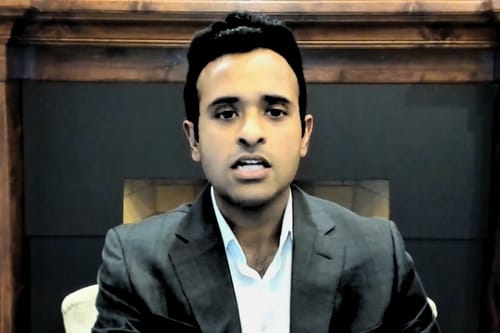
But his finances before the award were hardly modest. During a contentious 2023 interview with Mehdi Hasan, Hasan confronted Ramaswamy with tax-return figures showing roughly $650,000 in 2009 and roughly $450,000 the following year.
Ramaswamy did not ultimately claim he was broke. Defending his decision to accept $50,000, he acknowledged having “a few hundred thousand dollars in the bank” and argued that someone in that position would still take the money.
That defense is perfectly understandable as a statement of personal financial self-interest. Fifty thousand dollars is $50,000, and the fellowship did not require applicants to be poor.
But it leaves the political contradiction intact. Ramaswamy had substantial financial resources and nevertheless accepted a valuable educational benefit that was available to him specifically because he belonged to a favored category: a New American from an immigrant family.
Then came the crusade against affirmative action
Ramaswamy’s subsequent rhetoric has not been limited to opposing racial quotas or arguing over the mechanics of college admissions. He has presented himself as an opponent of a much broader system of identity-conscious decision-making.
After the U.S. Supreme Court struck down race-conscious admissions programs at Harvard and the University of North Carolina in 2023, Ramaswamy called affirmative action “the single greatest form of institutional racism in America today” and promised that, as president, he would end it “in every sphere of American life.”
He went further, declaring that meritocracy and equity were “fundamentally incompatible” and calling for a restoration of “colorblind meritocracy.”
His 2022 book made the argument part of his personal brand. Its full title is Nation of Victims: Identity Politics, the Death of Merit, and the Path Back to Excellence.
The publisher’s biography on that same page contains a striking detail: it touts Ramaswamy’s Harvard education, hedge-fund career and Yale law degree, then notes that he attended Yale as a recipient of the Paul & Daisy Soros Fellowship for New Americans.
In other words, a book marketed around the “death of merit” carries an author biography noting that Ramaswamy benefited from a graduate fellowship he could not have received without qualifying through his immigrant-family identity.
His rhetoric has continued as he moved into Ohio politics. In a lengthy 2025 interview on the Shawn Ryan Show, Ramaswamy described himself as having been a “crusader” against DEI before opposition to it became fashionable and celebrated what he called a “post-DEI” moment. He contrasted equal opportunity with what he derided as attempts to produce equal results.
That philosophy invites an obvious question when applied to Ramaswamy’s own biography: If institutions should distribute opportunity without regard to identity, why should the child of Indian immigrants have access to a graduate fellowship that the child of native-born Americans could not even apply for?
His immigrant background was not incidental
One possible response is that Ramaswamy earned the fellowship. There is every reason to believe he did.
The 2011 fellowship class was highly competitive. Contemporaneous reporting from Stanford said 30 fellows were chosen from more than 1,000 applicants and that the awards provided as much as $50,000 in grants plus $40,000 in tuition support over two years.
Nothing about acknowledging Ramaswamy’s accomplishments changes the eligibility structure.
This is the same distinction at the heart of affirmative-action debates generally. Beneficiaries do not have to be unqualified for a preference to exist. The relevant question is whether membership in a particular group changes someone’s access to an opportunity.
For Ramaswamy, it did.
His immigrant background was not a biographical footnote added after he won. It was the threshold fact that permitted his application to be considered.
If his parents had been born in Cincinnati instead of India, Ramaswamy could have possessed the same Harvard diploma, worked at the same hedge fund, earned the same hundreds of thousands of dollars and secured the same admission to Yale Law School. He still would not have qualified for the fellowship.
A politically inconvenient piece of his biography
The fellowship later became sensitive enough that Ramaswamy paid a Wikipedia editor who removed the reference from his biography shortly before he announced his 2024 presidential campaign.
TiffinOhio.net previously reported that the paid editor removed references to both the fellowship and Ramaswamy’s service on Ohio’s COVID-19 Response Team. His campaign acknowledged paying for edits but denied they were politically motivated, saying the changes were intended to correct factual distortions. The fellowship reference was later restored.
That episode is often reduced to the politically explosive Soros surname, but George Soros is largely beside the point here. The fellowship was established by his older brother, Paul Soros, and Paul’s wife, Daisy, both Hungarian immigrants. There is no basis for portraying Ramaswamy’s fellowship as a grant from George Soros or his political network.
The more consequential connection is the one in the program’s name: New Americans.
Ramaswamy received an educational opportunity because he belonged to a class of Americans the program was explicitly created to assist.
The standard Ramaswamy now sets for everyone else
Ramaswamy did nothing improper by applying for the fellowship. He satisfied its rules. The program was not need-based, so his substantial income did not make him ineligible. And a young professional accepting $50,000 that an institution willingly offers him is not, by itself, scandalous.
The issue is the standard Ramaswamy later chose to impose on everyone else.
He does not merely argue that poorly designed DEI programs should be reformed. He has turned “meritocracy” into a defining political principle and attacks affirmative action and identity-conscious institutions as fundamentally incompatible with it.
But one of the institutions that helped Ramaswamy along the way explicitly considered identity before merit ever entered the equation. It first asked whether he was an immigrant or the child of immigrants. Only after he passed that test did his accomplishments matter.
Ramaswamy benefited from that system while already earning sums that most Americans will never see in a year. When challenged years later, he defended taking the $50,000 because it was available to him.
There is nothing irrational about that decision.
What is difficult to square is Ramaswamy’s insistence that identity-based opportunity is corrosive when other people receive it, while treating the identity-based opportunity he received as simply a smart decision to take free money.
For Vivek Ramaswamy, the road to becoming one of America’s loudest opponents of affirmative action included an affirmative-action fellowship available to him because his parents came to America from India.