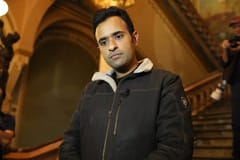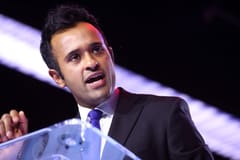
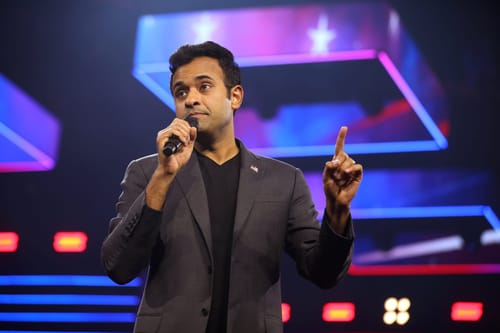

Vivek Ramaswamy built his pharmaceutical empire with companies that repeatedly turned to the H-1B visa program to employ foreign workers. Businesses he founded or that operated within his corporate network received 88 H-1B petition approvals between 2017 and 2024, according to federal immigration records. Now, as he seeks to become Ohio’s next governor, his campaign is collecting money from executives connected to companies that rely on the same foreign-worker visa program.
An examination of Ohio campaign-finance filings by TiffinOhio.net found that Shannon Woodfin, an executive at H-1B-dependent Infinite Computer Solutions, contributed $10,000 to Ramaswamy’s gubernatorial campaign in August and provided another $1,953.56 in catering in September. The company submitted 541 H-1B labor condition applications in fiscal 2026, according to records compiled from U.S. Department of Labor disclosures, and obtained 291 H-1B petition approvals during the fiscal year.
The donations add to Ramaswamy’s extensive history with the employment-based immigration system, one he publicly defended during a 2024 controversy over American technology companies hiring foreign-born engineers. Rather than fault employers for choosing foreign talent over American-born workers, Ramaswamy blamed American culture, declaring that the country had “venerated mediocrity over excellence” and criticizing its failure to produce enough technically skilled workers.
At the same time, two billionaire businessmen whose companies sponsor H-1B workers have contributed a combined $35 million to V-PAC, the independent super PAC established to support Ramaswamy’s campaign for governor. Jeff Yass, co-founder of Susquehanna International Group, has contributed $30 million, while Elon Musk, whose companies include Tesla and SpaceX, contributed another $5 million.
The records establish a financial and political relationship spanning Ramaswamy’s own companies, the executives supporting his campaign and major employers that continue to use the H-1B system. They also place his record on foreign-worker hiring squarely within Ohio’s gubernatorial race, where the next administration will help determine which technology businesses receive public incentives and what commitments the state demands in return.
Ramaswamy’s business empire secured 88 H-1B approvals
Ramaswamy founded Roivant Sciences in 2014, building a pharmaceutical holding company that developed, acquired and financed an extensive network of drug-development businesses. He served as chief executive until January 2021 and remained chairman until February 2023, when he departed to pursue the Republican presidential nomination.
During his presidential campaign, Politico reported that Roivant had obtained 29 H-1B petition approvals between 2018 and 2023, according to U.S. Citizenship and Immigration Services records.
That figure represented only part of the corporate network’s immigration history.
An October 12 investigation by The Daily Beast examined federal immigration records for nine additional companies founded by Roivant, operated as its subsidiaries or otherwise associated with its business network. Together, those companies accounted for another 59 approvals, bringing the total to 88 between 2017 and 2024.
Datavant Sciences, a healthcare technology company founded by Roivant in 2017, accounted for 24 approvals between 2019 and 2024. Nine involved new employment, nine involved changes of employer, two involved continuing employment and four were amended petitions reflecting changes in employment conditions.
Lokavant, which originated within Roivant before separating in 2023, accounted for another nine approvals. VantAI, launched as a Roivant subsidiary in 2019, accounted for eight between 2020 and 2023.
Myovant Sciences, another former Roivant subsidiary, accounted for six approvals before its sale. Oncopia Therapeutics accounted for four, while Axovant Sciences, which Ramaswamy founded in 2014, accounted for three. Covant Therapeutics, Immunovant Sciences, Kinevant Sciences and Urovant Sciences accounted for the remaining approvals.
The figures come from the USCIS H-1B Employer Data Hub, which records employer petitions for foreign workers in specialty occupations. The 88 approvals include new employment, extensions, changes of employer and amendments rather than 88 separate new workers. Some approvals occurred after Ramaswamy had left Roivant’s management or after individual companies had separated from the organization.
That corporate history is significant because Roivant was not simply a company in which Ramaswamy held a passive investment. He established the business, directed its development for years and helped create the corporate structure under which numerous subsidiaries operated.
He also retained a substantial financial stake after leaving the company’s leadership.
In a May 2026 filing with the Securities and Exchange Commission, Ramaswamy disclosed beneficial ownership of 25,534,970 Roivant shares, representing 3.6% of the company’s outstanding stock. His ownership stake kept him financially tied to the business he founded as he campaigned for Ohio governor.
Nearly $12,000 from an executive at a visa-dependent technology contractor
Ramaswamy’s latest Ohio campaign-finance disclosures reveal another connection to the H-1B industry.
Shannon Woodfin of Columbus contributed $10,000 to Vivek Ramaswamy and Rob McColley for Ohio on August 22, according to the campaign’s August monthly report filed with the Ohio Secretary of State. The contribution identifies Woodfin’s employment as “Sales Infinite Computer Solutions.”
The campaign’s September report records a second contribution from Woodfin on September 23: $1,953.56 in in-kind support described as catering.
Combined, those transactions represent $11,953.56 in campaign support from an executive associated with a company that federal immigration records identify as dependent on H-1B workers.
Infinite Computer Solutions, headquartered in Rockville, Maryland, is an information technology services and consulting company operating in industries including healthcare, telecommunications, finance and technology. The company publicly identified Woodfin among its healthcare business leaders in September, and professional information lists Woodfin as vice president of healthcare client services.
The company’s immigration filing history documents extensive use of the H-1B program. It submitted 564 labor condition applications in fiscal 2025 and 541 in fiscal 2026. The same database reports 291 approved H-1B petitions in fiscal 2026, out of 296 petitions decided.
Infinite Computer Solutions is classified as an H-1B-dependent employer. Under federal Department of Labor rules, businesses with at least 51 U.S. employees generally fall into that category when H-1B workers constitute 15% or more of their workforce.
The designation is more consequential than simply appearing in a federal database of companies that have occasionally sponsored foreign workers. It establishes that foreign employees holding H-1B status account for a substantial proportion of the employer’s U.S. workforce.
Infinite Computer Solutions’ filings identify positions in software development, engineering and technical services. Its records also describe work performed at third-party client locations, a staffing and contracting arrangement in which the sponsoring employer places technical workers at another company’s worksite.
Federal law imposes additional recruitment and non-displacement obligations on H-1B-dependent employers, subject to certain exemptions. Those rules address both the sponsoring company’s employees and workers at outside businesses where H-1B personnel are assigned.
The campaign contributions were recorded under Woodfin’s name, not Infinite Computer Solutions. But the employer disclosed in Ramaswamy’s own campaign filing connects the donor to a business with an extensive, documented H-1B sponsorship history.
Ohio staffing firms show how the foreign-worker system operates
The use of H-1B workers at third-party client sites is not limited to large national contractors. Federal immigration filings also document the practice among smaller Ohio-based technology staffing businesses.
At Dizer Corp., an IT staffing company based in Painesville, an H-1B labor condition application filed in June 2025 identified company president Jagdish Medarametla as the employer contact. The application sought authorization for a .NET developer working at ONEOK, an energy company, in Tulsa, Oklahoma.
The federal labor record identified ONEOK as a secondary employer, meaning the worker would perform services at another company’s worksite rather than exclusively at Dizer’s own offices. The application also identified Dizer as H-1B-dependent.
The filing listed an offered annual salary of $86,000 and a prevailing wage of $72,592 for the position. The figures document the compensation disclosed to federal labor officials, rather than a comparison with what a specific American employee was paid.
StaidLogic, another Ohio-based technology services company, has a similar immigration record. Federal labor disclosures identify its chief executive, Kiran Basireddy, as the company contact on H-1B filings and document proposed employment at outside client sites, including ServiceNow.
According to federal-data-derived records, StaidLogic submitted 23 H-1B labor condition applications in fiscal 2025 and another 27 in fiscal 2026. It is also classified as H-1B-dependent.
Gathi Analytics, headquartered in Dublin, Ohio, has sponsored technology workers under the same program. Its immigration records identify Vamsi Kora as a chief executive and employer contact, and show more than 100 labor condition applications during fiscal years 2022 through 2024. The company is also classified as H-1B-dependent.
These filings describe an established industry practice: technology service providers sponsoring foreign technical workers for employment that may take place at the offices or facilities of other businesses. They also show why the distinction between an ordinary employer that occasionally uses H-1B visas and an H-1B-dependent staffing company matters when evaluating corporate hiring practices.
$35 million from billionaires whose companies sponsor H-1B workers
Some of the largest financial supporters of Ramaswamy’s gubernatorial bid are business leaders whose companies also use the foreign-worker visa program.
Jeff Yass, the billionaire co-founder of Susquehanna International Group, has contributed $30 million to V-PAC: Victors, Not Victims, the independent super PAC established to help elect Ramaswamy governor. His contributions include $10 million in March 2025, two $5 million contributions in early 2026 and another $10 million contribution dated August 10, 2026, according to federal campaign-finance data.
Susquehanna International Group sponsors H-1B workers for positions including software development and quantitative research. Its immigration records identify 93 labor condition applications in fiscal 2025 and 92 in fiscal 2026.
Elon Musk contributed another $5 million to V-PAC in May 2026, according to federal campaign-finance records.
Tesla, the automaker led by Musk, is among the country’s major H-1B sponsors. Its federal filing history shows 2,909 labor condition applications in fiscal 2025 and 2,931 in fiscal 2026. The company’s applications include engineering, software development and other technical positions. SpaceX, another Musk-led company, also sponsors H-1B workers.
Yass and Musk have contributed a combined $35 million to the organization backing Ramaswamy’s gubernatorial candidacy. Those contributions are separate from the money received directly by the Ramaswamy-McColley campaign.
V-PAC describes its mission as electing Ramaswamy Ohio governor. The organization operates as an independent-expenditure-only committee, allowing it to accept unlimited donations while remaining legally separate from the candidate’s official campaign operation. Its receipts and spending are disclosed through the Federal Election Commission.
Unlike Infinite Computer Solutions, neither Susquehanna International Group nor Tesla is classified as H-1B-dependent in the immigration records reviewed. Their inclusion illustrates a different financial connection: two of the biggest donors financing Ramaswamy’s election effort lead or founded companies with established histories of sponsoring foreign employees.
Ramaswamy blamed American culture for companies hiring foreign-born engineers
Ramaswamy’s business history and campaign donors are accompanied by his own outspoken defense of technology companies hiring foreign-born talent.
On December 26, 2024, amid an intense debate over immigration and hiring practices in the technology industry, Ramaswamy published a lengthy statement on X explaining why major technology employers frequently favored foreign-born and first-generation engineers over native-born Americans.
His explanation focused on the shortcomings he perceived in American culture.
“Our American culture has venerated mediocrity over excellence for way too long,” Ramaswamy wrote.
He criticized American society for celebrating popularity and athletic success over academic achievement, contrasting prom queens with mathematics competition winners and popular athletes with valedictorians. He argued that the country’s cultural priorities had undermined its ability to produce the technical talent that employers wanted.
Ramaswamy specifically rejected the argument that Americans lacked innate intellectual ability. Instead, he contended that the way Americans raised children and rewarded achievement helped explain the hiring decisions of major technology firms.
His position placed responsibility for the perceived shortage of American-born engineers on the country’s culture and education priorities, while defending employers’ decisions to recruit from a global talent pool.
The comments triggered a backlash from conservative figures who argued that American workers were being overlooked as companies expanded their reliance on foreign labor. The controversy exposed a division between supporters of tighter employment-based immigration restrictions and technology industry leaders who maintained that access to foreign specialists was necessary for business growth.
For Ramaswamy, the debate was not merely theoretical. He had spent years leading a corporate network with documented H-1B use, and his former companies had secured dozens of federal petition approvals. As an Ohio gubernatorial candidate, he is now receiving financial support from individuals connected to businesses that sponsor the same category of workers.
Ohio workers and the next governor’s economic development policies
The financial relationships have direct relevance to Ohio’s economic development strategy as Ramaswamy seeks the governor’s office.
Ohio has aggressively pursued technology investment, including data centers, advanced manufacturing facilities and large corporate expansions. Those projects can involve state and local tax incentives, infrastructure commitments and public resources intended to encourage businesses to invest and create jobs.
Ramaswamy has advocated expanding Ohio’s technology industry and attracting additional investment, including new data center and advanced computing projects. Such developments are frequently promoted for their potential economic benefits, although their long-term employment requirements and demands on public infrastructure vary significantly.
Federal authorities control H-1B petition approvals and the rules governing employment-based immigration. Ohio’s governor, however, appoints officials and influences the agencies responsible for economic development, public incentives and corporate recruitment.
That distinction matters because state officials can decide what employment commitments businesses must make when receiving taxpayer-supported economic development assistance. The next administration will have substantial influence over whether those agreements prioritize specific job-creation targets, wage levels, workforce development or other conditions.
The Department of Labor’s H-1B rules also recognize the consequences that foreign-worker placement can have for domestic employees. Certain H-1B-dependent employers face restrictions on displacing comparable U.S. workers within specified periods, including requirements concerning placements at other employers’ worksites. Those protections depend on the employer, the worker and the circumstances of the application.
The public records establish the central relationships: companies within Ramaswamy’s business empire obtained 88 H-1B petition approvals; he publicly defended technology companies’ preference for foreign-born engineers while criticizing American culture; a senior employee at an H-1B-dependent technology contractor provided nearly $12,000 in support to his campaign; and two billionaire business leaders whose companies sponsor H-1B workers have put $35 million behind the independent organization supporting his election.
As the November 3 election approaches, those records put Ramaswamy’s own business practices and financial supporters at the center of a consequential question for Ohio: how the next governor will use the state’s economic development authority to shape employment opportunities for the workers those public investments are supposed to benefit.