
A governor makes judgment calls about people. Who gets appointed. Who gets trusted with power. Who gets cut loose when conduct crosses a line. Most of those calls happen without a reporter in the room, which makes the ones that happen in public the only preview voters get.
Vivek Ramaswamy has made four of those calls in public this year. They do not line up.
A state representative investigated over an accusation involving a minor relative came off his endorsements page and has stayed off, without Ramaswamy ever saying a word about why. A second state representative came off the same page and was back on it two hours later. A congressman under a House Ethics investigation into domestic violence allegations, condemned by both of Ohio’s Republican U.S. senators, is still listed as of Tuesday. And the super PAC that exists to elect Ramaswamy has twice built television ads around the fact that his opponent was sexually abused as a child.
Four allies. Four outcomes. None of them tracking how serious the underlying accusation was. There is no principle that produces that set, and the campaign has never articulated one.
What the campaign did in April
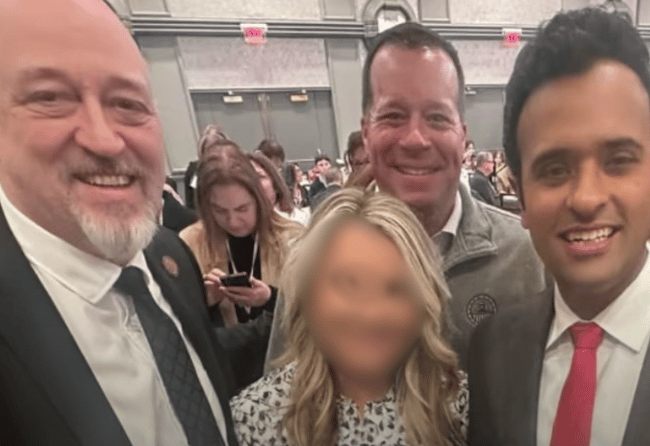
In April, TiffinOhio.net reported that Ramaswamy’s endorsements page listed two state representatives: Rodney Creech of West Alexandria, whom a minor female relative accused in 2023 of climbing into bed with her while erect and wearing only his underwear, according to Ohio Bureau of Criminal Investigation records; and Gary Click of Vickery, the Republican who represents Tiffin and Fremont, who had told a legislative committee that young girls confided in him about their sex lives.
Click’s remark came during sponsor testimony on House Bill 68 before the Ohio House Public Health Policy Committee on April 19, 2023. Describing what he said were the effects of puberty blockers, Click, a former fundamentalist Baptist pastor and community theater actor, told the committee that “young girls who’ve gone through this have told me it is very, very painful to have sex.” A former senior pastor at Fremont Baptist Temple, Click has never publicly identified who those girls were, how old they were, when the conversations happened, or in what capacity he was having them.
Creech was never charged. The Republican special prosecutor who closed the case wrote that Creech’s conduct was “concerning and suspicious,” but that the evidence fell short of the threshold for prosecution. Creech denied the allegations and called them demonstrably false. That was still enough for the leader of his own caucus: House Speaker Matt Huffman stripped him of all four committee assignments and asked him to resign. Creech did not. Nine months later Huffman restored the assignments and asked the state party to endorse him, explaining that the allegations “either weren’t true” or it “wasn’t clear if they were true.”
Within two days of the TiffinOhio.net reports, both names came off vivekforohio.com. No announcement. Web Archive snapshots caught it. Then, roughly two hours after this outlet documented the removals, Click’s name reappeared, and Click told his followers that reports of his removal had been “greatly exaggerated.” The archived snapshots said otherwise.
Nothing about the underlying allegations changed in those 48 hours, or in the two hours after that. This was not a stale endorsement sitting on an abandoned page nobody had noticed. The page moved. Click vanished. The removal became public. Click returned. Whatever the campaign was weighing, it was not the substance of what either man had been accused of, because none of that substance changed at any point in the sequence.
What the episode does establish is capability. This campaign knows how to take a name off its website, and it can do it inside a business day.
Creech’s name has stayed off since. Ramaswamy has never publicly asked him to step aside, and Creech is the Republican nominee in House District 40 on the November ballot.
The Miller test
Which brings us to the name that is still there.
A fetch of Ramaswamy’s endorsements page on Tuesday shows U.S. Rep. Max Miller listed under “Ohio Congressional Delegation,” alongside Jim Jordan and Warren Davidson. Gary Click is listed under “Ohio State Legislators.”
Miller is the subject of a House Ethics Committee investigation opened Aug. 4 into whether he engaged in domestic violence and abuse or illegal drug use. He asked for the investigation himself. His ex-wife, Emily Moreno, has alleged in court filings and police reports that he threw scalding water on her, shoved her against a wall and held a gun to her head, and that their 2-year-old daughter was injured in his care. Miller denies all of it — “I categorically deny abusing my former wife,” he said in a livestream on Aug. 2 — and he faces no criminal charge.
This is the easiest call a candidate will ever be handed, because the pressure is coming from inside the party. Emily Moreno’s father is U.S. Sen. Bernie Moreno, who wrote that “If there are any basic standards of character required to hold elected office, Max Miller fails them. He should not serve in the House of Representatives.” On Aug. 6, Ohio’s other Republican senator, Jon Husted, called on Miller to quit both the race and the seat. Gov. Mike DeWine called the allegations troubling. Americans for Prosperity’s Ohio director called Miller unfit to serve.
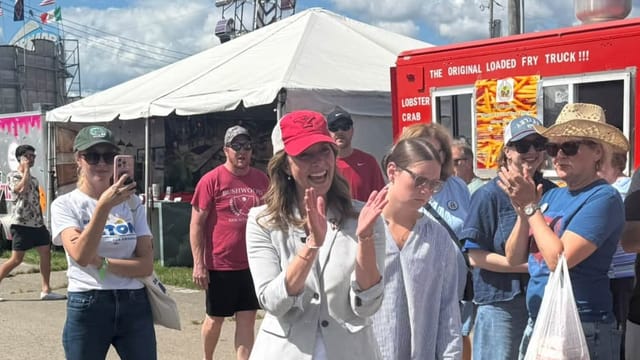
Asked about Miller at the Ohio State Fair on Aug. 5, Ramaswamy said: “I wish everybody’s family well. My prayers are with the granddaughter who’s involved in that situation. And I think that is the most important thing.”
Two U.S. senators, a governor and a major conservative advocacy group found words. The nominee for governor found prayers. Ohio Democratic Party spokeswoman Katie Seewer put it more sharply, saying in a statement that “Vivek Ramaswamy’s silence regarding the horrifying abuse allegations against Max Miller is disqualifying.”
The deadline for Republicans to replace Miller on the ballot passed at 4 p.m. on Aug. 10 with no substitute filed. He is locked in. Ramaswamy’s endorsement survived that deadline too, and it has now survived more than two weeks of allegations graver than the ones that got Creech scrubbed inside 48 hours. Congressman Mike Carey held a fundraiser with Miller as co-host after the ethics probe opened. Silence is passive. A campaign page is a published document, and buying a ticket is not passive at all.
What the ads say
Here is what makes this more than an argument about website maintenance.
During the same months that Ramaswamy’s campaign was moving names on and off a page, the super PAC whose sole stated mission is electing him has twice put his opponent’s childhood sexual abuse on Ohio television.
In 1994, Dr. Amy Acton answered a question on her Ohio medical licensure application disclosing that she had sought therapy after being sexually abused as a child. That question no longer appears on Ohio applications, because it was found to deter applicants from getting treatment. V-PAC: Victors, Not Victims built an ad around that disclosure in the spring, telling viewers Acton “admitted to emotional or mental illness, drug addiction, or an alcohol problem,” and closing by telling them they would not want her as their doctor and “definitely not as governor.” Days after the Cook Political Report moved the race from Lean Republican to Toss Up on July 10, the material ran again.
That is not an argument about taxes, or COVID policy, or schools, or energy. A woman was sexually abused as a child and got therapy. Ramaswamy’s most powerful outside political operation turned that into a reason to distrust her.
Acton campaign manager Phil Stein said in April that “we were shocked and disgusted to see Ramaswamy’s allies shame Amy for being sexually abused as a child.” In July, after the second round, he said: “Vivek Ramaswamy is once again spreading lies about Dr. Acton and shaming her for being a survivor of childhood sexual assault, all to distract from the fact that Ohioans can’t stand him.”
The day after the first round of criticism, he posted a video to X dismissing Acton as having no vision “other than complain about what someone else did to her.” That was Ramaswamy speaking. Not a super PAC. Not an anonymous account. The man asking Ohio to make him governor.
V-PAC is not a grassroots operation with a message problem. Federal filings show five men — Jeff Yass, Ross Stevens, Ratmir Timashev, Elon Musk and Bill Ackman — have supplied $37 million of the roughly $42 million it has raised. None of them lists an Ohio address. In June alone, the committee reported more than $8.2 million in spending against Acton, nearly $8 million of it in a single payment. Somebody with money approved that ad, twice.
The money and the record
The pattern is not confined to endorsements. Ramaswamy’s campaign accepted more than $10,102 from Andrew Havas, a Statehouse lobbyist who served 90 days in jail after a 2009 guilty plea in a case involving a 15-year-old — originally charged as sexual misconduct with a minor, reduced to misdemeanor assault. Havas had already resigned as Husted’s Franklin County campaign chair over the same case. The campaign also took $10,000 from Mark Hauser, who served federal prison time in the Varsity Blues admissions scandal. No campaign-finance violation has been alleged in either instance. The question is not legality. It is what a campaign does once it knows.
The Acton campaign has added a further count, noting that Ramaswamy declined for months to call for release of the Jeffrey Epstein files and that a pro-Ramaswamy super PAC took $100,000 from Epstein associate Glenn Dubin in 2023 and dissolved without refunding it, despite a pledge to do so. Dubin was never criminally charged and has denied wrongdoing; that money went to the PAC, not to Ramaswamy’s campaign, and Ramaswamy said at the time that his campaign would redirect the smaller sum he personally received to anti-trafficking causes.
And there is the part of this that is about governing rather than campaigning. Ramaswamy’s running mate, Senate President Rob McColley, stalled Senate Bill 341, the bipartisan measure that would end marriage for 17-year-olds in Ohio with no exceptions. In February he said the Senate would “certainly take a serious look at it and probably pass it.” By May, Republicans had pulled it from the Judiciary Committee’s agenda and McColley was saying, “We’ve still got time left in this legislative session.” Lawmakers went home for the summer without passing it. Ohio’s next lieutenant governor is on the ballot with Ramaswamy.
What it adds up to
Every individual fact here has a defense available. Miller denies the allegations and has not been charged. Creech was never charged. Click has broken no law. The ads belong to the super PAC. Donations are not endorsements. A bill can always be scheduled next session.
What they do not describe is a standard.
Rodney Creech drew a BCI investigation, a special prosecutor who called his conduct concerning and suspicious, and a speaker of his own party who asked him to resign. His name came off the page, and Ramaswamy has never said why or asked him to leave the ballot.
Gary Click gave testimony about young girls and sex he has never explained. His name came off the page and went back up two hours after the removal was reported.
Max Miller is under a House Ethics investigation into domestic violence and drug allegations, has been called unfit by his former father-in-law and told to resign by Ohio’s other Republican senator. His name is still up.
Amy Acton is not an ally, so she got the other end of it: her childhood sexual abuse on television, twice, paid for by five men who do not live in Ohio.
Rank those four by the seriousness of what is alleged and you get one order. Rank them by how Ramaswamy’s operation treated them and you get a different one. The two lists have nothing to do with each other.
The issue is not whether Vivek Ramaswamy committed the conduct attributed to anyone else. He did not. The issue is what he does when he is confronted with it. That is what judgment is, and it is the whole of the job he is applying for.
So here is a question he should have no trouble answering:
What does someone in Vivek Ramaswamy’s political orbit have to do before Ramaswamy decides he no longer wants their name attached to his?