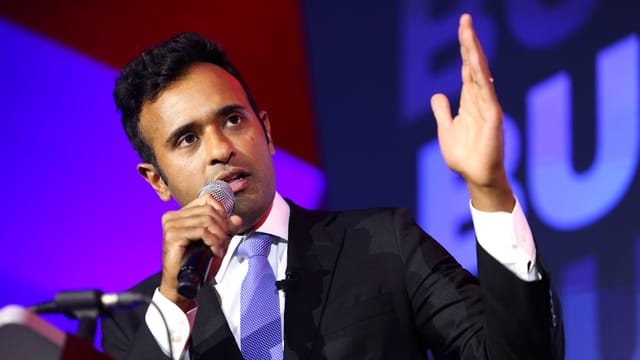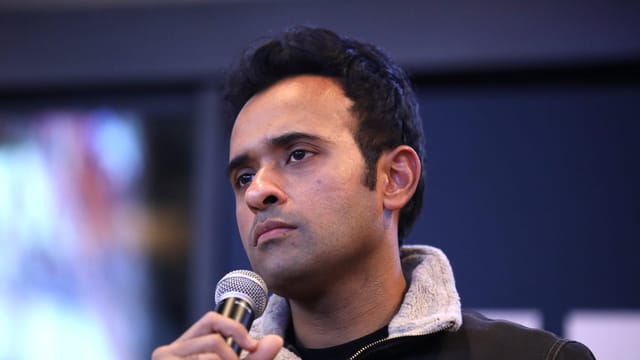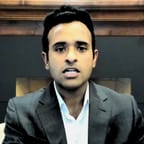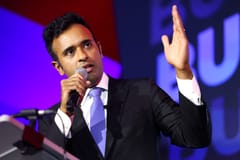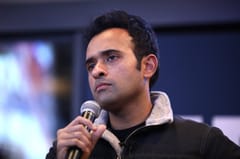

Vivek Ramaswamy ruled out a 2028 presidential run exactly once: one sentence, to one reporter, 18 months ago, before a single vote had been cast in Ohio. He has not said it again since becoming the Republican nominee for governor on May 5.
He has good reason not to. The arithmetic of the next presidential cycle is brutal for a first-term Ohio governor, and he knows the numbers better than anyone — he ran them himself in 2023.
What he promised
In February 2025, days before launching his campaign at a Butler County aerospace plant, Ramaswamy told NBC News that if elected governor he was “fully committed to serving a full term.”
Then he went further. Asked about his plans by the Wall Street Journal, he said he intended to be a two-term governor. “Those eight years will go by quickly,” he said.
Eight years is a claim on two full Ohio election cycles, made by a man who had spent the previous 24 months running for president, angling for a Cabinet post, lobbying for a Senate appointment, and taking — then abandoning — the co-leadership of the Department of Government Efficiency. Dave Yost built his primary campaign on that pattern. Yost is gone. The line stuck.
Forty-three days
Ramaswamy declared for president on Feb. 21, 2023 — 623 days before the 2024 election. Run that same interval back from Election Day 2028, which falls Nov. 7, and the launch date is Feb. 23, 2027.
Ohio’s next governor is sworn in Monday, Jan. 11, 2027. Feb. 23 is 43 days later.
Not one budget. Not one legislative session. Six weeks. A campaign built at the pace of his last one would be hiring in Des Moines and Manchester while the new administration in Columbus was still filling agency directorships.
Ohio law won’t stop him
Five states force an officeholder to quit before running for something else: Arizona, Florida, Georgia, Hawaii and Texas. Florida exempted presidential candidates in 2023, in a bill signed by a governor who was about to become one. Ohio has no such law at all. A sitting Ohio governor can run for president and keep the job while he does it.
The only hard limit sits at the far end. Article III, Section 2 caps a governor at two successive four-year terms. It says nothing about ambition.
2028 is occupied
JD Vance leads the Pollsmax average of national 2028 Republican primary polling at 40.0%, with Marco Rubio at 19.3%. Ramaswamy sits at 2.2%. Trump has called Vance “most likely” his heir apparent.
Vance is also from Ohio. And Ramaswamy’s campaign for governor was assembled out of Vance’s own political shop — strategist Jai Chabria, adviser Andy Surabian, ally Arthur Schwartz and pollster Tony Fabrizio all moved over in early 2025. Challenging Vance in 2028 would mean running against the operatives who built the operation, at 2%, against a sitting vice president with the president’s blessing, having just broken a promise to the state that elected him.
That isn’t a lane. It’s a cliff.
2032 is the cycle that fits
Run the numbers four years out and everything that blocks him disappears.
Ramaswamy turned 41 this month. He would be 47 on Inauguration Day 2033 — younger then than Vance is today. A single completed term as governor runs Jan. 11, 2027 to Jan. 13, 2031: promise kept, record built, term limit untouched, campaign launched from private life with a national donor file already in hand. Win a second term in 2030 and the timing tightens, but the constitutional clock still doesn’t bind until January 2035.
The one variable he can’t control is whether Vance wins. An incumbent Republican president fills the 2032 cycle. A defeated Vance empties it — and a two-time presidential candidate fresh off four years running a large industrial state stops being an asterisk and starts being a front-runner.
The machine is already federal
V-PAC: Victors, Not Victims, the outside group spending on Ramaswamy’s behalf, is not an Ohio committee. It is registered with the Federal Election Commission as an independent-expenditure-only super PAC, FEC ID C00892919, first filed in November 2024 — three months before he entered the governor’s race.
It reports $41.8 million raised this cycle and $25.9 million in cash on hand as of June 30. Federal committees aren’t built for one contest; they keep filing with the FEC until they terminate. Four billionaires supplied 98% of its second-quarter money, including $5 million from Elon Musk. A national fundraising apparatus, run by national operatives, aimed at Ohio for now.
What the ballot actually asks
The eight-year promise was made in February 2025. Since then the New York Times has listed him among Republicans who could make a quick leap from a governor’s race to a national campaign, he has spent 79 days of an election year outside Ohio including 14 international travel legs, and Steve Bannon has told his audience to write the state off.
The race is tight. The Pollsmax average of Ohio governor polling has Ramaswamy up less than a point, and an Aug. 13 Wedgewood survey had Amy Acton ahead 47-46. Acton has outraised him from actual donors three filings running.
Ohioans aren’t just choosing a governor for four years. They’re choosing whether to hand the office to a man whose answer to “will you run for president again” is yes, and whose only open question is which cycle. On the calendar, 2028 costs him everything. On the calendar, 2032 costs him nothing.