
About 9% of Ohio’s state lawmakers are moms of children under 18, according to a new report, giving them insight into issues impacting families with minor children, several said in interviews.
The third Politics of Parenthood: Representation in State Legislatures report was recently published by the Vote Mama Foundation, a nonprofit organization that studies the political participation of mothers in the United States.
About 4% of Ohio state lawmakers were moms of minors when the first report was published in 2022 and that number rose to 6% in 2024 for the second report.
Of Ohio’s 132 state lawmakers in 2026, 12 are moms of minor children as of February, according to this year’s report. Ohio would need 13 total moms of minors to reach proportional representation among the population at-large, according to the report.
Only two states have reached proportional representation: California and Virginia.
Ohio ranks 23rd in this year’s report — a significant jump compared to being ranked 37th in 2024.
“It’s important to have well-rounded conversations, and the only way to do that on each piece of legislation is to have a variety of people in these elected positions,” said Ohio state Rep. Lauren McNally, D-Youngstown.
Ohio lawmakers who are moms of minor children are:
-
State Sen. Susan Manchester, R-Waynesfield
-
State Rep. Ashley Bryant Bailey, D-Cincinnati
-
State Rep. Rachel Baker, D–Cincinnati
-
State Rep. Beryl Brown Piccolantonio, D-Gahanna
-
State Rep. Kellie Deeter, R-Norwalk
-
State Rep. Sarah Fowler Arthur, R-Ashtabula
-
State Rep. Latyna Humphrey, D-Columbus
-
State Rep. Crystal Lett, D-Hilliard
-
State Rep. Lauren McNally, D-Youngstown
-
State Rep. Monica Robb Blasdel, R-New Waterford
-
State Rep. Allison Russo, D-Upper Arlington
-
State Rep. Heidi Workman, R-Rootstown
The Ohio Capital Journal talked to Fowler Arthur, McNally, Bryant Bailey, and Piccolantonio about balancing motherhood and their work in the legislature.
“We need more moms in every state legislature across the country,” Bryant Bailey said.
“The ability to truly understand wholeheartedly a lot of the issues that plague our residents really starts with the lens of how we learn to be protectors as mothers, and it pains me that our government is not really suited for moms, I’ll even say for parents in general, especially of young kids.”
Nationally, 8.3% of state legislators are moms of minors — a 5.3% increase since the 2024 report.
Of the 7,386 state legislators in the United States, only 613 were moms with children under 18, as of February, according to the report.
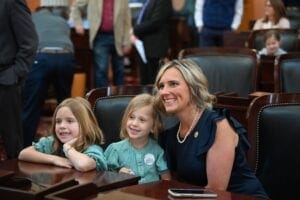
About 730 more moms with kids under 18 are needed to have proportional representation in state legislatures, according to the report.
“(Being a mom) is one of the busiest phases of life,” Piccolantonio said. “That is one of the reasons why the numbers are so low, and also the reason why it is so important to have those voices at the table when making policy decisions.”
California and Virginia have reached proportional representation.
“Getting mamas at every decision-making table requires paying attention to state legislatures, which pass tens of thousands of bills each year that affect nearly every aspect of families’ lives,” Liuba Grechen Shirley, founder and CEO of Vote Mama Foundation, said in a statement.
This is the first year moms of children under 18 have been elected to all 50 state legislatures, according to the report.
Challenges experienced
An often mentioned challenge of balancing motherhood and being a lawmaker is the distance from a lawmaker’s district to the Ohio Statehouse and missing out on family activities.
“I can’t just be home after session, regardless of what time session ends,” said McNally, who lives about three hours away from the Statehouse and has four children — ages 12, 10, 9, and 6.
“I can’t come home for an emergency. I’m not home in time for their baseball game because committee ended at four. I’m doing homework in between committee on FaceTime at the Statehouse with them, or helping my daughter pick out her school outfit for picture day on FaceTime while I’m down in Columbus.”
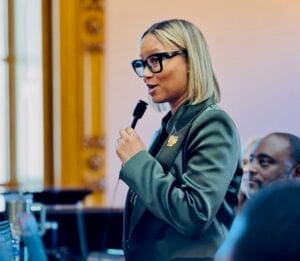
McNally acknowledged it can be hard to make it to events in the evenings or on the weekends.
“I get that you want me to come to your event on Sunday, but I want to go to my kid’s soccer game on Sunday,” McNally said.
To squeeze in extra time with her kids, she tries not to work on President’s Day or Martin Luther King Jr. Day when her kids are off school.
“When I am home, I try really hard to make moments that are exciting for them.”
But the work does not always stop, even when she is with her family.
“There’s very few places I go where I don’t get stopped to have a conversation about something, and that includes my kids’ baseball game or my kids’ dance competition, where my kids want me to focus on them,” McNally said.
Bryant Bailey has two children — ages two and seven — and she said there is some guilt at times when it comes to balancing legislative duties and motherhood.
“I don’t live in Columbus, so when I’m there to do the legislative work — whether we’re in session or not — it’s always going to be time away,” she said.
“Even when I am in Cincinnati, the work doesn’t stop. … There’s always that short-term feeling of are they seeing me enough?”
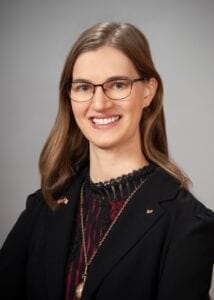
Becoming a mom has changed how Fowler Arthur spends her time traveling to and from the Statehouse, which is at least a three hour drive.
She typically leaves early Tuesday morning for committee meetings and goes back home Wednesday after session.
“I really try hard to be here to tuck them in and be here when they wake up as much as I can,” Fowler Arthur said.
“They’re always so happy to see that, but it is a lot more wearing, I think, on me personally just to be driving on top of these really full days that we already have.”
Even though Piccolantonio lives in Central Ohio, she’s not able to make it to everything for her sons.
“There are definitely sacrifices missing out on activities or things that get scheduled,” she said.
Her youngest son plays tennis, but she’s only been able to make it to one of his matches.
“I work to find ways to be constantly connected with him, even if I’m not physically there with him,” Piccolantonio said.
“We try — in the times that I’m not as busy — to schedule more time together. I try as hard as I can to keep Sundays clear.”
State Rep. Sarah Fowler Arthur
Fowler Arthur and her husband legally adopted their children — ages 8, 9, and 10 — almost three years ago after fostering them.
Becoming a mom has made Fowler Arthur, who is the chair of the Ohio House Education Committee, more passionate about children learning how to read and the importance of math.
“I didn’t really connect how absolutely unprepared for everyday life someone could be until my kids came into my house officially going into second grade and going into first grade in the public school, and still could not read, and seeing them struggle through the process,” she said.
“If they have those two basic fundamental skill sets (reading and math) they really do have the world at their fingertips. If they don’t, they are at such a huge disadvantage compared to their peers who can read.”
Fowler Arthur occasionally brings her children to the Ohio Statehouse — sometimes if they can’t find child care and other times as part of their homeschooling education.
“They really love to come and to observe and be a part of just the day-to-day activities of the legislature, which I think is a really neat hands-on experience,” she said.
“They love coming home and playing state representatives.”
State Rep. Lauren McNally
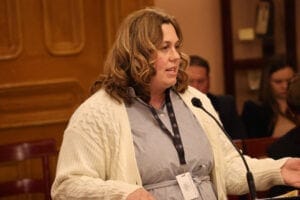
McNally had her three youngest children while serving on Youngstown City Council before being elected to the Ohio Statehouse.
“Both times I ran for city council, I was pregnant,” she said. “They’ve been my winning lucky charm.”
At the Statehouse, most of McNally’s testimony for bills includes a personal story about her children.
When she testified in support of Ohio House Bill 63 — which would require security cameras at all rest areas — McNally talked about how her family decided where to stop on a road trip while driving through West Virginia.
“I didn’t know it, but our then three-year-old was getting motion sickness,” she said in her April 2025 testimony.
“Our family weighed the pros and cons of stopping … It wasn’t until we made it to a Welcome Center that we finally stopped, got her cleaned up, and went on our way. … (Travelers are) looking for locations with a presumption of safety.”
From wearing her campaign shirts during election season to conversations about McNally’s work during dinner, her children are “very much involved” in her job as a lawmaker.
“It’s not a traditional job from that perspective,” McNally said.
“Protecting your family unit while also being in the public eye like this is a balance.”
State Rep. Ashley Bryant Bailey
Being a mom impacts every decision Bryant Bailey makes and the implications it will have for her two children.
She introduced Ohio House Bill 768 which would allow certain child care staff members to receive publicly funded child care.
“My daughter goes to daycare, and I know full well there are teachers at her daycare that can’t afford to send their own kids there,” she said.
“I talk to the child care workers at my daughter’s school all the time about how difficult it is, and I know firsthand how expensive childcare can be.”
State Rep. Beryl Brown Piccolantonio
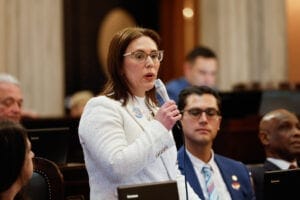
Piccolantonio said her sons — ages 22, 20, and 16 — are the reason she serves in the Ohio legislature.
“It’s at the forefront of my mind whenever I’m thinking about any bills that we’re talking about,” she said.
“When I’m making decisions, a lot of times I’m thinking about it from the perspective of what would my kids think about me doing this.”
Piccolantonio often finds herself asking how a bill would affect young people and families.
“How would this legislation make it easier or more difficult for a family, for a mom, to be able to afford to live in Ohio or to be able to have opportunities in this state?” she said.
Piccolantonio wrestles with her children being part of public life.
“You are a public servant, it really is a full family commitment … but for kids who are minors, they’re not consenting to be part of public life, and yet they are part of public life,” she said.
Most people Piccolantonio’s sons interact with know their mom is a state representative.
“Their identities are set in that way without them having made a choice about that,” she said.
“It weighs on me a lot. They are young people trying to forge their own identities. That’s a lot to carry on their shoulders.”
She often talks about that with her sons.
“I have a lot of different roles, but in my mind, my first role is always as mom.”
Follow Ohio Capital Journal Reporter Megan Henry on X or on Bluesky.
This story is republished from the Ohio Capital Journal under a Creative Commons license. View the original article.