

When Izetta Thomas was just starting out on her journey as a special education teacher in Ohio, she quickly learned the history that held up the work she did.
“I knew and learned that disability rights and everything that I am able to do as an intervention specialist, or a special ed. teacher, was hard fought for and won, which also means it was under threat,” Thomas said.
She left her job to lead the Columbus Education Justice Coalition, but Thomas said she misses the classroom every day, and has held on to the belief that the job of an educator “may be one of the most politically charged careers in this day and age.”
“I do think that if you are called to do this work, it is worth it, but you should go in eyes open, and go in knowing public education is under attack, and if certain folks have their way, then other systems and education would be under attack, too,” Thomas said.
Educators and advocates like Thomas are worried that reduced public school funding and a lack of resources has taken its toll already, causing teacher shortages both in Ohio and nationwide. But there is hope that opportunities exist, if the state can get behind them.
National, pervasive, and ongoing
Anyone and everyone in the education field is looking for solutions to staff shortages in public schools. While advocates blame the problem on a lack of financial support from the state government, officials are pushing for more creative recruitment strategies.
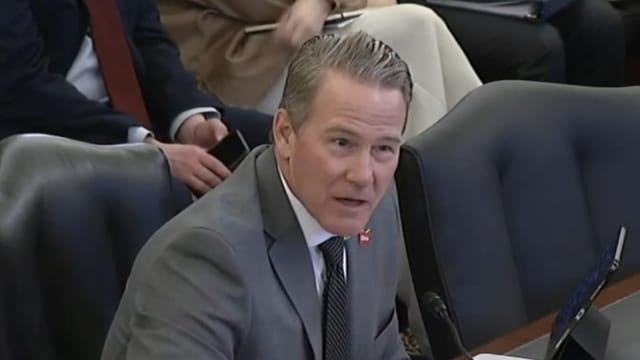
“The teacher shortage issue, the teacher pipeline issue, whatever buzzword we’re using to identify it at the moment, is something that’s national, pervasive, and has been ongoing for quite some time now,” said Jason Wagner, Ohio’s interim superintendent of public instruction.
Wagner told a May meeting of the Ohio State Board of Education that across the country, more than 400,000 teaching positions were unfilled or filled by teachers without full certification in the 2024-2025 school year. That amounts to 1 in 8 teaching positions in the U.S.
The biggest shortages are in the areas of special education, science, and math, Wagner said, though deep shortages are also present in English/language arts, elementary education, and career technical education.
State data is a little more complicated, as the full picture of what the teacher shortage looks like needs work, according to educators and advocates. The Ohio Education Association and the Ohio Federation of Teachers said anecdotal evidence from around the state certainly shows a struggle to attract and retain qualified teachers, but they’re awaiting new data on teacher “vacancies” from the state.
“It could be that we’re not seeing a whole lot of openings yet, but this anecdotal data of having less applicants apply means that looking down the road we could have a potential shortage bigger than what we have right now,” said Melissa Cropper, head of the Ohio Federation of Teachers.
The most recent state operating budget included a provision directing the Ohio Department of Education and Workforce to begin collecting data on teacher vacancies in the 2026-2027 school year. That data isn’t expected to be released until at least the end of 2027, according to Wagner.
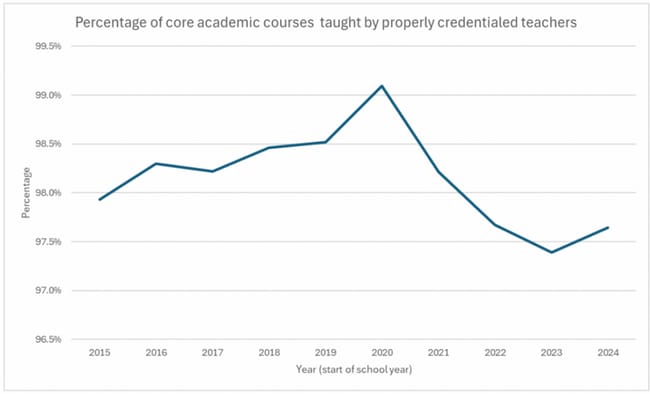
The interim superintendent said the state’s annual education report cards show a “pretty steady, gradual decline” in the rate of properly certified teachers. He said it’s something the state “should take note of,” but that Ohio is faring better than other states when it comes to qualified teacher retention.
Ohio’s percentage of core academic courses taught by properly credentialed teachers stood just above 97.5% in 2024, a small rise from the previous year, though still lower than any year between 2015 and 2022. Wagner said pandemic-year credential flexibility caused a jump in 2020.
“So while, yes, we can observe trends here, it is worth noting that Ohio does rank very highly as far as … national averages compared to other states with actually having properly certified teachers in the classroom,” Wagner said.
He also noted that Ohio’s starting salaries are “comparable” with the U.S. average. According to state data, Ohio’s average starting salary for a teacher is $43,800, versus the U.S. average of $44,530.
Still, he said, the vacancy data is going to be “very helpful when we have it.”
Teachers need more
Math teacher Laura Fehskens said she came to her subject area because of the shortage of math teachers when she came out of school.
“I wanted to be a teacher, but I also wanted to have a job when I came out of school, so that was one of the tipping points in choosing secondary math, was that I knew there were jobs out there,” said Fehskens, who teaches at the Miami Valley Career Technical Center.
Though that was more than a decade ago, she has watched school administration battle with a fading pool of candidates for jobs.
“I spoke with both my direct supervisor and one of the other supervisors, and they stated that the pool of qualified candidates is maybe half as big as it was when he began as a supervisor 15 years ago, and it’s even worse for math,” Fehskens said.
Fehskens and Thomas agree on some of the main factors playing into the lack of interest in the field: lack of respect and support for teachers, a lack of commitment to consistent funding for public schools, and the increasing weight of documentation and standardized testing.
“I hear from a lot of my friends who are still in the classroom that they don’t have time to teach anymore because of the paperwork that goes with it,” Thomas said. “I had a lot of paperwork … but it’s triple now with the legislation that has come from the state, and a lot of the things that are mandated at the federal level.”
Education advocates decried the underfunding of public schools as EdChoice private school vouchers were made nearly universally available to all income levels. Opponents of the voucher system say its taking away from public school coffers and population.
Without the proper funding for wages and resources, educators say class sizes have increased, teachers are overburdened, and it’s a struggle to meet accommodations for the students that need it most.
Fehskens said Miami Valley has had to get “super creative” in finding ways to provide small group testing to those with special needs and individualized education plans that require them. Sometimes that means pulling a student out of an elective, or conducting two days of testing just to serve a student properly.
“If we had the staff that we needed, if we had the funding needed to provide for those staff, then those students would better receive those accommodations in real time and that’s, of course, going to be better for the student and the teachers in the long run,” Fehskens said.
Bringing in a new generation
While colleges and universities are working to find ways to bring in new teachers, a state-funded program to build up the workforce didn’t make it past the state operating budget.
The Grow Your Own Teacher scholarship that provided $7,500 per year for four years to students going into education is no longer accepting applications as the state works to “wind down” the program, according to Jana Fornario, of the Ohio Department of Higher Education.
The program allowed students to receive the scholarship if they agreed to teach for at least four years in their home district. If a spot was not available in their home district, the scholarship winners could serve at another “high-need” district.
The scholarships had recently been expanded to allow students at educational service centers, community schools, and career tech to be nominated for the scholarships. In the 2025-2026 school year, 856 students were nominated for the awards, 206 were awarded scholarships, and 168 accepted, according to state data. The amount was a significant bump from the year before, which Fornario said could be because of the expanded eligibility, but also because the program was more publicly known.
“I think the flexibility contributes, but I also want to say that we saw much more interest and awareness from districts,” Fornario told the state board of education.
For the 2026-2027 school year, the agency was able to award scholarships with remaining funds, taking students from previous waitlists of applicants. A scholarship was accepted by 143 students this year.
“I believe if we had been able to conduct a new round, I think we would have seen continued exponential growth, in all likelihood,” Fornario said.
Wagner told the State Board of Education that while financial incentives are important, growing the teacher workforce “has to be a comprehensive approach.”
“Reducing the turnover rate, engaging in efforts to increase our retention, not only benefits our students, but also benefits district and school administrators who are trying to fill these gaps in ways that are sustainable and not costly to the district or the school that they’re in,” Wagner said.
New bills currently active in the Ohio Statehouse would work to narrow grade bands for educator licenses, and could give student teachers compensation to incentivize them to stay. Ohio Senate Bill 144, which has bipartisan support but has been stuck in the Ohio House since November, would require the Ohio State Board of Education to specify whether a license is being issued to teach grades Pre-K through five, fourth through eighth grade, or grades seven through 12. Current law only requires licenses to specify pre-K through eighth or grades seven through 12.
“We really think that any kind of shortage or staffing issues at the middle level will be solved with not just a (preschool through eighth grade) license, but the P through 5, and then a four through eight comprehensive license would be able to solve those shortages just as easily,” Dr. Melissa Askren-Edgehouse, president of the Ohio Association of Private Colleges for Teacher Education, said during a meeting with the state board of education. Askren-Edgehouse is also the director of the school of education at the University of Mount Union.
Ohio House Bill 523 would allow a public school to pay a student teacher a stipend determined by the school, and allow public colleges and universities to establish a lower tuition rate for a student enrolled in a “teacher preparation program” while working as a student teacher. The bill also has bipartisan support, has passed the House, and is awaiting Senate consideration.
Associations and academics working in teacher education said higher education institutions need to bridge the gap to bring new teachers into the workforce, which is happening at some schools.
Universities like Bowling Green and Miami of Ohio already have partnerships with technical schools and career centers to help high-schoolers get a leg up in the education field, according Dr. Alicia Crowe, president of the Ohio Association of Colleges for Teacher Education. Kent State University, where Crowe is an interim dean and professor, is also working with multiple local schools to create teaching pathways.
Private institutions are trying out similar programs to help reduce the cost for students hoping to go into education.
“Many of these programs are surrounding primary education or primary intervention specialists, but they can earn an associate’s degree (at a community college) and then only need four semesters at a university,” Askren-Edgehouse said.
The use of “teacher academies” is also proving useful for students exploring the idea of becoming an educator, giving students hands-on experience in schools and with teachers.
“The programs are doing great at the high school level, and we’ve been seeing some success with the students coming to us,” Askren-Edgehouse said. “So it’s great that they’re having that exposure very early on when they’re still in high school, so they can really say yes, this is definitely the profession for me.”
On top of giving teachers incentives to stay in the field, earnest appreciation goes a long way without the need for extra resources, according to Wagner.
“It is our obligation to spread the message that yes, it is tough, but it is worth it, that this is a noble profession, that we have educators who make a difference in people’s lives,” Wagner said.
This story is republished from the Ohio Capital Journal under a Creative Commons license. View the original article.