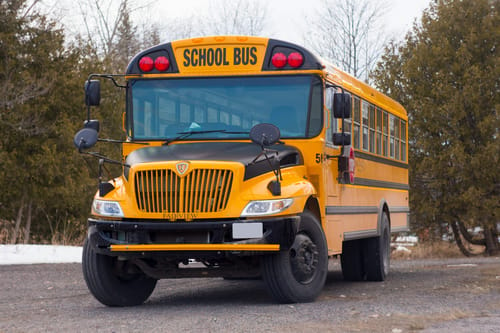

Ohio public school districts continue to be desperate for bus drivers, while the status of school transportation as a whole is being debated by public and private schools alike.
A recent transportation workgroup put together by the state recommended, among other things, a “comprehensive system change” to transportation along with immediate actions to “ease current system challenges and build the new system foundation.”
The shared goal of the workgroup was to”to transport as many students as possible to and from their school of choice safely and consistently – regardless of where they are enrolled,” according to a recent report.
However, disagreement among the workgroup members on how to implement those goals was made clear in their final recommendations.
In the most recent state operating budget, the Ohio Pupil Transportation Workgroup was tasked with “exploring transportation issues,” including a look at the current system and a study ending in recommendations on “the feasibility of each school district providing transportation to students enrolled in a community school or nonpublic school on days that the school district is not open for operation.”
The group agreed that school transportation and the funding to do so was an issue in need of resolution, but they acknowledged that even the members of the workgroup “do no agree on what all the core challenges are.”
Members included representatives from private schools, religious schools, public schools, career centers, and educational service centers, as well as two Ohio state senators and two Ohio House members, one from each political party in each chamber.
Three workgroup members noted that they “do not support the recommendations report:” Shauna Murphy, of Cincinnati Public Schools; Josh Biederstedt, of Patrick Henry Local Schools; and state Sen. Catherine Ingram, D-Cincinnati.
“Family school choice” was noted in the report as a “valued principle in Ohio” that is “respected by all workgroup members.”
“However, not all stakeholders fully agree on how to best accomplish safe and reliable transportation across education systems for more students,” the report stated. “Therefore, the recommendations identify where divergence of opinion exists while seeking to inform policymakers of viable options for moving forward.”
“School choice” is a term often used by those who support the use of private school vouchers funded by taxpayers to allow students to move to nonpublic schools.
Religious education advocates supported the recommendations of the workgroup when it came to opening up transportation to more students.
The workgroup used data from the Ohio Department of Education and Workforce, case studies and briefs submitted by members, and “panel discussions” of “transportation experts and leaders” among school districts and communities.
Transportation to school districts as it stands now was established in state law starting in 1966, when the law stated that traditional school districts were to provide bussing for the districts and chartered nonpublic schools.
Districts are required to transport those students unless deemed “impractical to transport,” based on six different factors, in which case a payment is given to the family to compensate for transportation.
“The (payment in lieu of transportation) process is imperfect, and for many families a payment does not solve the daily school transportation problem,” the workgroup report stated.
“This is particularly true for families experiencing poverty and those with inflexible work schedules.”
In the 2025-2026 school year, the workgroup found that more than 22,000 students were deemed “impractical” for transportation, with all but 1,000 of those enrolled in community or chartered nonpublic schools.
The impracticality issue made headlines in 2024, when former Ohio Attorney General Dave Yost sued Columbus City Schools for not busing private or charter school students. The school district said it believed it was following the law.
In May, the Ohio Supreme Court said Yost did not have legal standing to compel the district to do so, and that only 63 students were impacted, citing the former attorney general’s own facts.
“The attorney general has not shown that a case affecting a small number of pupils within one school district of the state concerns the well-being of ‘a substantial segment’ of the state’s population,” the court ruled.
One of the recommendations given by the workgroup was elimination of the impracticality clause over time, with the legislature working to phase out the payment system for transportation deemed impractical.
“In a new transportation system, (payment in lieu of transportation) should be exceptionally rare or phased out completely,” the workgroup stated.
Bus driver shortages
The report also noted the “persistent bus driver shortages” in the state, with Ohio Department of Education and Workforce data showing that on average, only 14.68% of vacant school bus driving positions were filled in fiscal year 2025.
In 34 districts across the state, 10% or less of the vacant bus driver jobs were filled, according to the state.
Part of the problem districts are seeing in recruiting and keeping bus drivers is the wages and benefits that come with the job, something that is exacerbated by the General Assembly’s decision to lower the funding to the Fair School Funding Plan in the last operating budget, according to Jeff Wensing, head of the Ohio Education Association.
“If you’re not fully funding the schools, if you’re not making it attractive to be a bus driver, if you’re not making it feasible to have enough buses to transport those kids, you can’t make it work,” Wensing told the Capital Journal.
A current listing for a Columbus City School bus driver listed the salary at $23.56 per hour, with at least five years of driving experience, possession of a Class B commercial driver’s license, and pre-service driver training through the Ohio Department of Education and Workforce.
The Cleveland Metropolitan School District had a listing for a bus driver at $21.65 per hour, and a “driver trainee” at $12.94 per hour.
Toledo Public Schools listed hourly compensation for bus drivers at $18.56 to $22.59, with an unspecified “annual longevity bonus” after five years.
While Wensing said the recommendations of the group were good goals, without more money, more bus drivers, and more school buses, he likened the plan to having 500 guests at a venue with a capacity of 200.
“You can only imagine the service you would get if you overload a venue like that,” Wensing said. “It’s the same with transportation, you can’t pull the rabbit out of that hat.”
Among the recommendations pushed by the workgroup were bus driver recruitment strategies “with additional state support.”
The workgroup’s call to fund the transportation portion of the education funding formula was praised by Melissa Cropper, who directs the Ohio Federation of Teachers.
But she said the group strongly disagrees with “a main premise of these recommendations – that the state is equally responsible for transportation for private school students and that transportation funding should follow the student to an unaccountable private school.”
“We should not commit to any additional funds for private school students, including additional transportation funding, until we are meeting our promise to the 90% of Ohio students who attend public schools,” Cropper said in a statement to the Capital Journal.
While the General Assembly reduced the amount going to the Fair School Funding Plan in the last operating budget, the state-funded private school voucher program saw funding in the billions of dollars.
Religious private school advocates praised the workgroup’s implementation of “school choice” in the report and recommendations.
“Ohio has made tremendous progress expanding school choice, but those opportunities mean little if students can’t get to school,” said Troy McIntosh, director of the Christian Education Network, a division of the religious lobby group Center for Christian Virtue.
“We urge the General Assembly to act on these recommendations and ensure every eligible student has reliable transportation, regardless of the school they attend.”
The Catholic Conference of Ohio also commended the workgroup’s findings. The conference’s associate director, Tom Rhatican, was a member of the transportation workgroup.
“A parent’s choice of the best educational option for their child often becomes moot without the reliable transportation promised in Ohio law,” said Brian Hickey, executive director of the conference, in a statement.
It’s unclear when, or if, the General Assembly could take up the recommendations. The legislature is currently on an extended summer break until after the November general election.
Once lawmakers return, they have a tight turnaround to take action on priority legislation before the end of the General Assembly term. Any legislation not passed before the end of the year will need to be reintroduced in the new General Assembly, starting in 2027.
Requests for comment from Ohio House Speaker Matt Huffman and Ohio Senate President Rob McColley were not returned.
This story is republished from the Ohio Capital Journal under a Creative Commons license. View the original article.