
The State Library of Ohio is moving in a positive direction, as court battles over funding for U.S. libraries end, and the state gets recognized as the top state in library circulation.
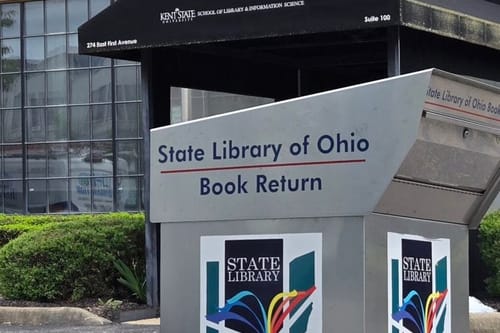
The State Library of Ohio is a state agency that houses and preserves state founding documents and historical artifacts, and also distributes federal funding for things like statewide digital materials and other resources.
“When our children fall in love with a great book, federal funds helped a library do that; when historians explain our shared state history, a federally-funded library project helped with that, too,” State Librarian Mandy Knapp told the Capital Journal.
The funding the library receives comes through the Library Services and Technology Act, distributed by the Institute of Museum and Library Services. According to institute statistics released this week by data analysis organization USA Facts, Ohio had the highest library circulation per person in both physical and electronic materials in 2023. It was also the third highest state in library visits per person, and most library cards per person, according to the data.
The institute is a federal entity that was up for elimination since the beginning of President Donald Trump’s second term, as part of an early effort by the non-governmental Department of Government Efficiency to slash federal spending. According to the Office of Budget and Management and the U.S. Department of the Treasury, the institute spent $280 million in fiscal year 2024.
The institute’s funding falls under the umbrella of the National Foundation on the Arts and Humanities, and the overall foundation spending amounted to 0.01% of all federal spending, USA Facts found.
Attorneys general in 21 states filed a lawsuit in 2025 to stop the dismantling of the institute, and in November, a federal court sided with those attorneys general, saying the Trump administration could not go forward with plans to eliminate the agency, its funding, and its staff of less than 100.
The Trump administration appealed the decision, but then requested that the appeal be withdrawn, which a federal judge granted on April 6.
“Libraries can move forward with confidence that IMLS funding will be available to sustain the vital services communities rely on,” said Sam Helmick, president of the American Library Association, in a statement.
A separate lawsuit was filed by the association, in which a May 2025 order temporarily barred mass layoffs of institute employees. This week, a settlement was reached in that case “that protects the Institute of Museum and Library Services and ensures the agency will continue carrying out its work,” according to a statement by the library association.
The settlement would allow the institute to continue funding grants, conducting research, and operating programs to assist libraries and museums in the U.S., the association stated.
The battle continues, however, as the budget process at the federal level begins again, and national library advocates continue to worry that funding cuts could be on the horizon.
Trump’s proposed budget takes the nearly $300 million in the previous budget for the institute, and chops it to $6 million, “for necessary expenses to carry out the closure of the Institute of Museum and Library Services.”
“The budget proposes to eliminate funding for several independent agencies, including the Institute of Museum and Library Services, as part of the administration’s plan to move the nation towards fiscal responsibility and to redefine the proper role of the federal government,” the budget proposal states.
Along with the proposed elimination of the institute, the budget request from the Trump administration would take the Innovative Approaches to Literacy program, which received $25.5 million in 2025, down to zero. According to the U.S. Department of Education, the program awards grants to promote literacy through “enhanced school library programs; early literacy services, including outreach to parents of young children … and the distribution of high quality books.”
The department said the program would be consolidated under a newly proposed “Make Education Great Again” program.
“Consistent with the administration’s efforts to return education to the states, the request would empower states to use federal funds flexibly to meet their needs without the administrative burden and programmatic silos of current law,” the department said in a summary of the proposed budget.
Even with the dramatic cuts showing up in the new proposal, the American Library Association isn’t panicking yet, with a pattern of congressional support behind them.
“The president has repeatedly underestimated congressional support for libraries and the lengths to which advocates will go to protect library services,” Helmick said in a statement. “Thanks to library advocacy, Congress increased library funding, just as they did all four years of the president’s first term.”
But the State Library of Ohio is moving forward both physically and financially, setting up shop in two new facilities, and out of a location that Knapp told state legislators was aging to the point of putting preservation efforts in danger.
The funding the agency received from the institute has been used for things like a peer-to-peer reading program at Southview High School in Sylvania, and the purchase of book repair machines by the Northern Buckeye Education Council in Archbold, machines that have been used by 11 school libraries and one public library as of September 2025, according to the State Library of Ohio.
“At a time when many districts face limited or nonexistent book replacement budgets, this simple yet powerful solution is keeping books in students’ hands,” the agency stated.
The state library’s current location will close on April 14, but access to digital collections through the Ohio Digital Library will continue as the agency moves to its new locations. Administrative offices will be staying in downtown Columbus, while collections will be moved to a “specialized archival facility” in Gahanna, according to the library.
This story is republished from the Ohio Capital Journal. View the original article.