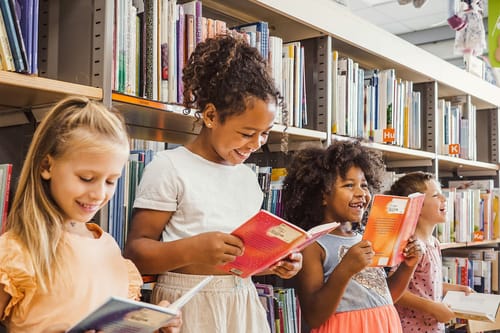

Public school librarians in Ohio are raising alarms about book bans and funding cuts.
School librarians have been navigating challenges in their work as long as they’ve been among the stacks in their local districts.
Proposed legislation to filter the reading choices students can make has brought concern, and budget reductions make some worry about the future of public school librarians as a mainstay in schools.
“Right now, a lot of administrators and school boards look at having school librarians as a luxury,” said Gayle Schmuhl, president of the Ohio Educational Library Media Association. “I think a lot of school librarians (in Ohio) are just hoping to stay employed.”
Schmuhl said many members of the association were wondering about the future of their jobs with cuts to public school funding in Ohio and debate over property taxes that go to education.
Cuts to state public education has been talked about for decades, especially after multiple Ohio Supreme Court decisions that said the state was not paying its constitutional fair share.
In 2022, a model called the Fair School Funding Plan came about with bipartisan sponsorship, and was passed in what some saw as a new era for Ohio. The plan was to fund schools based on actual need from school district to school district.
The model almost made it through the six-year phase-in as planned, but Ohio Republican lawmakers abandoned it in the last operating budget.
While the most recent state operating budget included a $226 million increase in school funding, the Fair School Funding Plan model needed at least triple that amount to maintain its initial calculations and keep up with inflation.
Lawmakers, however, increased private school voucher funding into the billions.
Courtney Johnson was a school librarian in Columbus for 10 years, and seeing funding plans decrease for public schools played a part in her move back to teaching English.
She worried that though the funding priorities for schools hadn’t been spelled out, the cuts might mean she’d be splitting her time as the librarian in multiple district buildings.
“I’m a person who likes to have roots in a place and go to my ‘work home’ every day,” Johnson told the Capital Journal.
Johnson said returning to the classroom also means following an entire class through their year-long experience, and still means helping kids with reading and writing, two things that are among the passions that brought her to the profession.
“Every kid has a story, even if they don’t trust that they do at first, and I love making space for them to tell their stories,” Johnson said.
As a librarian, she saw the importance of parents reading to their kids, students receiving the context of other subjects in school for “full background knowledge” to help them decode the words they’re reading, and encouraging the connection between kids and books.
“We’ve known this, that when kids see themselves represented in books, they feel more connected to the books, they’re going to like reading better,” Johnson said. “Likewise, kids can see how other people live in books, and develop empathy that way.”
Part of the job of the modern school librarian is discussing material with parents that they may find objectionable enough to demand it be taken off the shelves.
Sharon Hawkes, a retired librarian who is also part of the group Right to Read Ohio, decided to survey school librarians, with the help of the Ohio Educational Library Media Association’s member list.
Of those who participated in Hawkes’ study 56% “experienced censorship incidents” between 2021 and 2025.
While she only received responses from 32 school librarians, about 10% of the total school librarians in the state, she said the experiences were still indicative of a challenge in Ohio.
“We’re getting some clues about what’s going on,” Hawkes said, noting that because there’s no standard survey system in each state to study censorship in libraries, the count made by organizations like the American Library Association may be less than the actual amount happening across the country.
The American Library Association reported 98 attempts to censor 355 books in Ohio from 2021 to 2024, and last year, there were seven attempts to censor 129 books, according to the ALA.
Schmuhl agreed that the study was representative of the experience she’d heard of in the state.
“I did see that school librarians in our areas were being proactive and trying to have good communication within their school districts (about attempts to ban books),” Schmuhl said.
In Hawkes’ study, of the 16 censorship requests in Ohio between 2021 and 2024, eleven were “challenges without removals,” while eight resulted in a book ban of some kind, and three involved “relocations of books or other materials.”
According to the researcher, librarians use “objective criteria” in decisions about what materials are age-appropriate and relevant for the school libraries. Their training qualifies them to decide on the inventory, and to deal with challenges from parents, where the majority of material challenges came from in the study.
The majority of school librarians who responded to Hawkes’ survey had between 11 and 15 years of experience as the director or manager of their current library, and more than 62% had a Master’s degree in Library Science.
“More than anything, I wanted people to understand that parents do have the right to guide what their children read and when they read it … they can approach their librarians about it,” Hawkes said. “What they can’t do is ban books for other people’s children.”
For Johnson, moving back to English doesn’t mean she’ll avoid the topic of censorship.
“I think I’m going to deal with that in public schools under what we have going on right now, no matter what my position is,” she said.
The legislature approved one measure to compel public libraries to relocate “inappropriate” materials out of the sight of minors, but Gov. Mike DeWine vetoed it as “not workable.”
Another bill still in consideration by the legislature would order vendors of online educational resources that go to public libraries and schools to create protections to prevent “inappropriate” content from making it to kids’ eyes.
Opponents of the materials have said the bill could have unintended consequences, removing materials that are educational as well.
Johnson’s classroom goals include helping kids maintain reading to “get them ready for this really difficult world that we’re navigating,” and bring the parents in as part of it.
“We need to work together as parents and school communities to make sure kids are achieving literacy, and we know that having access to books at home, and at school, at their fingertips, is just the beginning of it,” she said.
This story is republished from the Ohio Capital Journal under a Creative Commons license. View the original article.