
The Ohio Redistricting Commission unanimously passed a congressional map in a Friday morning meeting, increasing Republican advantage in the state 12-3 and blocking a referendum effort. Democrats expressed optimism they could hold their five seats.
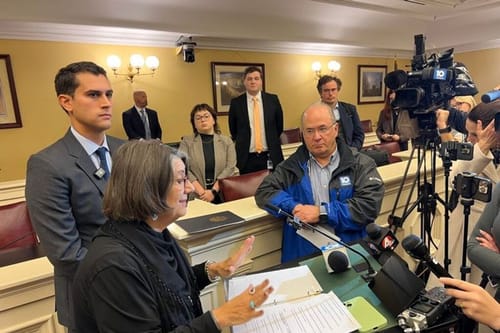
The commission unanimously approved the map to raucous disapproval from the crowd gathered in the Ohio House Finance hearing room.
The map was introduced at Thursday’s meeting by commission co-chair and state Rep. Brian Stewart, R-Ashville.
Republicans currently hold 10 out of 15 Ohio U.S. Congressional districts.
The map gives Republicans the advantage in 12 of the 15 districts in the state, with Republican U.S. Rep. Jim Jordan’s 4th district seeing the biggest GOP advantage at 72%.
Democratic U.S. Rep. Shontel Brown’s 11th district sees the biggest advantage in her party, according to the map, at 78%.
U.S. Reps. Marcy Kaptur, Greg Landsman, and Emilia Sykes would all see significant impacts to their district.
Landsman’s 1st district would lean Republican with a 54% to 47% breakdown.
Kaptur’s 9th district would lean Republican with a 54.5% to 45.5% Republican to Democratic ratio.
Sykes’ 13th district would lean Democratic, 52% to 48% Republican, according to data provided by the commission.
Stewart said the bipartisan passage was a mark of success for redistricting reforms that were passed in 2015 and 2018, and for the commission itself.
“I think there was a very real incentive and a desire amongst the legislative leaders … that we want this process the voters approved to work,” Stewart said.
“I think there is an intention that there would be some compromises, there would be some recognition of the fact that we would like to come out of here with a deal that both parties could move forward with for multiple years.”
Democrats on the commission voted to adopt the map because they said they were in an “impossible” situation in which they were provided worse options and felt they needed to take the opportunity to get the best map available.
House Minority Leader Dani Isaacsohn, D-Cincinnati, said the process was out of their control, so they did what they could to preserve Democratic opportunities.
“This is not the congressional map that Ohioans deserve, however, I do believe with this map we have averted a disaster,” said Senate Minority Leader Nickie Antonio, D-Lakewood.
The previous map, adopted in March 2022, had a breakdown of 10 Republican districts and five Democratic districts.
In September, Democrats proposed a map that would have had eight Republican and seven Democratic districts.
That map heard hours of supportive testimony in the Joint Committee on Congressional Redistricting, but never received a vote.
Republican leaders on the commission, including Gov. Mike DeWine, approved of the commission-created map, saying it was a proper compromise across the aisle.
They also acknowledged motivation that a referendum would not happen with passage by the commission.
Without bipartisan approval by the commission, the congressional redistricting process would have headed back to the General Assembly.
Once there, legislators could have passed a map with a simple majority in the Republican supermajority that makes up both chambers.
Auditor of State Keith Faber said the argument that the state’s voting trends, 55% Republican to 45% Democratic, would bring a map with eight GOP and seven Dem districts doesn’t represent “Ohio’s political geography.”
“This concept that you’re going to be able to draw districts within that range without gerrymandering is false,” Faber said. “… You can’t get to an 8-7 map without unnecessarily splitting and dividing (cities, counties and townships).”
Ohioans expressed their disagreement with Faber, saying state leaders and legislators just hadn’t worked hard enough to get to maps that match that ratio.
Testimony at Thursday’s and Friday’s meeting had a unified message: Ohioans who attended the meetings greatly disapproved of not only the 12-3 map, but the process to get to the adoption.
“This isn’t a compromise, it’s a threat,” Julia Cattaneo, of Columbus, told the commission.
Stewart on Thursday had referred to the people who attended the meeting — many of whom have regularly attended meetings over the several years of the congressional and statehouse redistricting battles in Ohio — as “paid actors.”
On Friday, some citizens pinned “not a paid actor” labels on their shirts.
They continued their shaming of the commission for “ignoring the law, ignoring the voters,” as Mia Lewis of Common Cause Ohio put it, and emphasizing the need to take politicians out of the redistricting process.
“I wish that the argument between committee members had been about how to fairly draw up county lines that would have fine-tuned those districts to be more accurate,” said Columbus resident Beth Lykins.
“…I think what I say here doesn’t really matter in the end. You will do what you want to do and I have to live with the realization that our government doesn’t work in the way I was taught in my Youth in Government program.”
The map has the potential to be legally challenged, which would be done at the Ohio Supreme Court.
Previous map challenges in the redistricting process, including the 10-5 redistricting map used for the most recent elections, have been struck down as unduly partisan.
The makeup of the state supreme court has changed since then, however.
Current Chief Justice Sharon Kennedy stood in the minority in previous votes on redistricting maps, saying she would have kept the maps in place.
The current supreme court is made up of six Republican justices and one Democratic justice.
This story is republished from the Ohio Capital Journal. View the original article.