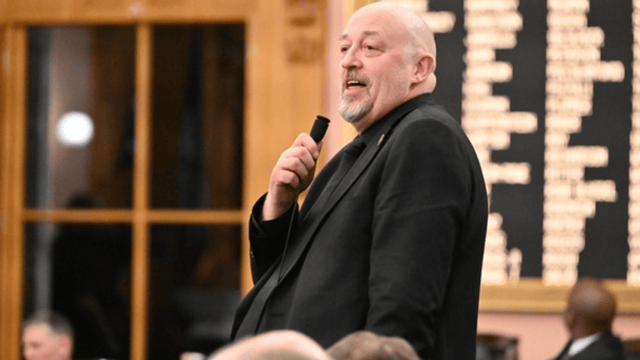
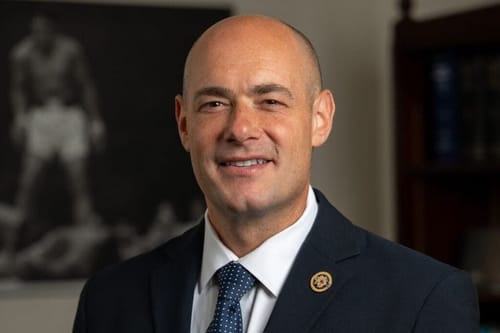

Ohio U.S. Rep. Greg Landsman was one of just four Democrats who voted last month against a war-powers resolution governing military action in Iran. Now he wants the war to end, and says he’ll vote for another resolution given the chance.
But he won’t say whether the fix in which country now finds itself was predictable.
On Feb. 28, President Donald Trump launched a war against Iran — a nation of 92 million — after little consultation with Congress, and almost none with the American public or U.S. allies. Now, with Iran choking off a huge portion of global energy supplies, oil prices spiking and the stock market falling, Trump is making vague predictions that the war will be over in another “two to three weeks.”
The latest timeline comes nearly five weeks after Trump originally said the war would take four to five weeks, and then raised it to six. Confusingly, Trump has also repeatedly claimed that he’s already won the war.
Many security experts say that Trump is flailing because he’s not in control of the timeline.
Iran has long prepared for such an attack and the tight geography of the Strait of Hormuz enables it to stifle the flow of 20% of the world’s oil and other vital commodities. That allows it to inflict economic pain on the rest of the world.
Iran “is now executing a strategy that has managed to neutralize key U.S. and Israeli air defense batteries, severely damage U.S. military bases in the Persian Gulf, inflict substantial economic pain, and drive a wedge between the United States and its Gulf allies,” Narges Bajoghli, associate professor of Middle East studies at Johns Hopkins University, wrote March 26 in Foreign Affairs. “The Iranian regime, in other words, is not just surviving the U.S. and Israeli bombardment. The serious economic and political problems it is creating for its adversaries are, on a strategic level, giving Iran the upper hand.”
This outcome was foreseen by many, and Trump was warned about it.
The Iranian regime has been in power since 1979, terrorizing its own people and sponsoring terrorism against its adversaries, including the United States. Yet no president before Trump launched a major war against it.
The war was historically unpopular when Trump started it. Those concerns were reflected in the House of Representatives when it voted on a war-powers resolution on March 5.
It would have required Trump to end military involvement in “unauthorized hostilities,” and it nearly passed the House. Landsman joined three other Democrats in voting against it.
It failed 212-219. So if Landsman and the other Democrats had all voted for it and all other things stayed the same, the resolution would have passed by a single vote.
The resolution had already failed in the Senate, so passage wouldn’t have had the force of law. But it would have been an unprecedented rebuke of an American president at the start of a war.
At the time, Landsman said he wasn’t giving Trump a blank check.
“Congress declares war, and Congress must fund it,” he said. “These are targeted strikes on core military assets — missiles, rockets, drones, ships. I support targeted strikes to destroy Iran’s missiles and bombs to stop the regime from taking more lives.”
Landsman added that he would support a separate war-powers resolution that would give Trump 30 days to wrap up the war. It hasn’t come up for a vote.
The war in Iran has escalated since, with Trump giving an ever-shifting set of rationales for the war and its endgame.
Facing intensifying pressure to find an off ramp, Trump addressed the nation from the White House on Wednesday night.
He boasted about “victories like few people have ever seen before.” He said that the United States has plenty of its own oil and of Iran he said, “we’re there to help.”
That ignores that oil is traded on a global market, so shortages anywhere manifest as higher prices at Ohio gas pumps.
Trump thus far has been unable to break the blockade. But he called on U.S. allies to simply take and “cherish” oil from the Strait of Hormuz.
And he said the strait could open “naturally.”
But the president also suggested that because American service members have already died in the war, the United States military has to stay in the region and “finish the job,” which at times he said was regime change.
Referring to his attendance at ceremonies when the bodies of dead service members repatriated to the United States, Trump claimed those were the families’ wishes.
“I was with them and their families, their parents, their wives and husbands,” he said. “We salute them, and now we must honor them by completing the mission for which they gave their lives. And every single one of the people — their loved ones — said ‘Please, sir, please finish the job.’ Every one. And we are going to finish the job and we’re going to finish it very fast. We’re getting very close.”
However, Pete Hegseth, Trump’s defense secretary, has made similar claims and at least one family denied them.
Trump’s talk left global markets deeply worried about the future in the Persian Gulf. Oil prices began to spike while he was still giving it, and continued to rise on Thursday.
“Essentially, I did what no other president was willing to do,” Trump said during his speech.
Which might raise questions about the decision by Landsman and the other three Democrats to vote against the March 5 war powers resolution.
His office was asked if it was predictable that if attacked, Iran would close the Strait of Hormuz.
It was asked if it was also predictable that, given his past conduct, Trump would undertake a venture such as a Middle East war without clear goals, proper planning or consideration of the risks.
Landsman didn’t respond directly.
“It’s time to be done, and I’ll support a War Powers vote if it comes to the floor,” he said in an email. “This was supposed to take weeks not months. Trump’s handling of the communication has been absolutely terrible. The military’s work to destroy the regime’s weapons shield around its enrichment facilities has made the world safer. Time to be done.”
This story is republished from the Ohio Capital Journal. View the original article.