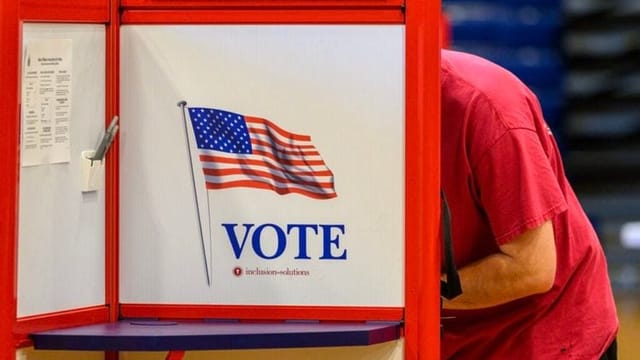

When Ohioans cast their midterm ballots over the next two weeks, many will be asked to vote for or against proposals for local tax levies, which includes more than 130 statewide school issues to fund what the legislature won’t in public education.
Local property taxes are already the largest source of funding for most public schools across Ohio. Residential property owners are tapped out and plenty tired of schools coming to them hat in hand. But when district levies fail cash-strapped schools do without. Without staff. Without services. Without programs to enrich learning.
Multiple public school districts have been forced to lay off teachers, cut courses and extracurriculars. Classroom size has swelled to capacity. Teachers are overburdened.
Students get less than the optimum instruction they deserve. Educating the next generation of Ohioans should be the top priority of state leaders.
Yet Ohio has repeatedly scaled back its investment in the public school system that educates nearly 90% of the state’s K-12 students.
For almost 30 years the Republican-run legislature has shirked its constitutional duty to fund a “thorough and efficient system” of public schools and shifted the load of paying for local districts on to homeowners.
The state share of public school funding has fallen from a high of 47% in 1999 down to an estimated 35% in 2026 and 32.2% for 2027.
Ohio ranks near the bottom nationally (around 45th) in state K-12 revenue. Statehouse Republicans appear determined to put public schools out of business.
In the current state budget, legislators scrapped the final phase of a six-year, bipartisan school financing formula that was designed to more accurately reflect the genuine cost of educating students and the financial capacity of each community to support its schools.
The Fair School Funding Plan (FSFP) marked a significant step toward correcting the decades-old disparity in school funding that was heavily dependent on local taxes.
But for the 2021 funding plan to be successful in fixing the long-broken, unconstitutional funding model for Ohio’s public schools it had to be sustained by future budget-writing lawmakers. It was not.
The biennial budget for 2026-2027, passed by Republican majorities in the General Assembly and signed by Republican Gov. Mike DeWine, effectively abandoned and underfunded the FSFP by about $2.75 billion (compared to what the plan mandated) and provided just 5.7% of the state-level funding increase schools required based on the actual cost-based formula.
Republican Ohio House Speaker Matt Huffman, who has done more to privatize public education in Ohio than anyone, called the proposal to fully fund the last two years of the Fair School Funding Plan a “fantasy” and claimed the state couldn’t afford it.
Too expensive, scoffed Huffman while simultaneously funneling massive amounts of public money — over $1 billion annually — into private, primarily Christian schools.
The state-paid tuition checks (with no strings attached) are called vouchers.
Unlike state funding for public schools, that comes with oversight and accountability of tax dollars spent, there is zero accounting for Huffman’s private school boondoggle that finances religious institutions at the cost of local schools most Ohio kids attend.
In the 2026 fiscal year alone, the total amount of public funds spent on Ohio’s five private school voucher programs was $1.173 billion.
Almost half of that money, $532.8 million, went to the Education Choice Expansion vouchers that Huffman made universally available to every affluent family in the state (regardless of income) whose children attend private schools.
Last week an Ohio appellate court concluded the EdChoice voucher program violated the clear language of the state constitution by effectively setting up a “competing system of uncommon schools that is not subject to the same obligations imposed on Ohio’s system of common schools.”
The Ohio 10th District Court of Appeals ruling, which affirmed a lower court’s decision in 2025, noted that participating non-public schools on the public dole receive taxpayer funding in a manner that operates at the “detriment of Ohio’s public schools, and, consequently, the children who depend on those public schools for instruction, support, and opportunities that shape their future.”
State Republicans shrugged off the expected ruling confident it will be overturned by the Republican-majority on the Ohio Supreme Court.
Meanwhile, Huffman & Co happily handed Ohio property owners an even heavier public school funding burden this election cycle — with a slew of school levy issues on the ballot to counteract the legislature’s latest round of reduced state-level contributions to K-12 education — while adding more than a billion in taxpayer subsidies to the tab to bankroll diocesan schools.
Ohio’s 600-plus public school districts in the state can twist in a perpetual panic over funding shortfalls, negative cash balances, or severe deficits.
Private school lobbyists got their voucher hooks in the general revenue fund and, with powerful GOP backing, they’re not letting go. But Ohio voters may want a say in the matter especially as they’re filling out ballots over the next two weeks that promise bigger tax bills to keep their public schools afloat.
They may draw the line at subsidizing a “competing system” of parish schools when they’re already paying the lion’s share of one district’s operating budget.
Why not find out definitively what Ohioans think about funding Huffman’s exploding universal private school vouchers program — twice ruled unconstitutional — with an up or down statewide vote? Seems fair.
Colorado, Kentucky and Nebraska did in 2024, and voters rejected the creation or expansion of private school vouchers in all three states.
Ohioans are paying billions to prop up private schools while their public schools go wanting. The issue belongs on a ballot for Ohio voters to decide themselves.
This story is republished from the Ohio Capital Journal under a Creative Commons license. View the original article.