

Two sets of data released this month indicate that the high cost of gas is taking a bite out of consumers — and things are likely to get worse.
The Federal Reserve Bank of Cleveland on June 3 published one if its eight annual installments of the Beige Book. It seeks to assess economic conditions through online surveys and interviews with businesses, community leaders, economists and others.
The Cleveland Fed is one of 12 regional federal reserve banks. Its region comprises all of Ohio and parts of Pennsylvania, West Virginia, and Kentucky.
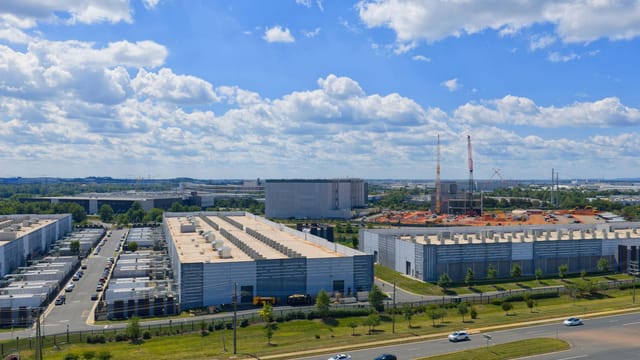
The most recent edition of the Beige Book said that there has been an uptick in manufacturing and overall business activity, but much of that is due to data center construction, it said.
“Demand for manufactured goods rose at a robust pace, largely driven by data center development,” it said.
However, it cited increasing costs — many of them a consequence of the war with Iran — and said that employers are hiring cautiously.
“The primary drivers of increases cited by contacts were rising fuel costs related to the Middle East conflict and spillover effects on material and service costs through increased fuel surcharges,” it said.
“Manufacturing and agriculture contacts reported cost spikes for fertilizer and petroleum-based products, such as resin, due to the Middle East conflict.”
And as consumers deal with higher energy costs, they’re pulling back on other spending.
“Consumer spending declined slightly in recent weeks,” the Beige Book said.
“Many retailers reported that higher fuel costs and related inflation had further dampened consumer spending, leading to decreased sales across various retail sectors including convenience and grocery stores, auto dealerships, and restaurants.
Retailers also reported increased credit card usage — possibly a sign that consumers are going into debt to make needed purchases.
As measured by the University of Michigan, consumer sentiment in May was at its lowest point at least since the 1970s. Consumer spending makes up nearly 70% of the overall economy.
“Consumer sentiment fell for the third straight month as supply disruptions in the Strait of Hormuz continue to boost gasoline prices,” Joanne Hsu, who directs the University of Michigan’s consumer surveys, said in a written statement. “Sentiment is now just below the previous historical trough seen in June 2022.”
She added, “The cost of living continues to be a first-order concern, with 57% of consumers spontaneously mentioning that high prices were eroding their personal finances, up from 50% last month. Lower-income consumers and those without college degrees posted particularly strong sentiment declines; these groups are more sensitive to increases in the cost of gas and other essentials.”
Eric Pachman, a Dayton-based data analyst who used to work for Exxon, last week published a newsletter saying that petroleum reserves are “frankly, terrifying.”
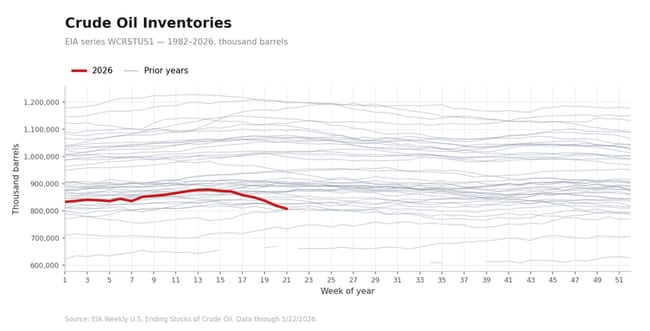
_Oil inventories are low and declining quickly.
(Visualization courtesy of Eric Pachman.)_
“Look at crude,” he wrote. “After climbing through the spring, inventories have turned and are falling fast – the steepest decline of any year on the chart. If that slope holds, we’re heading for territory we haven’t seen since the early 1980s, when those bottom grey lines were set.
Exxon executives warned late last month that as inventories go down, oil prices will skyrocket in the coming weeks — from about $100 a barrel now to $150 or even $160. Chevron issued a similar warning.
Pachman produced another visualization of diesel inventories that he said was even more bleak.
Its price affects you even if your car or truck lacks a diesel engine, he said, because 90% of freight tonnage in the United States is carried by diesel engines powering trucks, trains, and cargo ships.
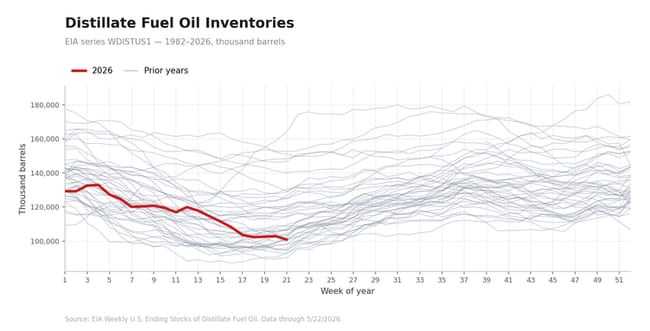
_Diesel inventories are far down compared to earlier years, represented by the gray lines.
(Visualization courtesy of Eric Pachman.)_
“… distillate (i.e., diesel) is the one that should stop you cold: stocks are now lower than they’ve been more than 90% of the time in over 40 years of record,” Pachman wrote.
This story is republished from the Ohio Capital Journal under a Creative Commons license. View the original article.