
More than 1 million Ohioans are not getting essential safety-net benefits for which they’re eligible, according to a new analysis by the Urban Institute. In many cases, just a fraction of low-income families are getting help with things such as energy assistance.
As electricity and grocery bills continue to spike, low-income families’ need for such benefits seems likely to intensify. But why they might be eligible and still not get them isn’t as straightforward.
“Eligibility depends on national and state eligibility policies and the demographic and income characteristics of the population,” the Urban Institute said in its State of the Safety Net report, which was published last week.
“Participation rates among those eligible for a program depend on many factors, including funding levels, administrative procedures, awareness of programs and their policies, and the decisions made by individuals in the context of their family situations.”
In other words, some eligible people might not be taking advantage of the programs because they can’t or don’t want to. But many others might not know about them, there might not be enough money to provide benefits to all who are eligible, or the paperwork hassle is too much to overcome, the analysis said.
In any case, millions are not getting help in Ohio who theoretically could, it showed.
For example, in 2023 just 1 in 5 of the 1.4 million households eligible for the Low Income Energy Assistance Program participated.
That compares to one-third in Pennsylvania, 20% in West Virginia, one-fourth in Kentucky, 17% in Indiana, and two-thirds in Michigan.
Energy assistance is critical to vulnerable populations. Policy Matters Ohio reports that in the Buckeye State, nearly half — 46.5% — of households receiving assistance in 2023 included a person with a disability. In addition, 39.5% had at least one person 60 or older and 14% had a child under 6.
Research has shown that states that administer block grants for things like energy assistance through active outreach have higher participation rates than those that simply wait for people to apply.
There were smaller variations in federal housing assistance. In 2023 in Ohio, 30.2% of 653,000 eligible households received it. That compares to 29.4% in Pennsylvania, 36.7% in West Virginia, 31.9% in Kentucky, 25.7% in Indiana, and 28.6% in Michigan.
Perhaps explaining the greater consistency, the Urban Institute report said the housing program is underfunded, so the available funding might be exhausted by providing benefits to similar shares of states’ eligible populations.
Also serving just a fraction of those eligible is Temporary Assistance to Needy Families.
It’s cash assistance to those with very low incomes. To qualify in 2023, a family of three must have made less than $12,432 that year.
In Ohio, just over a fifth of the 190,000 eligible families received benefits in 2023. In Pennsylvania, 17.8% did. In West Virginia, just 15.1% did, followed by 14.7% in Kentucky, 8.5% in Michigan, and just 5.9% in Indiana.
In a 2023 report, the Urban Institute said participation rates in the program have plummeted since it was converted into a block grant in 1996.
Often to control growth in the cost of safety-net programs, the federal government converted some into block grants and gave states much control over how to administer them.
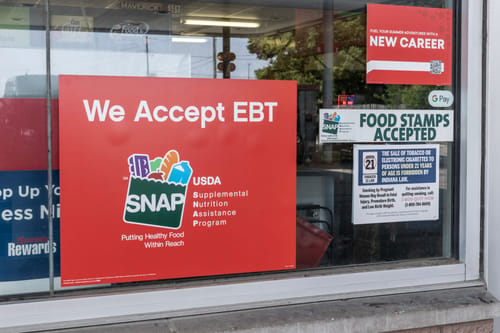
In 2023, 57.2% of the 2.3 million Ohioans eligible for Supplemental Nutrition Assistance Program received benefits. In Pennsylvania, 59.9% did. In West Virginia, it was 49.9%. In Kentucky, it was 55.2%. In Indiana, 59.2% and in Michigan 56.3%,
That means millions of eligible people in those and other states aren’t getting modest nutrition assistance as food costs continue to rise.
Many more are likely to lose help.
President Donald Trump’s Big Beautiful Bill that was passed last summer made the deepest cuts in the history of the program — $186 billion over 10 years.
This story is republished from the Ohio Capital Journal under a Creative Commons license. View the original article.