

According to analysis of national census data, black-owned businesses in Ohio continue to increase payroll, and drive jobs and income in the state.
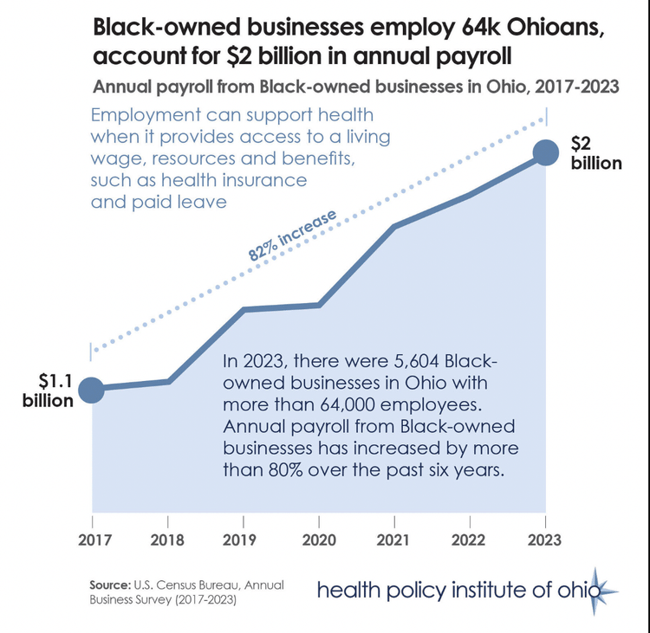
The Health Policy Institute of Ohio analyzed the most recent U.S. Census data to find that the more than 5,600 Black-owned businesses in Ohio employed more than 64,000 employees. The data also showed that annual payroll for those businesses had increased by 82% between 2017 and 2023.
“The data on the economic impact of Black-owned businesses in Ohio demonstrates that the state’s diversity is one of its greatest strengths and that the success of the Black community leads to success for the state overall,” the institute stated.
Annual payroll from Black-owned business went from $1.3 billion in 2017 to $2 billion in 2023, according to census data.
Analysis of data from the same period by the Brookings Institution spotlighted five areas of Ohio, three of which have seen growth and two that have seen dips in the number of Black-owned businesses. In the Toledo metro area, 3.3% of all businesses are owned by Black employers, an increase of 85% from 2017. The Akron metro area has seen a 27% increase in Black-owned businesses, and the Cincinnati area saw 125% growth between 2017 and 2023, with 3.5% of all businesses Black-owned.
The Dayton area and the Youngstown metro area have seen drops in Black-owned businesses, with Dayton’s number dropping by 56%, and Youngstown’s down by 39% between 2017 and 2023.
While the areas had overall increases over the seven-year span, all but one area saw drops in Black-owned businesses when the data was narrowed to 2022 to 2023, the most recent data studied.
Toledo’s number went down 1%, Akron’s lowered by 29%, Youngstown’s was 77% less, and Dayton’s Black-owned businesses saw a 56% drop. Cincinnati saw a rise of 18% in the one-year span, according to the Brookings Institution.
The data was similar to states around the country, with the institution showing 72 metro areas in the U.S. with growth, of the 116 areas studied. Metro areas with the largest losses from 2022 to 2023 were Atlanta, San Francisco, Raleigh, Charlotte, and Virginia Beach. The study said “recent attacks on government programs that center on diversity, equity, and inclusion threaten continuing progress,” noting the Minority Business Development Agency’s elimination by the Trump Administration, and changes to the Small Business Administration’s program to bring federal projects to “socially and economically disadvantaged small businesses.”
“With numerous structural barriers to growth – such as credit access, intergenerational wealth gaps, and outsized levels of debt – Black-owned businesses will not magically grow without inclusive and intentional policy and investments,” Andre Perry and Hannah Stephens wrote for the Brookings Institution.
White employers continue to own the most businesses by far in the nation, and data shows Native Hawaiian and Pacific Islander employers own the least, with Asian American, Latino or Hispanic, and Black owners falling in between. Despite this, Black employers saw the second-largest proportional increase, according to the Brookings analysis.
“As underrepresented race and ethnic groups own more employer businesses, their share of ownership moves closer to their share of the population,” Perry and Stephens wrote. “This growth is a tool to combat centuries of racial disparities in ownership and wealth.”
In 2023, Black Americans made up 14.4% of the U.S. population, but only owned 3.4% of businesses, according to census data.
In a 2023 report by the Ohio Department of Development, the state reported the Black community as 14.5% of the state’s total population, and reported Black-owned businesses made up 11% of all businesses.
This story is republished from the Ohio Capital Journal under a Creative Commons license. View the original article.