
Before Sarah Hanline’s abortion, she had named her daughter Charlotte.
She and her husband had planned the pregnancy, and excitedly told their family at 12 weeks, a landmark in pregnancy when she felt Charlotte was safely on her way.
At about the same time, Hanline had an anatomy scan, due to a backup in scheduling for ultrasounds.
Two hours after the anatomy scan, she was told by doctors that Charlotte had very little kidney tissue, and a 3% chance of survival.
“If she were to live, she would have to go on dialysis for her whole life, and then also have kidney transplants every 10 years or so,” Hanline was told.
Several more tests confirmed the issue, and also identified a severe heart defect. Hanline listened to kids and parents laughing at Cincinnati Children’s Hospital as she was told her daughter would never come.
“We sat in a room full of 15 specialists and they all told us that our daughter had a 0% chance of life, that she would either be stillborn or live seconds and then die,” she told the Capital Journal.
Despite having an inviable pregnancy confirmed by a host of tests and doctors, Hanline still couldn’t have the procedure to end the pregnancy right away. She was told she would need to wait another two weeks before labor could be induced.
“And then I would have to wait those two weeks, knowing my daughter was non-viable,” Hanline said. “I was feeling her every once in a while, and it was an awful, awful reminder that I was never going to meet her.”
Doctors said they feared being arrested and/or losing their licenses if they provided any other option. Confusion reigned, as a six-week abortion ban was not being enforced, but still sitting in court awaiting a final decision.
It was 2023, and the U.S. Supreme Court’s decision in the Dobbs case had ended nationwide legalized abortion the year before.
The issue had been sent back to individual states. Ohio voters had put the right to abortion care in the state constitution just one month earlier.
The Post-Dobbs landscape
When doctors told Hanline they wanted to wait to induce labor, she was 21 weeks and four days along. Because of the new amendment, abortions were legal until viability, generally considered to be 22 weeks gestation.
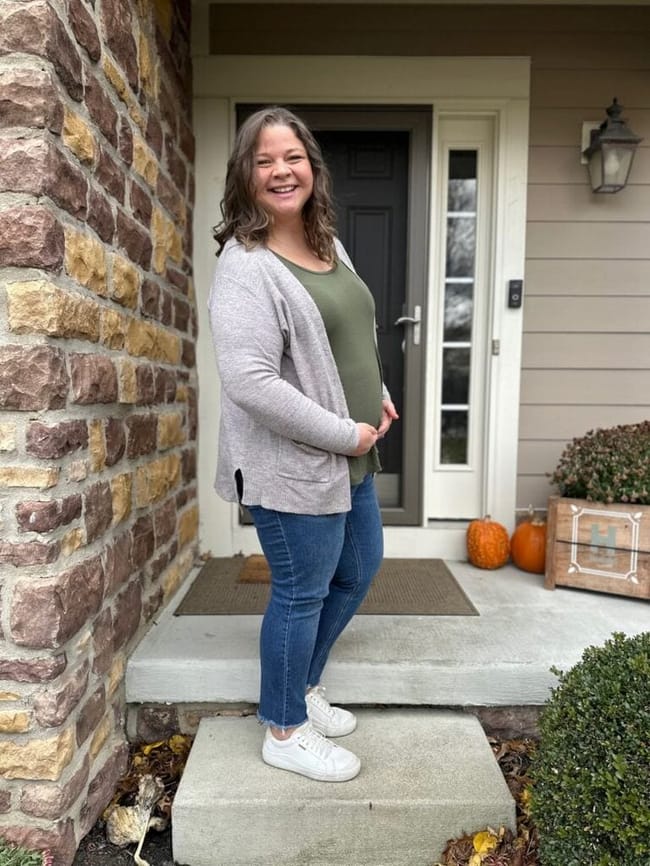
She and her husband called surrounding states after finding full clinics in Ohio, and found all other states were at capacity.
Luckily, she said, one of her physicians was able to find her a spot in the Cincinnati area, 45 minutes away, when Hanline was at 21 weeks and six days.
“In those 45 minutes, I saw no less than three billboards telling me I was going to hell, showing me pictures of babies, like, ‘why don’t you want to keep me,’” Hanline said.
“It was pretty awful, because I did want to keep my daughter so badly, and I would have given anything to not be having to say goodbye to her.”
It was also difficult when she went to D.C., and felt like she wasn’t heard by members of Congress.
Last year, she visited the office of Ohio Republican U.S. Sen. Jon Husted. A staffer listened to her story, she said, then reiterated Husted’s publicly pro-life stance.
“It was really hard to understand how we differed on that, when I was just telling (the staffer) how badly I wanted to meet my daughter,” Hanline said.
Last week, she went along with the organization Free & Just to press for abortion care support.
Alongside Hanline was Ashley Ammerman, a Blacklick resident who was also happy to find out she was pregnant with her first child in 2015.
Genetic testing at 10 weeks showed the fetus was positive for Trisomy 18, a condition the vast majority of fetuses don’t survive.
“(The doctor) comes in the room with just the worst look on her face that I’ve ever seen,” Ammerman said of her appointment following the genetic testing. “She said there’s just no chance of viability at all.”
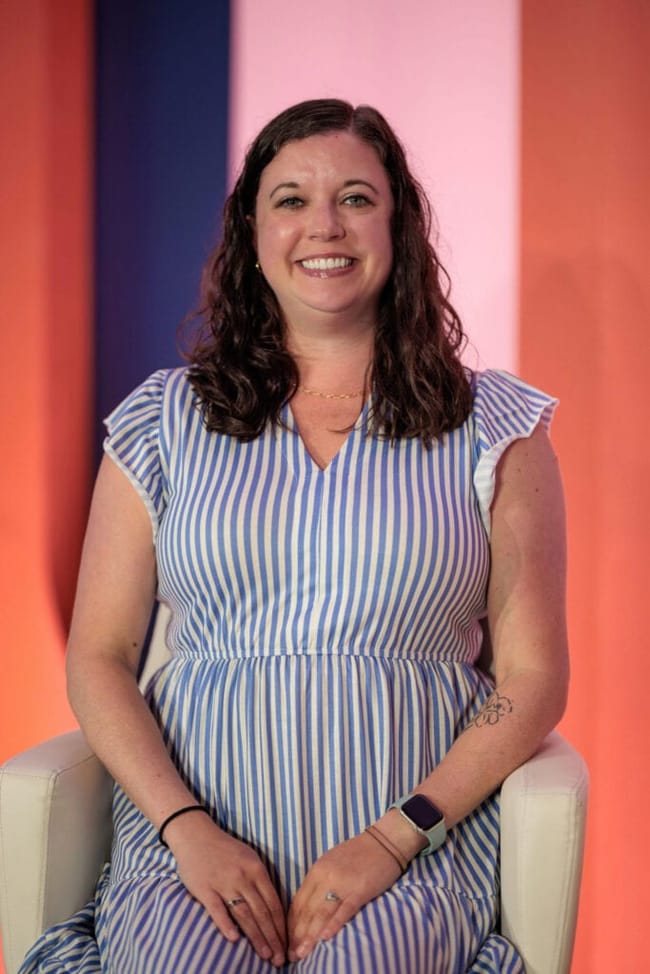
Specialists did other tests, not only confirming the diagnosis, but finding other issues as well.
“It was luck of the draw, is what they told me,” she said. “These are all completely standalone abnormalities that could happen.”
In order to terminate the pregnancy in Ohio at that time, Ammerman was given two options.
She could go to the hospital and have two doctors sign a document saying the procedure was necessary, which was required because the mother’s life was “not necessarily at risk,” or she could go to a women’s health clinic.
“If the two doctors were to sign off, it would be about $10,000, a night or two in the hospital, a lot of trauma,” Ammerman said.
“They said ‘Planned Parenthood’s about $800, they’re wonderful, you can go in and have the procedure.’”
She went with the latter. Similar to Hanline, with the help of one of her physicians, she was able to get in, and over the course of three days, received treatment and had the abortion.
Before all three of the appointments needed to get the abortion, protesters yelled at her and family members who came with her, she said.
“It was absolutely devastating, a wanted pregnancy, not something I ever thought I’d go through,” Ammerman said. “I was absolutely comfortable with my decision, but that doesn’t make it easier.”
Hanline, Ammerman, and individuals from other states, said they spoke with staffers for Ohio Republican U.S. Rep Warren Davidson, and Democratic U.S. Reps. Joyce Beatty and Emilia Sykes during their time in D.C.
They weren’t surprised by the responses from all involved, with Beatty and Sykes’ support for abortion care clear, and Davidson’s opposition just as plain.
Sykes is chair of a reproductive justice task force within the congressional Reproductive Freedom Caucus, and has sponsored and supported legislation for overall reproductive care, women’s health protection, contraception, IVF, and fertility treatments.
“I will keep fighting to protect those rights and ensure every woman can make her own health decisions without politicians getting in the way,” Sykes said in a statement to the Capital Journal.
Beatty is a fellow member of the Reproductive Freedom Caucus. On June 24, the anniversary of the Dobbs decision, Beatty stated on X that “abortion is healthcare, and everyone deserves the right to choose.”
Davidson also made a statement about the Dobbs anniversary on his official X page, saying the decision “correctly returned abortion policy to the states and the American people’s elected representatives.”
“The Constitution never created a right to abortion,” Davidson’s post continued. “Every life is a gift from God and deserves protection.”
Ohio’s protection
Immediately after Dobbs was released, then-Ohio Attorney General Dave Yost requested that a federal court reinstate the six-week abortion ban that had been tied up in court since 2019.
A primary problem for physicians at the time of the six-week ban, called the “Heartbeat Act” by supporters,” was the need for an “affirmative defense,” according to Dr. David Hackney, a maternal-fetal medicine specialist in Cleveland.
Hackney has since written a forthcoming book about the medical landscape for high-risk obstetrics after Dobbs.
In an affirmative defense, the physician must prove that an abortion was needed to preserve the health and life of the mother, rather than the burden of proof falling on the state.
“When a physician is considering abortion in high-risk circumstances, placing them under an affirmative defense causes confusion and hesitancy, which can in turn yield dangerous delays,” Hackney told the Capital Journal.
Abortion rights supporters represented by the ACLU sent the ban back to court after about 80 days.
The year after Roe v. Wade was struck down, 57% of Ohio voters approved the constitutional amendment that put reproductive rights like abortion until viability and miscarriage treatment into the state’s founding document.
To legal experts, it was exactly what the U.S. Supreme Court asked states to do under the decision.
“Dobbs was all about giving the power to the states, and what our state chose to do was pass this amendment,” said Jessie Hill, director of the Reproductive Rights Law Initiative at Case Western Reserve University, who worked with the ACLU of Ohio in multiple reproductive rights cases.
With the constitutional amendment now in play, a Hamilton County Common Pleas Court permanently blocked the ban, citing the new development.
While the state appealed the decision for other reasons, Yost said he would not fight the six-week ban decision.
“(The amendment) changed everything from a legal standpoint,” Hill said.
Cases are still ongoing regarding a 24-hour waiting period (even as lawmakers consider another bill to create the same waiting period), the use of telehealth for medication abortions, and transfer agreements for local hospitals and abortion clinics.
While Ohio has made the law clear through its constitution, Hill said things could become tricky if the federal government passes any policy against abortion rights.
Federal law preempts state law as a general rule, something state and federal lawmakers have brought up with so-called “fetal personhood” bills.
The measures aim to give embryos and fetuses constitutional rights.
Such potential laws are seen as unpopular, but the threat still remains.
Under the Trump administration, the FDA has been directed to reconsider approval of the abortion medication mifepristone, a drug that was approved more than two decades ago.
Ohio’s Husted has been a part of congressional hearings on the “dangers” of mifepristone.
Cuts to Medicaid funding slashed resources for and caused closures of Planned Parenthood, even though clinics can’t use federal funds specifically for abortion care.
“Having a hostile government at the federal level means that our hands are kind of tied,” Hill said.
Hope on behalf of the future
Though she didn’t know it at the time, Hanline was in the early stages of pregnancy when she spoke with the staff at Husted’s office in 2025.
She’s now the mother of a four-month old son, and plans to continue the fight on his behalf, and on behalf of the rest of her family.
“If I can just make people stop and think and start to question their own beliefs because my experience challenges their preconceived ideas of what an abortion is, I need to just keep chipping away,” she said.
Ammerman now has a nine-year-old, and her daughter is one of the many reasons she will continue supporting reproductive healthcare.
They both believe legislators who are against abortion rights could stand to hear the stories of current and future mothers who wanted their pregnancies, but are still thankful abortion was possible.
“I got married, I wanted a kid, I had a house, I had the financial security, I was ready,” Ammerman said.
“So for them to hear a story like mine, I think unfortunately, it has more weight than a story where a teenager was irresponsible in their eyes, even though both stories are equally important and have the same outcome.”
The change that the two mothers hope for could come in part from the upcoming November election.
As Hill continues to track and litigate reproductive rights cases in Ohio, the final word on all of them could come from the Supreme Court of Ohio.
“Having justices who are going to be accountable to the will of the people who passed the amendment, and who said we want the government out of our healthcare decisions, is really important, as is having justices who are going to read the text and follow what it says,” Hill said.
This story has been edited to clarify Hanline’s pregnancy timeline, and Husted’s stance on abortion.
This story is republished from the Ohio Capital Journal under a Creative Commons license. View the original article.