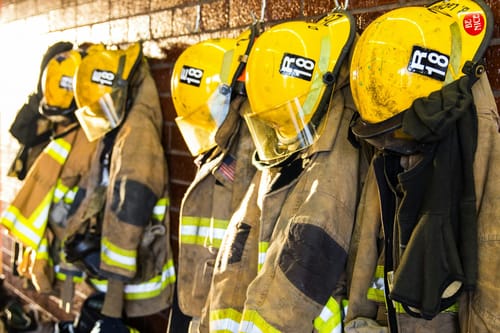
Firefighting has long been associated with acts of courage performed under some of the most dangerous and unpredictable conditions imaginable.
Yet beyond the immediate physical threats posed by collapsing structures, explosions, spills, and rapidly spreading flames, firefighters also repeatedly confront a far less visible menace: toxic contaminants released amid conflagrations and hazardous material incidents.
Unfortunately, over the years, studies examining firefighter health outcomes have raised growing concerns about the cumulative effects of such exposures — particularly as cancer now accounts for roughly 66% of line-of-duty deaths among career firefighters nationwide.
As such risks continue to escalate, attention has correspondingly intensified within the military fire services, whose specialized environments frequently involve aircraft troubles, fuel suppression operations, and chemical leaks that may have lasting repercussions.
Across Ohio, these issues are particularly relevant given the state’s extensive manufacturing infrastructure, transportation corridors, military installations, and densely populated urban centers, which collectively shape the range of emergencies and harmful combustion byproducts firefighters confront.
That said, the National Firefighter Registry for Cancer — launched by the Centers for Disease Control & Prevention (CDC) in 2023 — has emerged as a crucial initiative to strengthen scientific understanding and finally combat the occupational cancer risks in the fire service.
However, the registry’s effectiveness ultimately depends on sustained participation from firefighters themselves, since every enrollment contributes valuable evidence vital for future protection standards as well as preventive measures and relevant policy decisions.
The Expanding Threat of Toxic Exposure for Ohio Firefighters
Firefighters throughout Ohio endure conditions that present diverse and evolving occupational hazards.
Essentially, the state’s nearly 40,000 crews not only respond to residential and commercial fires but also routinely manage vehicle collisions, industrial accidents, perilous material releases, and rescue operations along major transportation and manufacturing hubs.
Yet while their acts are noble, they frequently encounter gases and other materials that can emit carcinogenic compositions, such as carbon monoxide, volatile organic compounds (VOCs), polycyclic aromatic hydrocarbons, hydrochloric acid, and heavy metals.
Once released, many of these substances can enter the body and trigger debilitating illnesses. In fact, specific research has further reinforced these concerns.
Examining more than 900,000 cancer cases logged from 1996 to 2019 under the Ohio Cancer Incidence Surveillance System, the recent analysis found that firefighters demonstrated increased odds of several malignancies — most notably those affecting the brain, thyroid, esophagus, and skin — compared with both the police and broader population.
Such findings align with mounting national evidence recognizing firefighting as an occupation associated with heightened cancer risk.
For military firefighters, the danger may become even more complex, as they typically operate in environments that heavily rely on advanced yet contaminated equipment.
Consistent with this, the Department of Defense has earned a reputation as one of the largest users of aqueous film-forming foam (AFFF), initially developed in the 1960s to suppress fuel-based fires rapidly.
Regrettably, what the authorities and health experts failed to discover sooner was that this tool’s composition — per- and polyfluoroalkyl substances (PFAS) — is highly persistent in the ecosystem, allowing it to cause pollution across over a dozen installations in Ohio, including Newark Air Force Base and Gentile Air Force Base.
Besides AFFF, materials used in insulation and fireproofing systems aboard naval vessels are also notorious for containing asbestos, lead, VOCs, and other toxic components — threatening the health of military firefighters who handle them during emergencies.
The Firefighter Registry Can Help Protect Firefighters
One of the most persistent obstacles in tackling firefighter cancer risks is the lack of sufficiently comprehensive long-term exposure data.
Although individual diagnoses continue to emerge across the fire service, isolated cases alone often cannot fully establish broader occupational patterns needed to guide policy reform and workplace protections.
With this, the National Firefighter Registry for Cancer was created to address this limitation by collecting occupational histories, exposure information, and health data from firefighters in Ohio — and nationwide — within a centralized research framework.
As participation increases, such a systemic tool can help researchers better identify how different firefighting environments, duties, and exposure patterns contribute to long-term cancer susceptibility.
In addition, this effort carries substantial implications for veterans seeking access to healthcare and other benefits.
While certain toxic-related conditions are already recognized under the Honoring Our PACT Act, some illnesses — even those associated with PFAS — still require extensive documentation before claims can proceed.
The National Firefighter Registry may help narrow these evidentiary gaps over time. Since enrollment officially opened in 2023, almost 50,000 responders from across the country — including more than 1,000 residents in Ohio — have joined, making it the nation’s largest firefighter cancer research cohort to date.
Nevertheless, participation still represents only a fraction of the American fire service workforce, which comprises well over one million firefighters.
Expanding enrollment, therefore, remains essential.
Every additional participant strengthens the collective body of evidence used to improve occupational safety standards, guide future health research, and support informed policymaking for firefighters and veterans alike.
For active-duty personnel, retirees, volunteers, and military firefighters throughout Ohio, participation in the registry is more than a personal contribution to research — it is an investment in building a stronger scientific foundation to protect future generations of emergency responders.
This story is republished from the Ohio Capital Journal under a Creative Commons license. View the original article.