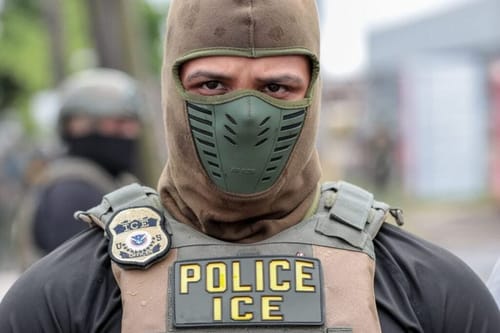

More than 130 medical calls have been made from the Butler County, Ohio jail since their Immigration and Customs Enforcement contract resumed last year, records obtained by the Ohio Capital Journal show, a 25% increase from the year before.
Located in Hamilton, Ohio, the Butler County jail is separated into three facilities: the Corrections Center on Hanover Street, which is the main complex and holds the most people, including ICE detainees. Then the Resolutions Jail on Second Street, and the Court Street Jail on Court Street, which handle overflow.
The jail holds roughly 1,063 people. According to data from ICE updated in February, 362 of the jail’s inmates at that time were ICE detainees. The Butler County sheriff renewed the jail contract with ICE in March of last year.
One hundred thirty-one EMS calls have been made since March 5, 2025, records show. One hundred ten were sent from the Corrections Center itself. Collectively, twenty-one were made from the overflow facilities Resolution and Court Street.
Comparatively, 105 calls were made from the jail in 2024. From March to December of that year, 100 calls were sent from the Corrections Center. Four from Court Street Jail and one from Resolution.
Butler County does not retain audio recordings of 911 calls. It is also unclear how many were made on behalf of ICE detainees as opposed to members of the regular prison population.
EMS logs show the reasons for these calls range from pregnancies to seizures. “General illness” is the most common category, appearing thirty-one times from March of last year to present. “Chest pains,” appear twenty-eight times.
Other reasons listed in the logs are as follows:
-
Seizures: 12
-
“Trauma”: 10
-
Fall: 5
-
Unconscious: 5
-
Stroke: 4
-
Assault: 2
The jail has faced allegations of medical neglect and abuse by lawyers, activists, and former detainees.
Law enforcement authorities deny any mistreatment.
“There is a completely false narrative going on with the community that are activists, and I will say that definitively,” said Chief Deputy Anthony Dwyer in a phone interview.
Dwyer listed the facilities personnel, including one doctor, a physician’s assistant, a nurse practitioner, a dentist, three nurses, nine full-time paramedics, seven part-time, four EMTS that are full-time and two that are part-time.
“In our facility, we have medical staff in the building 24/7,” Dwyer said.
“There’s medical care here. And in a facility with a thousand inmates, you’re always dealing with something… but I can guarantee you if you come to this facility as an ICE detainee and you have a medical need, it’s going to be solved. It will be dealt with.”
Others disagree. Among those who say Butler County Jail is unfit to hold ICE detainees is Pastor Irvin Heishman from West Charleston Church of the Brethren in Tipp City.
Armando Reyes Rodriguez, a member of Heishman’s church, was detained by ICE on April 14, held in Butler County Jail for three months.
He now resides in Honduras, his birth country.
Heishman visited and spoke about the conditions inside the jail. Heishman also discussed guard treatment of detainees, and recounted being introduced by Armando to a man who was “beaten badly enough that he had to be put in the hospital.”
“They threw him against that so hard that his arm was all messed up. And I saw him a week after it happened, and that was still oozing, like, liquids and blood from the wound. And he had no bandages. I was like: they’re really not even going to provide a bandage or something like that?”
The detainee was Luis Tenelanda. Deported to Ecuador, Tenelanda is filing a lawsuit in the U.S. District Court in Cincinnati, alleging that a sergeant punched him so hard he needed to be hospitalized.
“(The) Defendant punched Mr. Tenelanda in the stomach, under his ribs….As a result, Mr. Tenelanda fell back and hit his head and his arm on the metal bunk bed, causing him to pass out,” states the court filing about the incident, which allegedly occurred on June 8 last year.
The suit claims it took 40 minutes to an hour for the medical person to arrive, and when Tenelanda went to the jail’s medical unit, they told him he was in good condition.
Only after Reyes-Rodriguez noticed his bleeding arm was Tenelanda taken to an outside hospital, the suit alleges, on June 10.
“Mr. Tenelanda’s stomach and arm continue to cause Mr. Tenelanda extreme pain. Mr. Tenelanda is still currently unable to bend or to lift his left arm. There is pain from Mr. Tenelanda’s elbow to his shoulder at all times. As a result, Mr. Tenelanda has difficulty getting dressed and showering because he cannot use his arm,” states the court filing.
Butler County Jail strongly denies these allegations.
Lynn Tramonte, executive director of the Ohio Immigrant Alliance, slammed the treatment of detainees at the jail in an interview with the Ohio Capital Journal.
Tramonte’s organization is representing Tenelanda, and has represented other ICE detainees from the Butler County Jail. Tramonte recounted how numerous clients have said Butler County Jail didn’t address their medical needs.
“This is like the punishment and torture of people who haven’t committed crimes or are not even being accused of crimes,” Tramonte said. “And they’re being put in this jail. And it’s all simply as a strategy to get people to give up on their cases and deport.”
Julie Nemecek is the founder of the Nemecek law firm in Columbus, Ohio, and has represented several ICE detainees held in Butler County Jail.
Nemecek spoke about a doctor who “comes maybe every two weeks,” saying that the wait for medical care is very long.
“But especially clients who have mental health conditions, serious mental health conditions, they are not getting care, they are not getting the medication they need, and it’s inhumane,” Nemecek alleged.
Chief Deputy Anthony Dwyer spoke about the tours given to people who want to inspect the facility.
“I have hosted religious organizations. I had pastors from the area come in and tour the facility, and saw it, got to see ICE inmates in their environment. The state has come down for their inspections. And I can only say it any more boldly, that it is a false narrative.”
Dwyer added that he believes no amount of inspection will change the attitudes of people who oppose the jail’s ICE contract.
“I’ve had some of the activists come in and see it. It doesn’t matter. They stick with whatever narrative they want.”
Heishman was one of a dozen church leaders who toured the jail last August. According to him, access during the event was limited.
“We were able to look into the pods where the detainees are kept, but were not allowed to go in,” Heishman said. “We weren’t allowed to talk to anybody. They showed us the medical facilities, but there were no doctors there. They were just empty rooms. Yeah, so we really didn’t get to see much.”
In Heishman’s eyes, the jail doesn’t distinguish between ICE detainees and regular criminals.
“There’s supposed to be a difference when a person is detained for a civil matter. But you don’t get that difference at the county, at least, I certainly haven’t seen it at Butler County Jail.”
This story is republished from the Ohio Capital Journal under a Creative Commons license. View the original article.