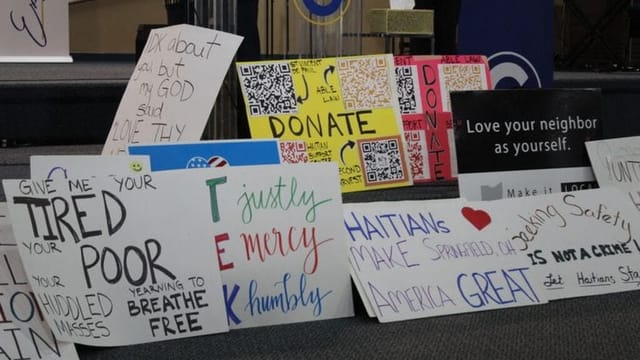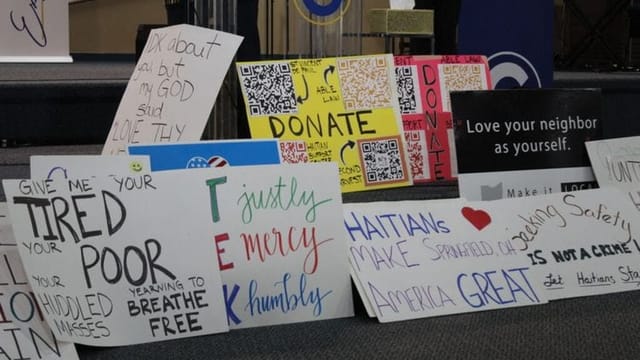


Ohio Gov. Mike DeWine says the Trump administration would be sending Haitian immigrants “back to hell” if it follows through on plans to arrest and deport them — a sharp break with his own party’s president days after more than 300,000 Haitians lost their federal protection from deportation.
“Haiti is hell today. So you’d be sending people … back to hell,” the Republican governor said in an interview Monday in Columbus with CBS News. “Very few of these Haitians will voluntarily go back to Haiti. If they have to leave, they’ll go someplace else. They want to work. They want to support their family. They don’t want to go back to Haiti.”
DeWine called the planned operations “a mistake” and said they would be “a blow to Springfield” and “a blow to the state of Ohio.”
CBS News reported Sunday that Immigration and Customs Enforcement has drawn up plans for a deportation push focused on Haitian immigrants that could begin as early as this week. The operations could focus in part on Ohio, where most of the state’s Haitian population lives in and around Springfield.
DeWine said he had “received no notification” from ICE about any such operation, The Hill reported, citing the same interview.
‘People who have helped Springfield really come back’
DeWine’s argument to CBS News was primarily an economic one.
“These are people who have helped Springfield really come back,” he said, pointing to Haitians who took jobs and opened businesses in a city whose economy had struggled for decades. “The Haitians who are living there and employed there, they came there to work, and they came there because there were jobs that were not being filled by other people.”
The immigration advocacy group FWD.us estimated in a January fact sheet that about 14,000 Haitian TPS holders lived in Ohio, contributing roughly $160 million a year to the state economy and paying about $18 million in federal and payroll taxes and $21 million in state and local taxes. The group put the Springfield metro area’s share at $91 million a year and Columbus’ at $44 million. Those counts date to early 2025, before the administration began moving to end the designation.
DeWine has used similar numbers himself. In a statement the day the U.S. Supreme Court cleared the way for the terminations in June, he said more than 10,000 Haitians living in Ohio legally through the program — most of them in the Springfield area — would lose work authorization and become subject to deportation, and that it would become illegal to employ them. TiffinOhio.net reported at the time that DeWine called the ruling a mistake.
‘Virtual chaos’ in Haiti
DeWine also pointed to conditions in Haiti, which he described to CBS News as “virtual chaos” with “no semblance of government.” Armed gangs control large areas of the country, and the U.S. State Department warns Americans not to travel there.
The Department of Homeland Security has taken the opposite position. In moving to end the designation last year, the department concluded that keeping it was not in the national interest and said conditions in Haiti had improved enough for Haitians to return home safely, according to CBS News. DHS told the network over the weekend that it was “closing time” for people losing status, and pointed them toward an offer of $2,600 and what the department called a “free flight home” for those who leave voluntarily.
How Ohio got here
Haiti was first designated for Temporary Protected Status in 2010, after an earthquake devastated the country, and the designation was renewed repeatedly in the years that followed. The Biden administration extended it in 2024, citing violence and instability.
After the Trump administration moved to end it, a federal judge blocked the termination in February, calling it arbitrary and capricious and partly rooted in racial animus. The administration took the case to the Supreme Court, which ruled 6–3 in late June that it could proceed with ending the program for Haiti and Syria. CBS News reported the termination was set to be formalized Monday.
TiffinOhio.net has covered each stage of that sequence, including how Ohio cities braced for the ruling, the rally hundreds of Ohioans held in Springfield hours after it came down, and the guidance advocates gave TPS holders on legal help and exit planning.
A stalled bill and a split Ohio delegation
Congress has one measure that would restore the protections. The U.S. House passed H.R. 1689 on April 16 by a vote of 224–204, directing DHS to designate Haiti for Temporary Protected Status into 2029. It reached the floor through a discharge petition that bypassed Republican leadership.
Ten Republicans voted for it, including two from Ohio: Rep. Mike Turner, whose 10th District takes in Springfield, and Rep. Mike Carey of the 15th District, according to the official House roll call. The Senate has not taken up the bill.
DeWine, who is term-limited and in his final months in office, has broken with President Donald Trump over Haitian immigrants before. In a 2024 interview with CBS News, he dismissed Trump’s claim that Haitians in Springfield were eating pets as something that surfaced online, noting that local officials found no evidence for it. He said then that the arrival of as many as 15,000 immigrants in a city of fewer than 60,000 had strained local systems, including health care, but that the newcomers had filled jobs and worked hard.
DeWine endorsed Vivek Ramaswamy, the Republican nominee to succeed him, who faces Democrat Amy Acton in the Nov. 3 general election.